
The stack came back through the room desk by desk, and every single one of us did the same thing with it. Took the top sheet, didn’t look at it, and put it straight up to our face. Teacher never said a word. Thirty kids inhaling their own homework, and that was just Tuesday.
The machine that made those sheets was a ditto machine, and if you went to school in America any time before about 1990, it ran your entire academic life. Spelling tests, word searches, the mimeographed field trip permission slip your mom never signed. It was the sound of the school day starting and the smell of it, too — sharp, sweet, and faintly chemical, on paper still cool and damp to the touch.
Nobody has explained this to anybody since, which is roughly how we like it. But there’s a real machine behind the memory, with a real reason it smelled like that and a real reason the paper was purple. Here’s the whole thing.
What a ditto machine actually was
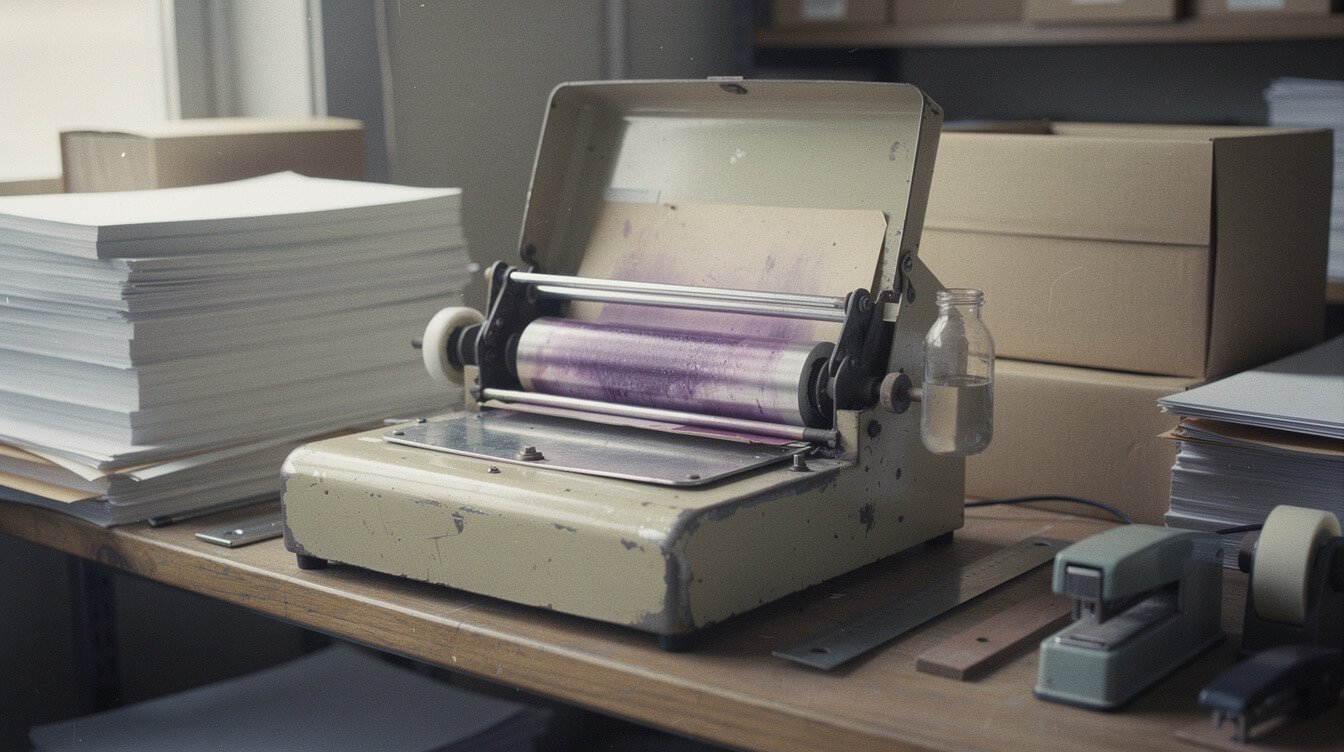
The proper name is a spirit duplicator. The “spirit” isn’t anything mystical — it’s the old sense of the word, as in spirits, as in alcohol. Wilhelm Ritzerfeld patented the thing in 1923, and for the next sixty years it was how any organization without money made copies: schools, churches, scout troops, bowling leagues, and every teenager who ever put out a fanzine from a basement.
The name we all actually used came from the Ditto Corporation of Illinois, who made them. Same deal as calling every tissue by one brand’s name. Say “spirit duplicator” to a room of fifty-year-olds and you’ll get blank stares. Say ditto and watch what happens to their faces.
Here’s how it worked. A teacher would type or write on a two-layer master sheet. The back layer was coated in a waxy, intensely pigmented ink, and the pressure of the typewriter key or the pen transferred that wax onto the back of the front sheet — a mirror image of whatever she’d written. That master went onto the drum of the machine.
Then she cranked it. Each blank sheet got brushed with a thin film of solvent on its way through, and when that damp paper pressed against the master, the solvent dissolved a microscopic layer of the wax and laid it down on the page. No ink cartridge. No toner. Nothing got printed onto the paper so much as the master slowly gave itself away, one sheet at a time, until there was nothing left of it.
Which is the part worth sitting with. A ditto machine wasn’t a printer. It was a machine for dissolving one piece of paper onto a hundred others. Every copy you got was a little fainter than the one the kid in front of you got, and if you sat in the back row, you got the ghost.
The part where she had to fix a typo
There was no backspace. The wax was already transferred, and the machine would faithfully reproduce whatever was on that master until the master died. So correcting a ditto master meant going at it with a razor blade — scraping the offending wax off the back of the sheet, then retyping over the bare spot, which worked about as well as you’d expect.
This is why worksheets from the era have that specific look: a word slightly out of alignment, a letter sitting a half-line high, a faint ghost of whatever used to be there. Those weren’t sloppy teachers. Those were the surgical scars of somebody who’d already typed four hundred words and was not starting over. The ditto machine made no allowance for human error, and every classroom in America quietly worked around it with an X-Acto knife.
Why the ditto machine smelled like that
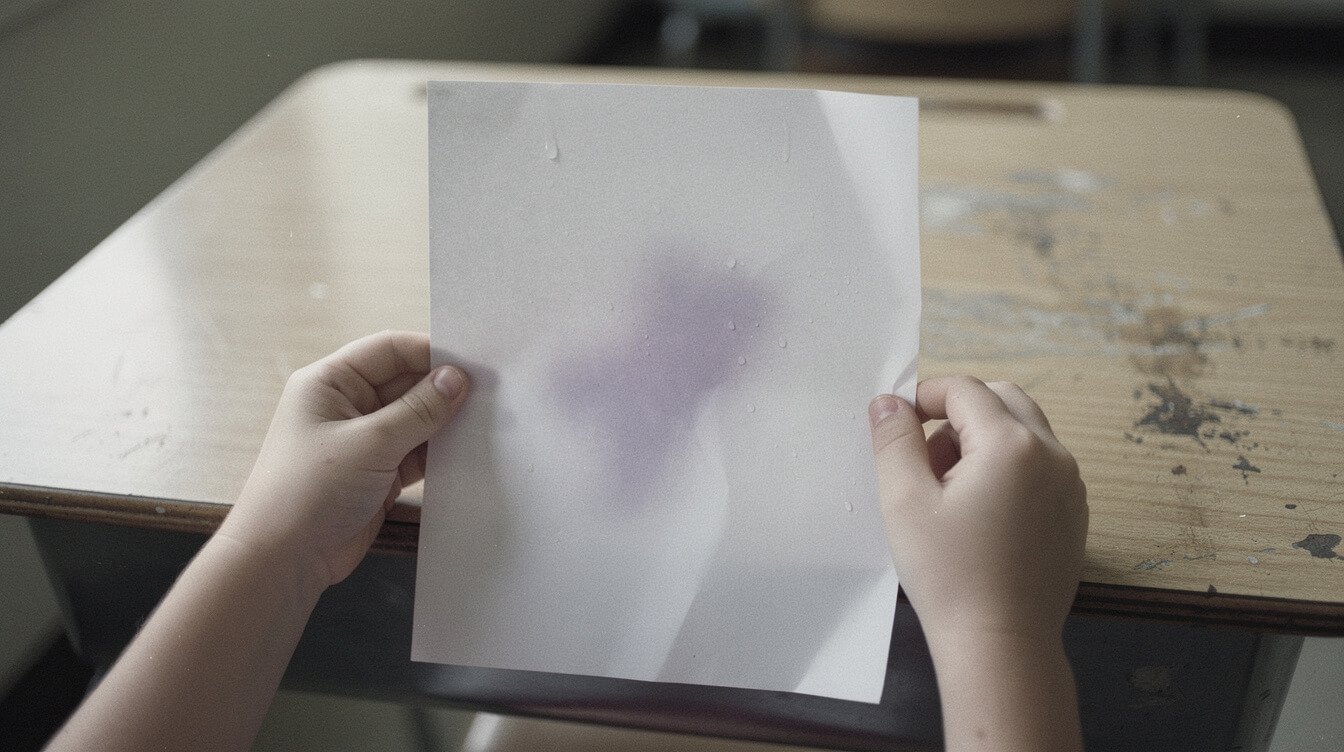
The solvent. That’s the entire answer. The fluid that dissolved the wax was alcohol — usually methanol, sometimes isopropyl, and if your school district was feeling flush, ethanol. The sheet came off the drum still wet with it, and what you were smelling was that alcohol evaporating off the page and into your face.
That’s why the smell had a shelf life. A fresh ditto was an event. A ditto that had been sitting on the teacher’s desk since second period was just paper. The window was maybe fifteen minutes wide, which explains the urgency of the whole ritual — nobody was going to say out loud that we were racing the evaporation rate, but we all knew the good ones came straight off the machine, and we all knew when we’d been handed a stale one.
It also explains a detail everybody remembers and nobody ever connects: the paper was cold. Not room temperature — actually cool against your fingers. That’s evaporation pulling heat off the sheet, the same reason rubbing alcohol feels cold on your arm. The ditto machine handed every kid in the room a small physics demonstration twice a week for a decade and not one of us asked a single question about it.
There’s a scene in a 1982 high school movie where a stack of paperwork goes backward through a classroom and every kid takes a hit off their sheet on the way down. No setup. No punchline. The movie just lets it happen and moves on, because at the time it wasn’t a joke, it was a documentary.
Was it doing anything to us? I’m not a chemist, and I’m not going to pretend to be one on the internet. What I can tell you factually is that it was alcohol vapor, that there was a lot of it in a closed classroom in February with the windows painted shut, and that no adult in the building appeared to have given it ninety seconds of thought. Make of that what you will. We turned out fine, mostly, which is the same thing we say about riding in the way-back without a seatbelt.
Purple, because purple lasted
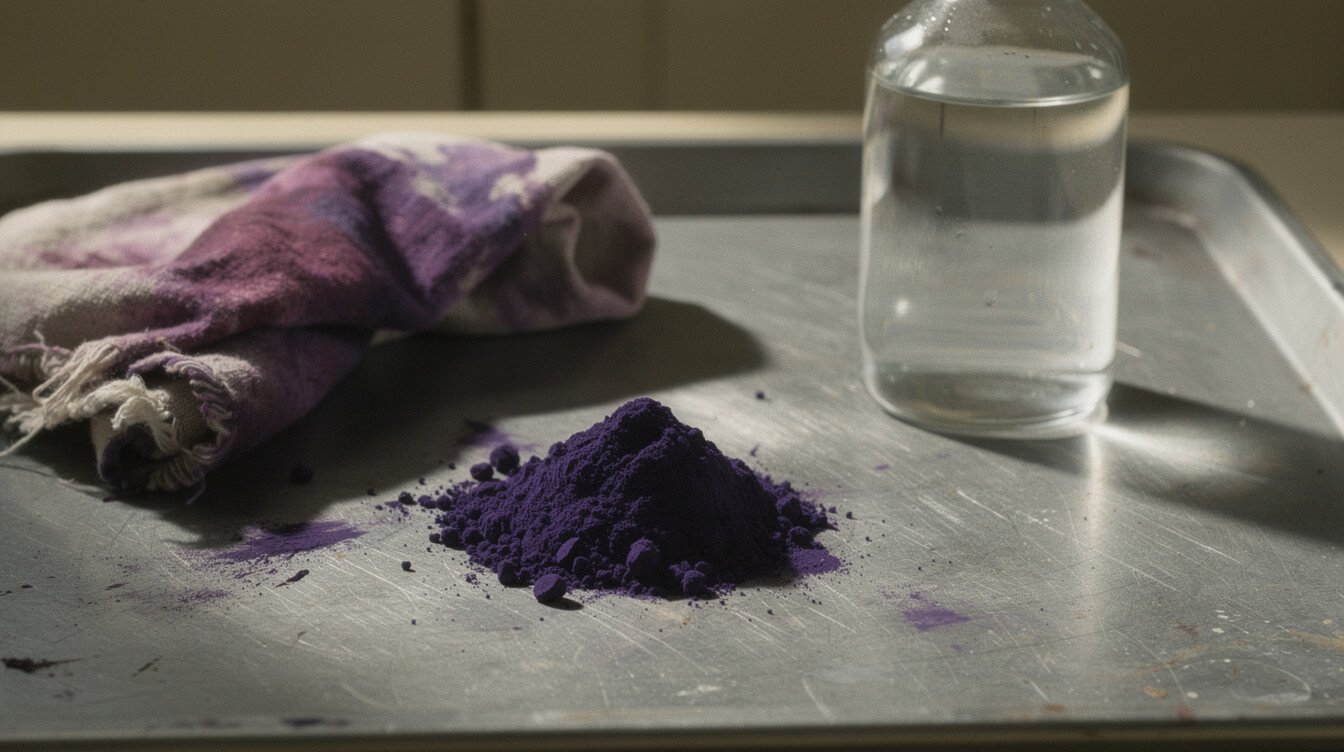
Everyone remembers the purple. Almost nobody knows there were other colors.
Green existed. Red existed. Black existed. You could even run a master with more than one color on it at once, which is how the occasional show-off teacher produced a worksheet with the heading in red, a trick that bought her about a week of goodwill. But the standard was purple everywhere, in every school, for decades, and that wasn’t an aesthetic decision by a committee somewhere.
It was chemistry. The purple came from an aniline dye, and aniline purple had two properties the others couldn’t match: it was extremely soluble in alcohol, and it was the most vividly pigmented of the set. High solubility meant more dye came off the master per pass, which meant more copies before the master gave out. High pigment meant that even a thin, nearly spent layer still read as a mark on the page instead of a rumor.
So purple was the one that went furthest for the money. In a school budget, “goes furthest for the money” wins every argument there has ever been. The color of our entire childhood education was chosen by a purchasing department optimizing cost per copy, and it happened to come out the exact shade of violet that now unlocks a memory in about forty million people at once.
The other factors mattered, too. A good master on smooth bond paper might give you five hundred copies. A tired master on cheap absorbent newsprint might give you fifty before it faded out entirely. Dense text and drawings ate the master faster than a few lines of spelling words. Which is why the elaborate hand-drawn worksheet always came out looking like it had been transmitted from a submarine.
A ditto was not a mimeograph, and the difference mattered
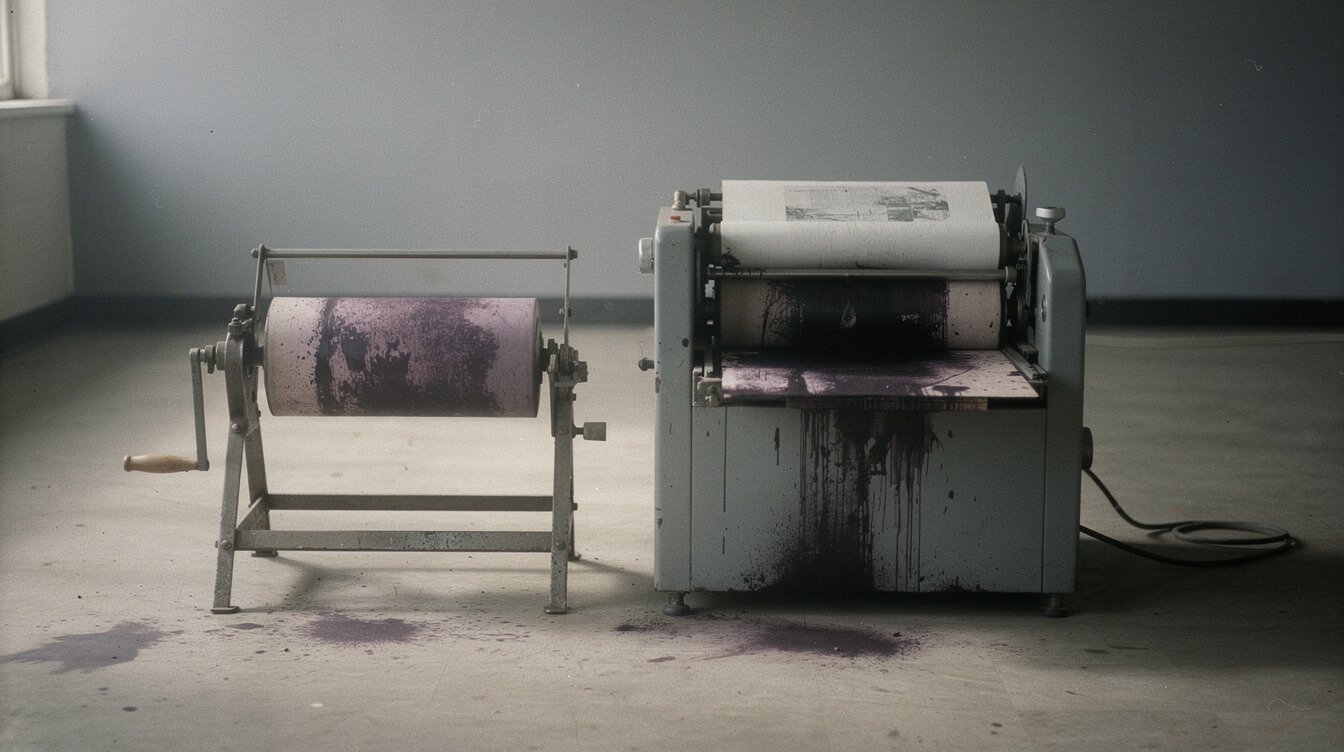
These two get used interchangeably and they are not the same machine. People will fight about this in comment sections, and the people correcting everyone are, for once, right.
The mimeograph came first — Edison patented it in 1876, and the A.B. Dick Company made it the standard office machine by the 1880s, a good forty years before the spirit duplicator existed. It’s a stencil process. You’d type onto a waxed stencil sheet with the typewriter ribbon disengaged so the keys punched clean through the wax, then mount the stencil on a drum packed with an ink pad. The machine forced ink through the holes you’d made. Often motorized, usually black, and capable of running into the thousands of copies off a single stencil.
The ditto machine was the cheap one. Hand-cranked, alcohol instead of ink, purple instead of black, fifty to five hundred copies instead of thousands. Worse in every measurable way.
And yet: ask anyone who went to school in 1979 about the mimeograph and you’ll get nothing. Ask about the ditto and you’ll get a whole story. The better machine lost the memory war to the worse one on a single feature, which is that one of them smelled like something and the other one didn’t. Nobody ever buried their face in a mimeograph sheet. There was nothing in it for them.
That’s the whole principle this place runs on, incidentally — the detail nobody put on the brochure is the one that stuck. It’s why the designs in the shop tend to be about the weird specific thing rather than the decade in general. The decade in general is a poster in a dorm room. The specific thing is the one that makes somebody across a parking lot nod at you.
The newsletter
Like a mixtape, but it shows up on its own
One email a week. The good posts, new designs, zero exclamation points. Unsubscribe whenever. We won't take it personally.
Why you don’t own a single one of them
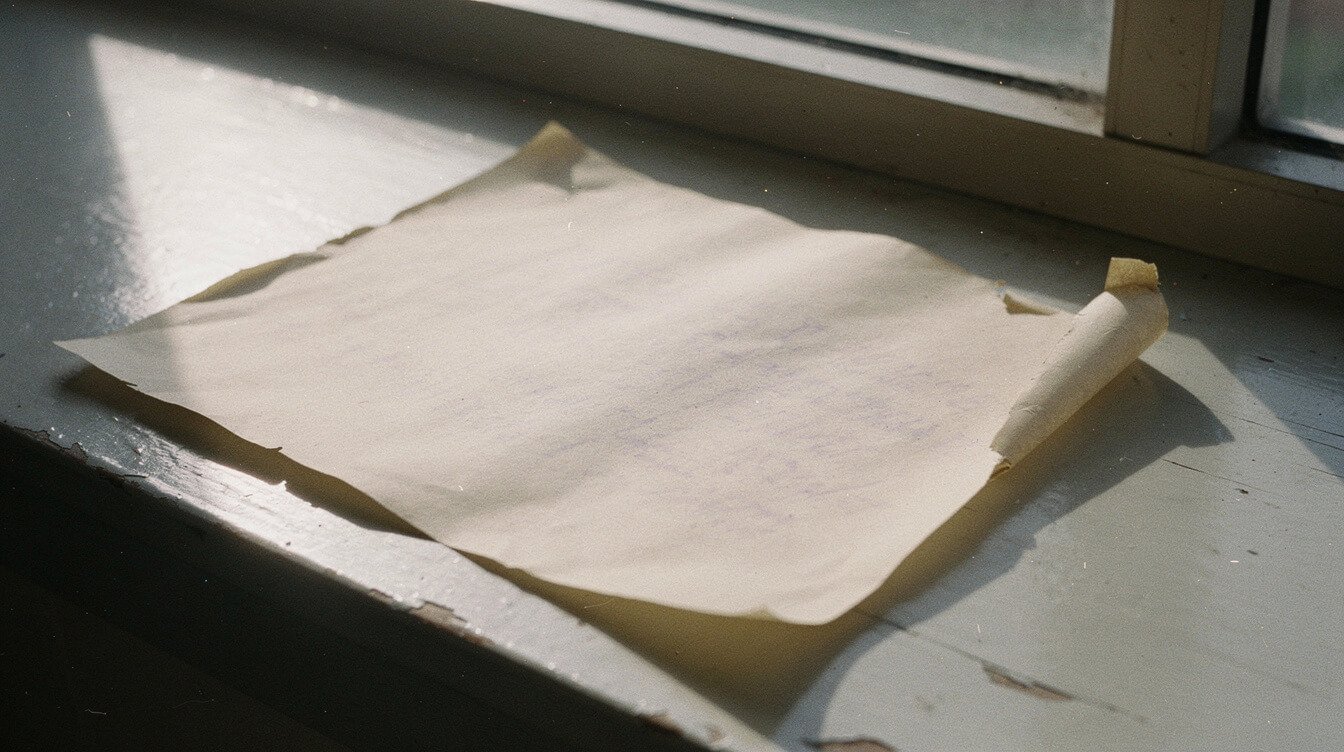
Go look. Go into the box in your mother’s basement with your name on it in marker — the one with the school pictures and the certificates and the construction paper turkey. There will be report cards. There will be drawings. There will not be a single legible ditto.
Two reasons, and they’re both baked into the process.
The first is light. Aniline dye fades hard under UV, and it doesn’t take decades — a ditto left in direct sun can go illegible inside a month. Anything that survived did so by sitting in the dark, flat, in a closed box, which is a description of approximately nothing a nine-year-old has ever done with a worksheet.
The second is the paper itself. Schools ran dittos on the cheapest stock in the supply room, untreated pulp full of residual acid, which yellows and embrittles itself from the inside over time. The artifact was designed to be thrown away that afternoon, and it has been honoring that design ever since.
So the single most vivid shared object of our entire school experience — the thing every one of us can still smell on command, decades later — is one of the only ones with no surviving physical evidence. The book fair order form you can still find scans of. The ditto is gone. It exists exclusively in the heads of the people who were handed one, and when we go, it goes.
The dittos that did survive
With one strange exception. The same machine that lost every worksheet in America preserved a whole underground literature, because the people who weren’t using it for spelling tests were using it to publish.
A ditto machine was the cheapest printing press a human being could get their hands on, and in the fifties and sixties that made it the engine of everything the publishing industry wouldn’t touch. Science fiction fandom ran on it. The mimeographed-and-dittoed fanzine circuit ran on it. So did the small-press poetry scene — Ginsberg’s Howl had a twenty-five-copy ditto run off in an office at San Francisco State before the edition anybody’s heard of ever existed.
Those survived. Not because the paper was any better, but because somebody decided they were worth keeping, boxed them flat in the dark, and eventually handed them to a university archive. Today they sit in special collections with climate control and acid-free folders, which is a genuinely absurd fate for a format designed to be read once and recycled.
So the ditto machine’s output did make it to posterity. Just the basement poetry, not the long division.
Which is either bleak or extremely funny depending on the hour, and we’ve always had a strong preference for the second reading.
Still got the receipts, just not on paper
The ditto didn’t survive. The memory did. Our designs go after the same kind of detail — the one that needs no caption and no explaining to anybody who was there.
Ditto machine questions people still ask
What was the purple smelly copy machine called?
A ditto machine, formally a spirit duplicator. If you’re searching for this phrase you have almost certainly been standing in a kitchen arguing with a sibling about it for twenty minutes. It’s ditto. You were right.
Why did ditto paper smell so good?
It was still damp with the alcohol solvent the machine used to dissolve ink off the master sheet — methanol, isopropyl, or ethanol, depending on the supplier. The smell was that solvent evaporating. Once the sheet dried, the smell was gone for good.
Why were dittos purple?
Aniline purple dye was the most alcohol-soluble and the most vividly pigmented option available, so it produced the most usable copies per master. Green, red, and black existed but came out fainter and cost more per page. Purple was the budget winner.
What’s the difference between a ditto machine and a mimeograph?
Different technologies entirely. A ditto machine is a spirit duplicator: alcohol solvent, a waxy master, hand crank, purple, fifty to five hundred copies. A mimeograph is a stencil duplicator: ink forced through a punched stencil, often motorized, usually black, and good for thousands. The mimeograph is older by about forty years and was the better machine.
How many copies could one master make?
Anywhere from about fifty to five hundred. Smooth bond paper, a high-quality master, and light text pushed you toward the top of that range. Cheap absorbent paper and a dense page of drawings pulled you toward the bottom, and you could watch the quality collapse in real time as the stack came back through the room.
When did schools stop using ditto machines?
Through the 1980s, as photocopiers got cheap enough for a school district to justify. There’s no clean cutoff date — it depended entirely on your district’s budget, which is why one town’s kids were getting crisp black photocopies in 1985 while the next town over was still cranking purple in 1991.
Are ditto machines still made?
No. The masters and solvent haven’t been in general production for a long time, and the machines that turn up are secondhand — mostly bought by letterpress and zine people who like the look. You can get a purple page out of one in 2026. You just can’t get the Tuesday back.
From the shop
Duran Duran Girls on Film Vintage Art T-Shirt
Price range: $24.99 through $26.99
Shop this designThe last class to get handed a wet one
Here’s the part that actually matters, and it’s the reason this memory belongs to us specifically rather than to everyone.
Boomers got dittos. Our parents got dittos. But they got them in a world where that was simply how copies were made, with no alternative to compare it to and nothing to mark the end. We got the tail. We were in the building during the exact decade the photocopier won, which means we are the cohort that got handed the damp purple sheet in third grade and a crisp black-toner one in tenth, and we noticed the switch while it was happening. We’re the last ones who can tell you what the room smelled like, because we’re the last ones who were in the room when it stopped.
Anybody younger gets a description. We get the thing itself, intact, triggered by one shade of violet.
That’s the whole currency around here. Not the decade, not the montage, not nostalgia as a mood — the particular, verifiable, slightly stupid detail that lands instantly with the people who were there and lands nowhere at all with everybody else. The crack in the cassette case. The specific Saturday morning hour. The smell of a worksheet.
Nobody has to explain it. That’s how you know it’s the right one.
Before you go
You made it to the end. Respect.
Get the best of these in one short weekly email, plus whatever we just printed. No spam. We were raised better than that. Mostly.