Search for 90s christmas decorations right now and the first result is a shop. It has a whole category called “A 90s Christmas”: six pages, forty products a page, and nearly every one of them is tagged New for 2026. Plaid nutcrackers. Tartan trays. A 28-inch jeweled Santa for $239. Two spots down there’s a forum thread where someone asks, very politely, how to replicate a 90s Christmas feel, and a few hundred people try to help.
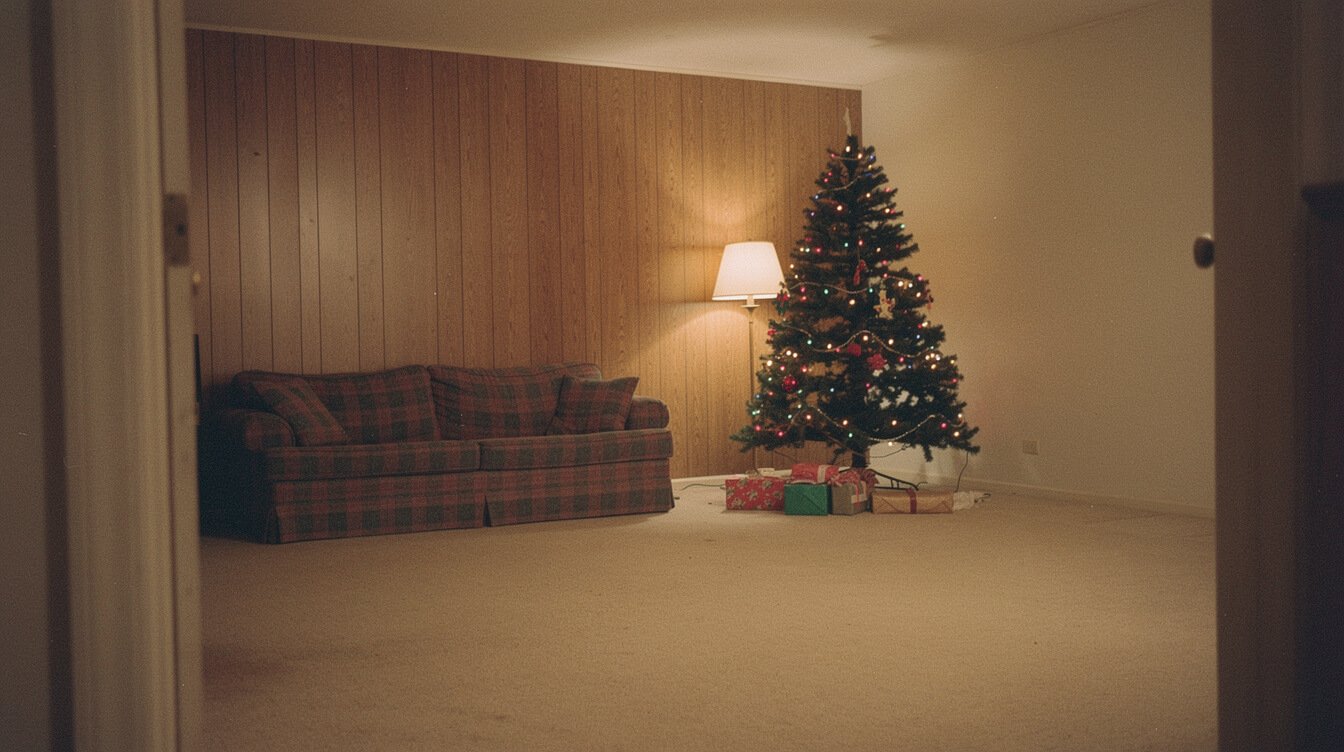
Both of them are aiming at the tree. Everybody does. Fair enough, the tree was the headline, and we’ve already said our piece about the tree. But anyone who actually lived in a 90s house in December knows the tree was the least of it. The tree stood in one corner. The rest of Christmas moved into every other room in the house, stayed six weeks, and didn’t pay rent.
90s christmas decorations took the whole house
It started the Friday after Thanksgiving, when somebody pulled the attic ladder down and handed boxes to whoever was standing closest. You didn’t volunteer. You were standing closest. By Sunday night, the house had been re-dressed top to bottom, and the tree was maybe a fifth of the job.
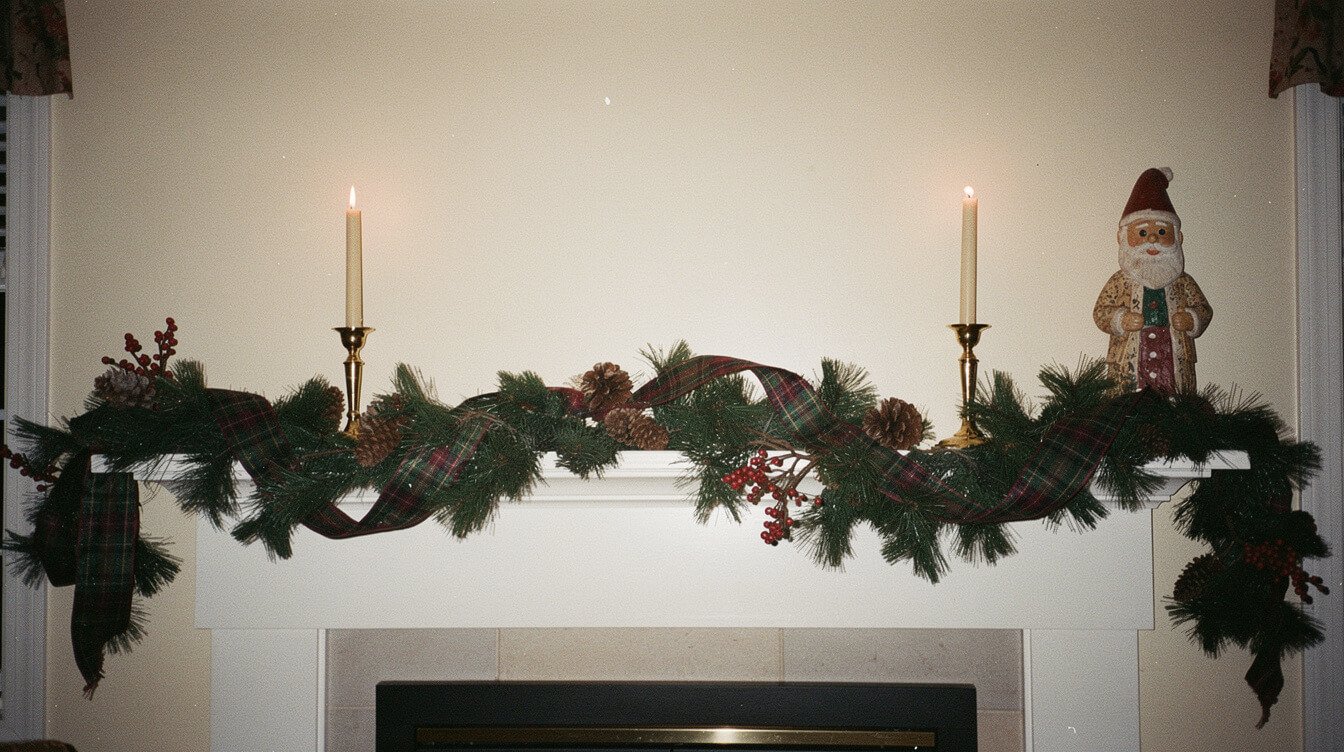
Here’s a rough inventory of a mid-90s house with a parent who took it seriously. A wreath on the front door and a smaller one on the back door, for the six people who used the back door. Garland on the banister, held on with green twist ties that were still on the banister in March. Electric candles in every front window. A runner on the dining table, a centerpiece on the runner, and a candle in the centerpiece that was never lit. A Santa on the piano, or on the TV if there was no piano. Stockings on the mantel, held down by cast-metal stocking holders heavy enough to stop a door, or a burglar.
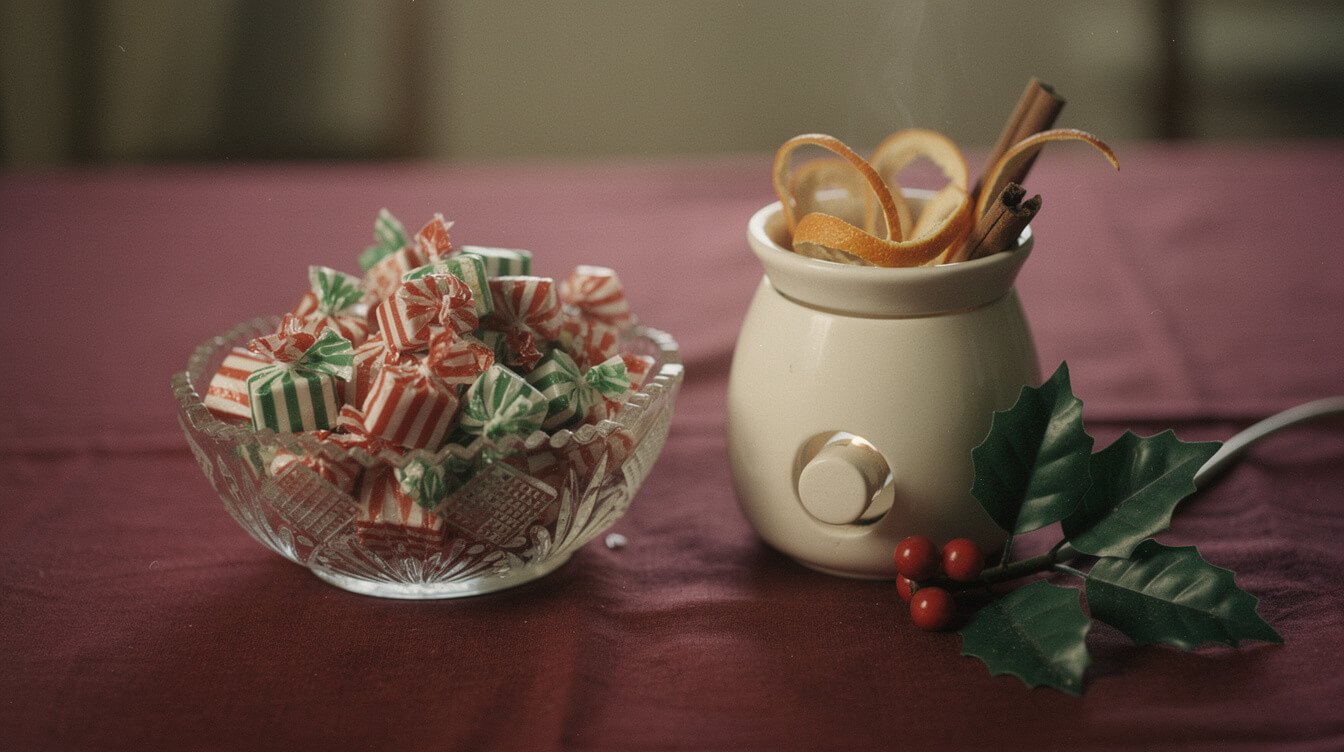
Then it got into the details. The everyday dishes went into a cabinet and the Christmas dishes came out, the plates with the holly around the rim, used for about five weeks and then hand-washed for an hour. The welcome mat got swapped for a Christmas welcome mat. The regular candy dish became the Christmas candy dish, full of hard candy that fused into a single object by the 15th. Even the light switch got a cover with a snowman on it, so you’d turn off the light and be reminded.
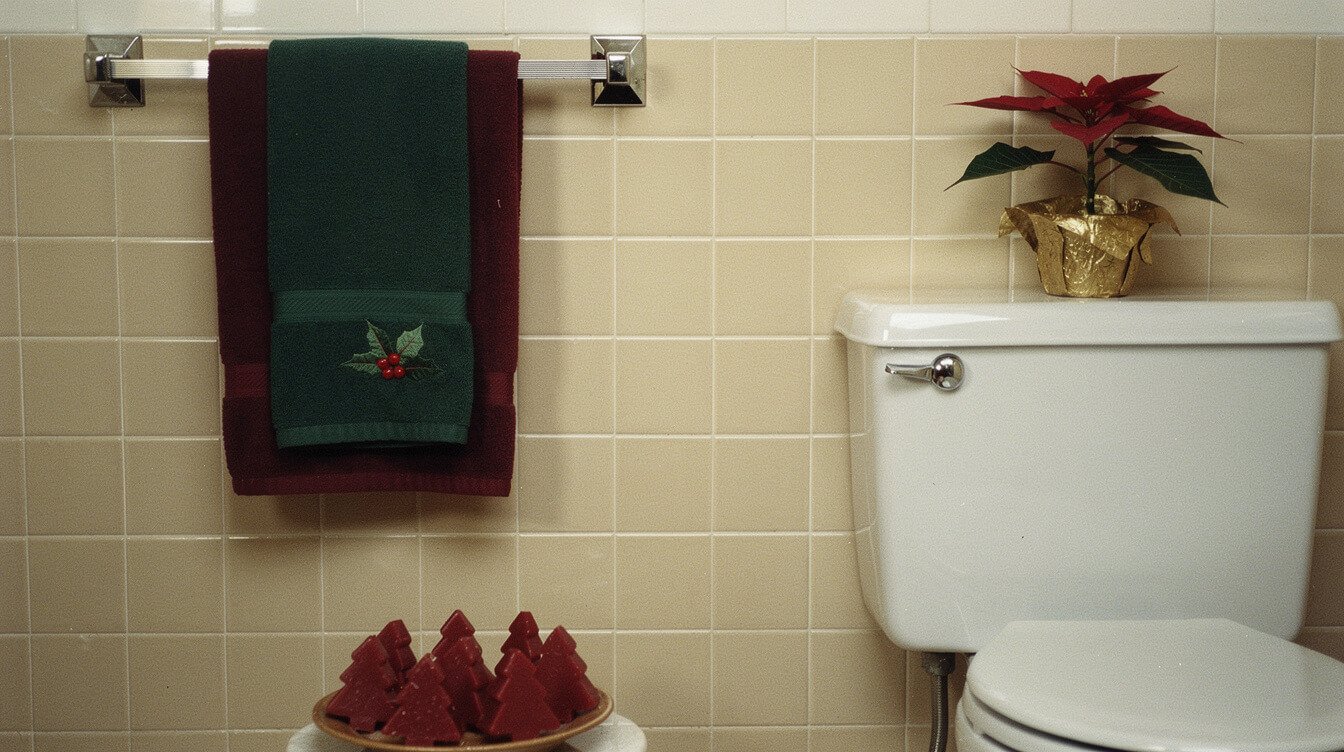
And then there was the bathroom. The guest bathroom got Christmas towels. Hunter green, an embroidered sprig of holly, folded in thirds over the towel bar with a precision you’d usually see at a military funeral. You did not dry your hands on them. Nobody ever said this out loud; you just knew. Wiping your hands on the Christmas towel was like sitting on the good couch in your swim trunks. You dried your hands on your jeans, or on the back of your neck, and you didn’t touch the little soaps shaped like trees, either. Those soaps were decorative. They outlived several presidents.
What’s interesting about all of this is how little of it ever shows up when people talk about 90s christmas decorations now. The tree gets photographed. The towel bar never did. But the towel bar is where you learned that Christmas wasn’t an object in the corner. It was a set of house rules, and they applied to every room, including the one with the lock on the door.
Hunter green, burgundy, and a goose in a bonnet
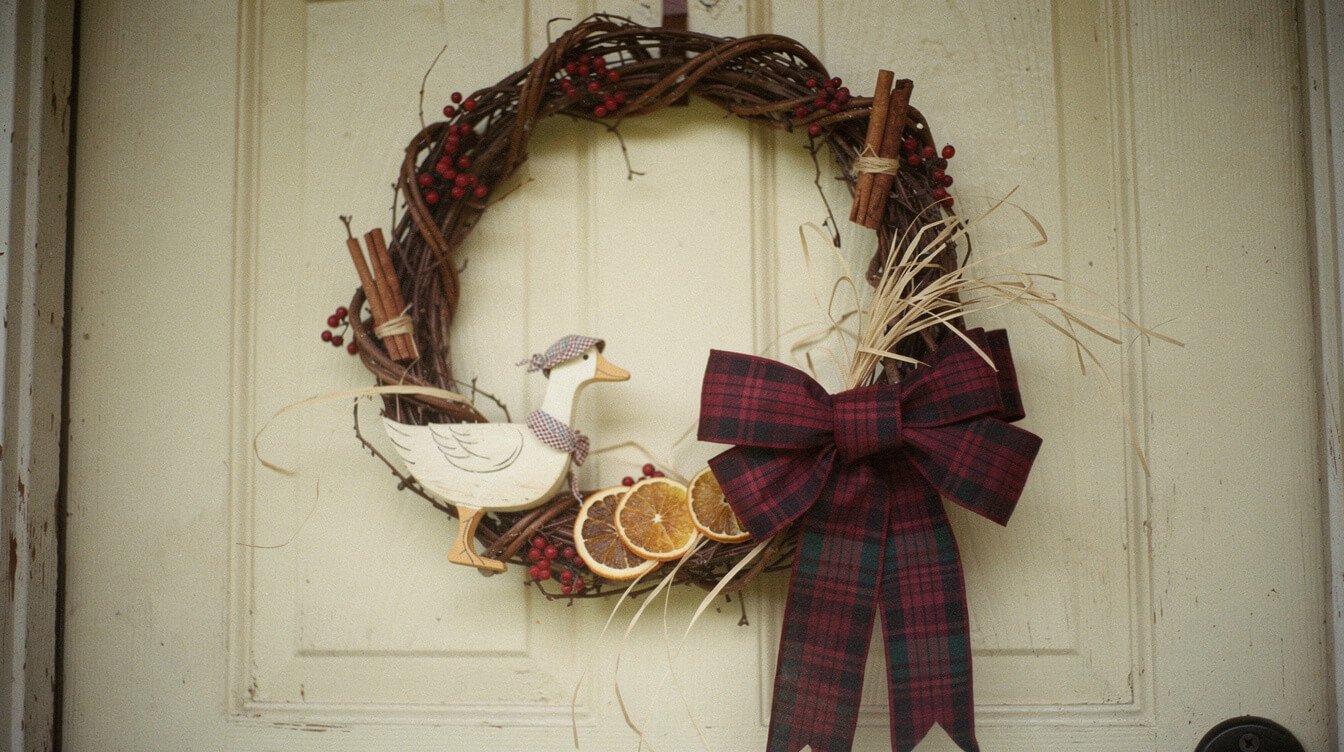
If you want the color of a 90s Christmas, it isn’t red and green. It’s red and green after a long day. Hunter green and burgundy, usually in plaid, usually tied into a bow with wire in the edges so it held its shape. It went on the wreath, the mantel, the tree skirt, the throw pillows that came out for the season, and the decorative tin full of cookies nobody was allowed to open until company came. A shade of navy wandered in sometimes. Nobody was allowed to ask why.
Around it was a whole material world: grapevine wreaths, raffia, dried orange slices, cinnamon sticks tied into bundles with twine, gingham ribbon, pinecones, little bags of potpourri that smelled like a candle shop had exploded in a bark mulch factory. And the animals. The country goose, white, wearing a bonnet and a gingham scarf, had spent the rest of the year in the kitchen, and in December she simply put on a red scarf and kept working. Wooden cutout Santas, roughly three feet tall, leaning against the porch rail. Rag-doll angels with raffia hair. A bear in a knit sweater.
The 80s decorated the house out of a catalog. We’ve covered how that worked: you bought a room, pre-matched, and so did everyone three states over. The 90s Christmas mostly came from somewhere much smaller. It came off a folding table in a school gym or a church fellowship hall on a Saturday in November. The holiday craft fair. Forty tables, a bake sale by the door, a raffle for a quilt, and a woman who painted wooden geese selling them for six dollars apiece next to a man who made birdhouses out of old license plates.
Your mother bought something there every year. That was the point of going. So the decorations piled up in layers, one craft-fair purchase at a time, and each one had a maker who lived maybe twenty minutes away. The Santa came from the lady at the end of the row. The angel came from a neighbor’s sister. The painted sign that said something about Christmas cheer came from a man who had clearly been asked to paint a lot of those.
That’s why the stuff in that $239 jeweled-Santa category doesn’t read as 90s, even when the palette is a dead match. It’s too finished, and it’s too consistent. The real thing was handmade by people who were good at it, but not that good, and you could see their brushstrokes. The goose’s eyes were slightly different sizes. That was the goose.
The lighted village on the cotton batting
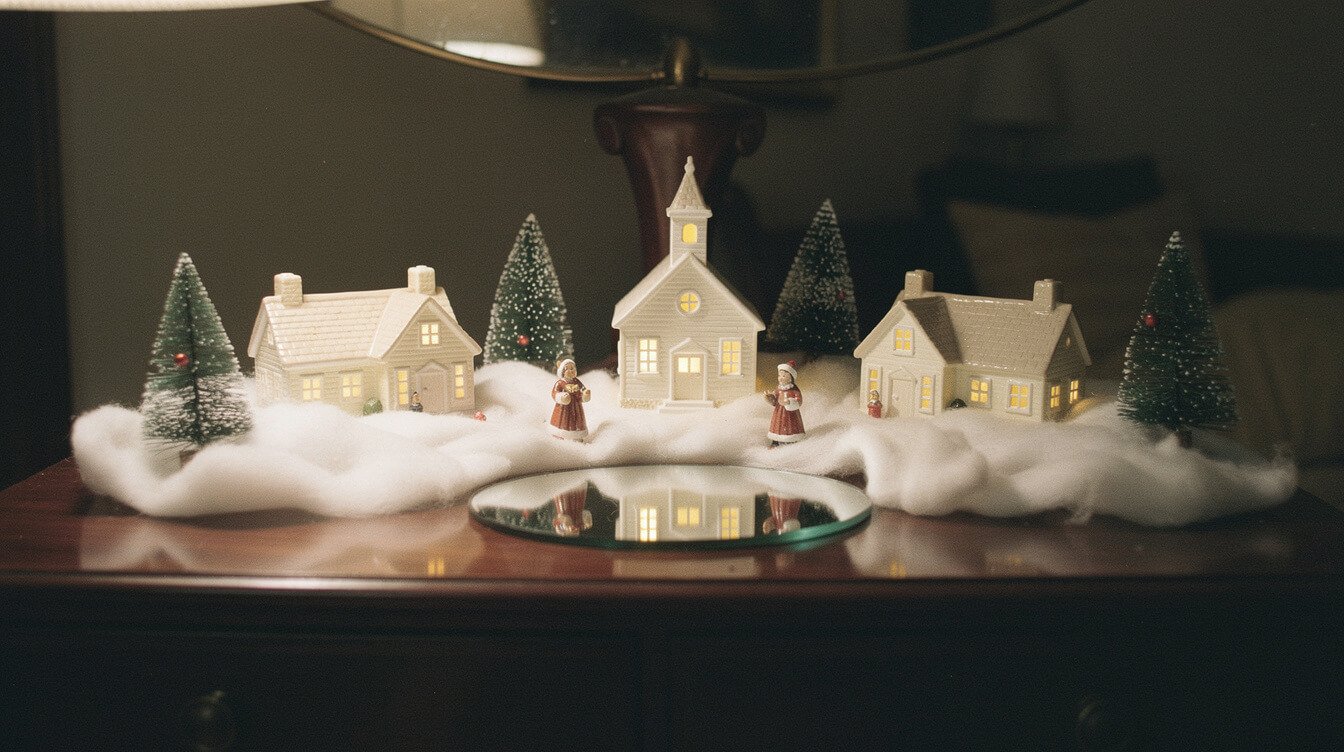
Somewhere in the house, usually on a sideboard or the top of the upright piano, there was a village. Little ceramic buildings, each with a light bulb inside, so the windows glowed: a church, an inn, a row of cottages, a bakery, sometimes a whole Victorian street. The lines had been around since the mid-70s, but the 90s were when they turned into a full suburban hobby. By 1992, the collectors had enough local clubs to need an umbrella organization for them.
Nobody bought a village. You bought a building. One a year, maybe two if there was a good sale, and it got added to the arrangement every December. So the village grew the way a real town does: unevenly, and with no plan. A colonial church sat next to a Bavarian bakery. A ski lodge turned up in what was clearly 1840s London. Nobody in the village seemed troubled by this.
The ground was cotton batting, pulled thin and lumpy across the sideboard so it looked like snow if you squinted, and like cotton batting if you didn’t. A hand mirror or a round shaving mirror served as the frozen pond. Small bottle-brush trees went up wherever the cords needed hiding, which was everywhere, because each building had its own cord, and they all ran out the back of the batting into one heroically overloaded power strip. The power strip was behind the sideboard. The power strip was warm to the touch. Nobody looked at the power strip.
Next to the village there were little figures. Carolers with their mouths open, a man selling chestnuts, a kid on a sled, all about an inch and a half tall and all with that same pale glaze. If you were eight, the village was the best toy in the house, and you weren’t allowed to touch it. You could look. You could move your face very close and look into the lit windows. If you moved the caroler from the church to the bakery, someone would know within the hour, and they would move her back.
The village is the clearest picture of what the 90s house was doing in December. It wasn’t decorating for a moment. It was building a collection, one piece a year, and the collection grew slowly enough that it felt permanent. By the time you left for college, the village had more buildings than the actual town you grew up in.
Window candles, spray snow, and the house on the corner
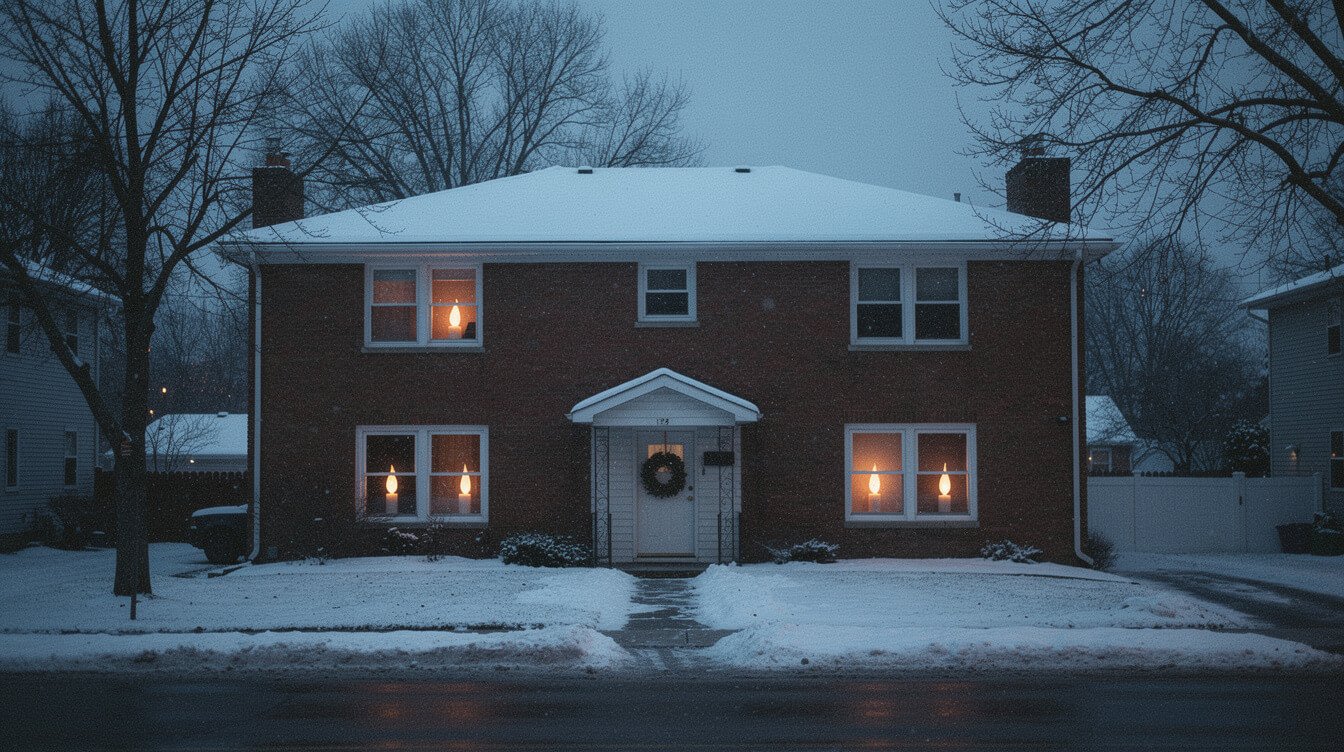
From the street, the most common 90s christmas decoration wasn’t a light display. It was a single electric candle standing in each front window. White plastic base, an orange bulb shaped like a flame, a cord running down behind the curtain. It looked dignified from the sidewalk and slightly haunted from inside. There was always one window whose candle was out. Sometimes it was the bulb. Mostly it was the outlet, which turned out to be controlled by a wall switch somebody kept flipping off.
Plenty of houses kept the lights inside because there was nowhere outside to plug them in. The outdoor outlet was not yet a standard feature of the American house. So the lights went around the inside of the front window frame, and an orange extension cord ran out under the front door for anything on the porch. That kept the door from closing all the way for a month, which no one considered a problem.
Then there was spray snow. An aerosol can of white foam, plus cardboard stencils of bells or stars, and the bottom quarter of every pane in the front window frosted over like a diner in a snow globe. It came off in January with a razor blade and an afternoon. Some of it never came off. There are windows still out there with a faint ghost of a 1993 bell in the corner.
And every neighborhood had the house on the corner. One family that went big, every single year. A father on a ladder, in the dark, in a windbreaker, for most of the first weekend in December. Light-up plastic figures from a decade or two earlier lined the lawn, along with a sleigh on the roof that had once been a real sleigh. In the last few years of the decade, a new thing showed up and spread across the whole country in about three winters: icicle lights. Short white strands dangling in rows from the gutter. Within a year or two they were on half the block, and the house on the corner had to find something new.
On a weeknight in mid-December, your family would pile into the car in pajamas and coats and drive slowly past that house, then across town to the street that went all in together. Nobody honked. The heater ran full blast. It was free, and it was the only time all year anyone’s father drove ten miles an hour on purpose. If you’re the one who still knows exactly which corner that was, the GenerationX shop has shirts for people who don’t need the address explained.
The newsletter
Like a mixtape, but it shows up on its own
One email a week. The good posts, new designs, zero exclamation points. Unsubscribe whenever. We won't take it personally.
Where the real 90s christmas decorations are now
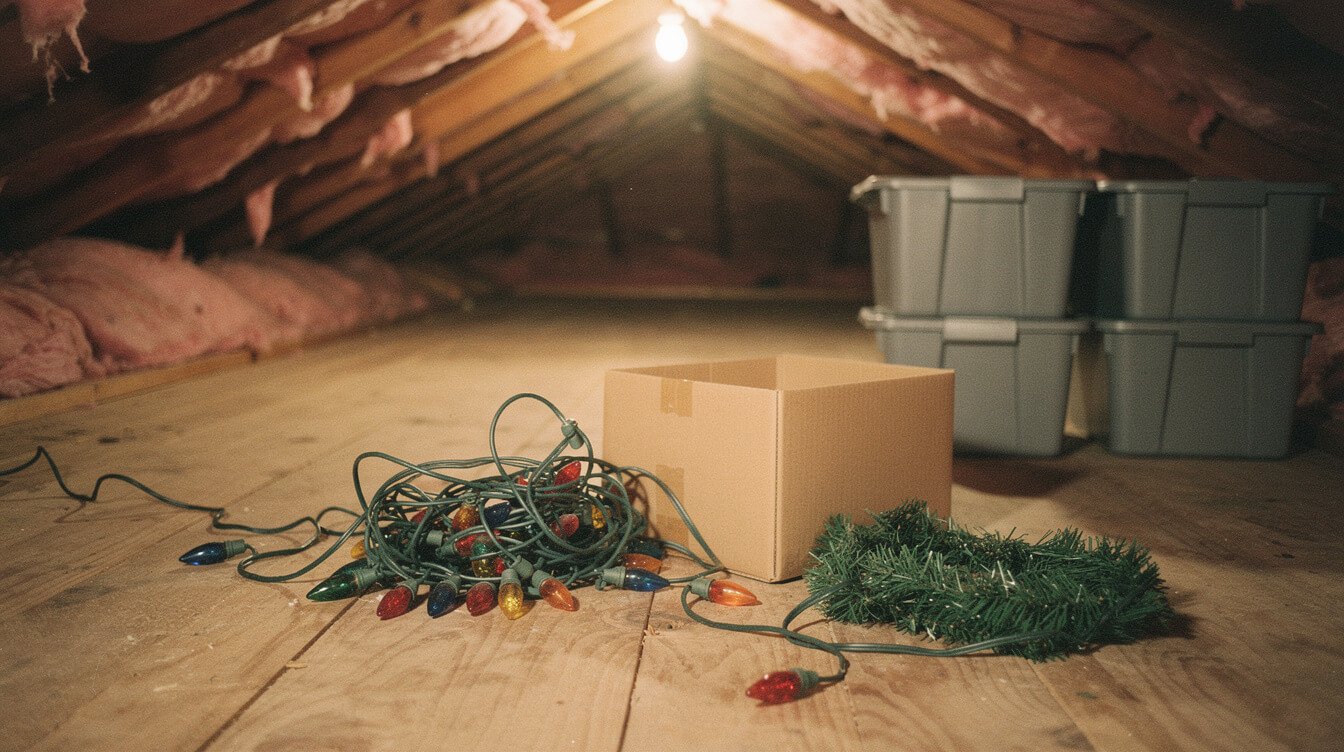
Here’s the thing the shopping results can’t tell you. The real 90s christmas decorations aren’t for sale new, because they were never really for sale new in the first place. Half of them came off a craft-fair table, and the other half were bought in 1991 from a store that isn’t there anymore. Where they actually are now is in an attic. Specifically, a parent’s attic, in a run of plastic bins with XMAS written on the end in marker. Sometimes a second, more recent hand has added DON’T THROW OUT.
Which means they’re about to become our problem. Gen X is the generation currently standing in that attic with a flashlight, deciding what to do with the village. Somebody has to. Mom’s moving into a smaller place, or the house is being sold, or you’ve just been asked very casually whether you want “any of the Christmas stuff.” That question is never casual. There’s nineteen buildings’ worth of village up there.
So if you’re on the receiving end, a little field guide. Take the village if the cords still work, and maybe even if they don’t, because replacement cords exist and the buildings don’t. Take the window candles; they still look exactly right, and they’ll outlive your next three houses. Take the ugliest handmade ornament, because that’s the one you’ll actually miss. Leave the potpourri. It has had a long life and does not need a second one. The Christmas towels can go to whoever wants them, since no one has ever used them and no one is going to start.
If you’re starting from nothing, the good stuff is in the same places it’s always been, just one generation downstream. Estate sales in November. The holiday aisle at a thrift store the week after Thanksgiving, when everyone else’s parents’ attics come in. A church rummage sale, which is basically the craft fair running backward. You’re looking for wear: a goose with mismatched eyes, a ceramic cottage with a chipped chimney, a garland that’s been twist-tied to a banister forty times. If it looks brand new, it was made for people who weren’t there.
And here’s the part that makes the whole category funny: the jeweled Santa is a fine Santa. It’s just not a 90s Santa. The difference between the two is about thirty years of being dragged up and down an attic ladder. That part, the store can’t sell you, and you can’t rush it.
Not for display. You can actually use it.
Unlike the guest towels. Shirts for the people who got handed the attic boxes. No plaid, no bonnet.
90s christmas decorations: quick answers
What were popular christmas decorations in the 90s?
Beyond the tree: grapevine wreaths with plaid bows, mantel garland, electric candles in the front windows, lighted ceramic villages on cotton batting, country-style geese, angels, and wooden Santas from the craft fair, Christmas dishes and towels, a special candy dish, spray snow on the windows, and, late in the decade, icicle lights along the gutter. The defining feature was coverage. Christmas went into every room, not just the living room.
What colors were 90s christmas decorations?
Hunter green and burgundy, mostly, with plenty of plaid, plus natural tones from raffia, grapevine, pinecones, and dried fruit. Bright primary red and green was more of an earlier look, and the all-white-and-silver look came later. If a “90s” set looks crisp and glossy, it’s probably newer.
How do I get the 90s christmas decoration look now?
Go for coverage instead of a statement piece. A little in every room beats a lot in one. Buy secondhand where you can, because the wear is half the look. And then leave it alone. The 90s house didn’t restyle the mantel every year. Things went back in the same spots, and that was the charm.
Where can I find vintage 90s christmas decorations?
Estate sales, thrift stores right after Thanksgiving, church rummage sales, and, most likely, your parents’ attic. Online marketplaces have plenty too, but you pay a premium for the word “vintage” in the listing. Look for village buildings with working cords, handmade wooden figures, and plaid ribbon that still has its wire edge.
Were inflatable yard decorations a 90s thing?
No. The big blow-up lawn figures arrived after the decade ended. The 90s yard was electric candles, a wreath, light-up plastic figures that were already old by then, and, for the ambitious, a gutter full of icicle lights. If somebody’s 90s-themed yard has a twelve-foot inflatable on it, they skipped a step.
Why did 90s houses have Christmas towels nobody could use?
Nobody has ever answered this, and we’re not going to try. Some things you just respect.

From the shop
Madonna Let Your Body Move 80s Pop Art T-Shirt
Price range: $24.99 through $26.99
Shop this designFinal thoughts: somebody has to take down the village
Every 90s christmas decoration had a second life the photos never show: January. The house got dismantled in reverse. Garland came off the banister and left the twist ties behind. The candles came down from the windows. The goose took off her red scarf and went back to her kitchen job. The village got wrapped building by building in the same newspaper it came out of, each piece nested in its original styrofoam (we kept the boxes for a reason), in an order that only one person in the house fully understood. Everyone else carried boxes up the ladder and handed them to whoever was standing closest at the top.
Then, in July, someone would find a single ornament hook in the carpet, or a caroler behind the sideboard, and the whole season would flash by for a second. That’s the bit you can’t order. Not the plaid or the palette, but the fact that the entire house had a second version of itself, and it lived in the attic eleven months a year, waiting.
Now we’re the ones standing at the top of the ladder. Take the village. Leave the potpourri. And dry your hands on whatever towel you like.
Before you go
You made it to the end. Respect.
Get the best of these in one short weekly email, plus whatever we just printed. No spam. We were raised better than that. Mostly.