
Search for 80s video games and you get a ranking. A top ten, a top twenty-five, a forum thread that’s just a few thousand titles in a row, and a video counting down the same eight games every other list counts down. Every list is confident. Every list is in order. And nobody who was actually there ranked anything at the time.
At the time, you played what you had, what your friend had, or what the rental shelf had left by Friday night. What you remember isn’t really the game, either. It’s not knowing. The game told you almost nothing, the box told you less, and there was nowhere to look anything up. So everything a kid knew about 80s video games came from somewhere else: a kid on the bus, an older brother’s friend, a cousin in another state who swore he’d beaten it. About half of it was true. Figuring out which half was most of the fun.
Every 80s video games list is a ranking, and nobody ranked them at the time

The ranking is a grown-up’s format. It assumes you had a choice, and mostly you didn’t. Games cost real money, birthdays came once a year, and a kid’s library was whatever arrived in wrapping paper plus whatever came in the box with the console. If you owned three games, you had three favorites. You’d defend all three on the bus, including the one that was clearly bad.
The rest of your library lived at other people’s houses. One friend had the sports game. One had the shooter. One had the long, strange one with the map that nobody understood, which turned into a group project that ran for most of a school year. You didn’t pick games so much as pick houses. (Toys ran on the same friend’s-house economy. Games just had a longer waiting list.) For a weekend, you could rent something from the video store, assuming the one copy hadn’t gone home with somebody on Tuesday and stayed there.
So the list isn’t wrong, exactly. It’s answering a question nobody was asking in 1987. The question in 1987 wasn’t “what’s the best game.” It was “how do you get past the part with the bridge,” and the answer was never in the box.
That’s the part of 80s video games that doesn’t fit in a top ten. Not what we played. How we figured out what we were playing.
The manual was four pages and half of it was a story

Open the box on most 80s video games and you’d find the game, a warranty card nobody ever mailed, and a booklet thin enough to read in the time it took the TV to warm up. Page one was the story: a kingdom, a princess, a planet, somebody’s stolen thing. Page two was a diagram of the controller with arrows pointing at the buttons. Page three explained that you had three lives. Page four was the enemies, drawn in an art style that looked nothing like the game.
That was it. The booklet didn’t tell you what the items actually did. It didn’t tell you where to go first, or whether the thing you’d been doing for an hour was the thing you were supposed to be doing. A lot of the early home games didn’t have an ending in any sense we’d use now. They just got faster until you lost, and the story on page one was the only story you were ever going to get.
So you learned by dying. You walked into the room, something happened, and you were back at the start. You tried the other door. Over a few weeks you built up a body of knowledge that existed nowhere except your own head and, eventually, a piece of paper (more on that shortly). Nobody thought of this as a design flaw. We thought it was the game. And in a way it was: when the box tells you nothing, finding out is most of what you paid for.
The first secret was real
The other thing the booklet never mentioned was what was hidden, and from very early on, things were hidden. In 1980, a programmer at the biggest home console company of the day was irritated that the company didn’t credit its programmers by name. So the programmer built a secret room into an adventure game, put their own name in it, and didn’t tell anyone. Players found it. The company, rather than pull it, decided it liked the idea and told its programmers to keep doing it. Someone there called the hidden room an Easter egg, and the name stuck.
Which means the first famous secret in a home video game was real. Hold onto that, because it matters for everything that came after. It gave every playground rumor for the next decade a little credibility it hadn’t earned.
The playground was the strategy guide

If the game wouldn’t tell you anything, you got the information the way you got everything else at that age: from other kids, mostly in transit. The school bus was the main exchange. The lunch table was the trading floor. Recess was for live demonstrations, performed with both hands in the air (“you jump, and right when he turns around, you go down, not up”) to an audience leaning in like you were explaining how to defuse something.
Every school had a ranking of sources, and everybody knew it without being told. At the top was the kid who’d actually done the thing and could prove it, ideally by having you over. Below that was the older kid, whose authority came mostly from being in fifth grade. Below that was the kid whose cousin had done it.
The cousin always lived in another state, which made the cousin impossible to check and very hard to argue with. The cousin had beaten everything. The cousin had a version of the game you couldn’t get here. Nobody ever met the cousin. Some of us have since come to suspect that there was no cousin.
And then the rumors
Every game had one. There was a secret level if you did a certain thing a certain number of times. There was a character you could unlock by holding two buttons on the second controller while the title screen loaded. There was a way to bring back someone who died in the story. Most of it was made up, some of it on the spot, by a kid who noticed the attention it got and saw no reason to stop.
You tried it anyway. You sat there holding two buttons for forty minutes, quietly sure the timing was the problem.
Here’s the catch: sometimes the rumor was true. The 1980 room was real. Up, up, down, down was real (you know the rest). The shortcut hidden above the ceiling, where nobody would think to walk, was real. So you couldn’t dismiss any of it. Every rumor carried a small chance of being the one that worked, and that small chance kept an entire school trying. Years later the internet settled most of them, one by one, and the answer was almost always “no, he made that up.” It’s oddly satisfying to find out. It’s also a little bit of a letdown.
Graph paper, a pencil, and a password you’d copy wrong

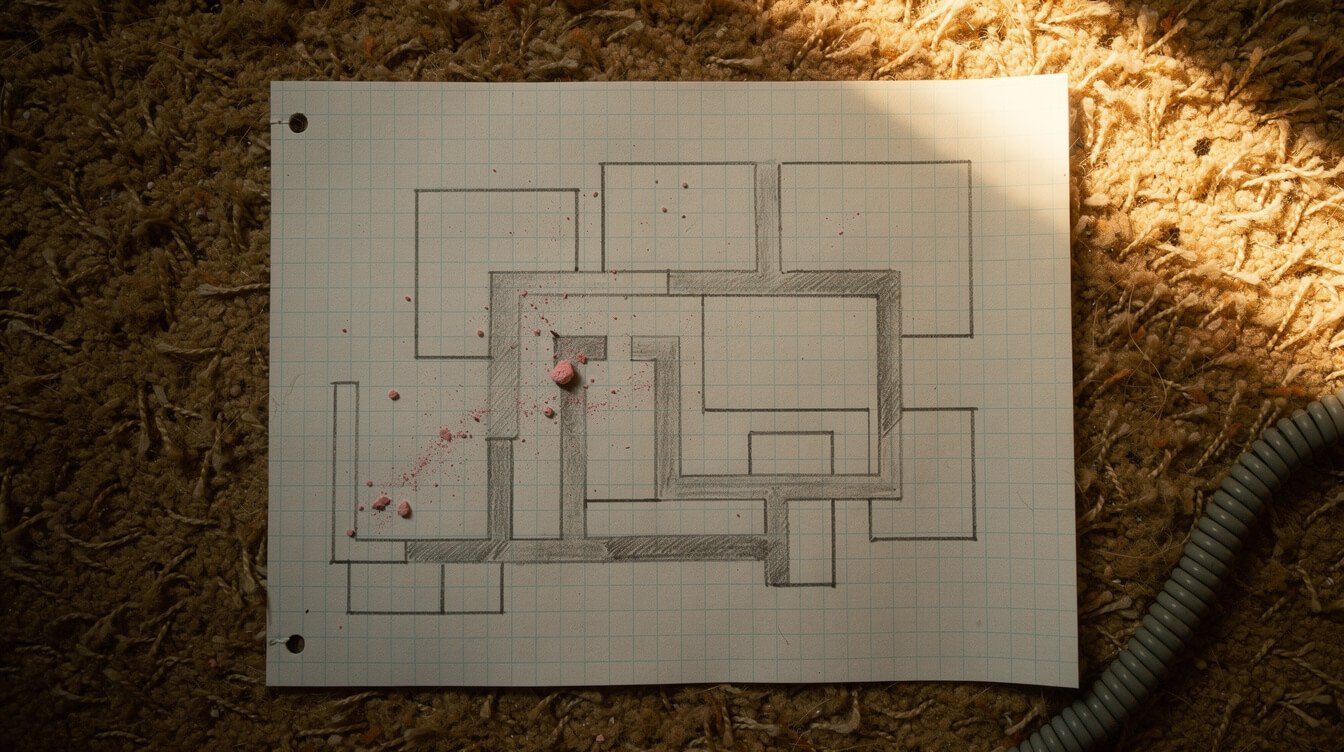
The serious players drew maps. Nobody told them to, and most of the 80s video games that needed a map didn’t come with one. The long games were big and repetitive, the rooms looked alike, and the only way to stop walking in circles was to write it down. Graph paper was perfect for it: one square per screen, a line for a wall, a gap for a door, and a heavily shaded square for the room where the thing that killed you lived. The map went in a folder, or under the console, or back in the box with the booklet that hadn’t helped.
Maps got traded. A good one was worth something. A few got run off on somebody’s parent’s office copier and handed around, which, looking back, was the same instinct as photocopied office humor: copy it, pass it on, never mind the smudge. Each copy of a copy got a little fuzzier at the edges, so the far corners of every dungeon were slightly uncertain. That felt about right.
The password
Some of the bigger games had no way to save, so when you stopped, the screen gave you a long string of letters and numbers, and that string was your progress. You had to write it down. You wrote it on whatever was nearby: the back of a homework sheet, the inside flap of a cereal box, your own hand. And you got one character wrong. Everyone did. Was that a zero or the letter O? A one or a lowercase L? You came back the next afternoon, entered it carefully, and the game informed you, politely, that the password was incorrect. A week of work, gone, over a handwriting choice.
The kids who learned this lesson once started writing passwords twice, in block capitals, with a slash through every zero. Some of them grew up to be the coworker who still does that. Now you know why.
The pause
For the games with no password and no save, there was one option: you didn’t turn it off. You hit pause and walked away and left it running, the TV humming in the dark living room, the game frozen mid-jump all night. You left a note on it. The note said DO NOT TOUCH.
Sometimes it worked. Sometimes a parent came through at six in the morning, saw the TV on, and did what any reasonable adult would do, which was turn it off and start the coffee. There is a particular silence when you come downstairs and the screen is dark. You know immediately. You don’t even need to check.
The newsletter
Like a mixtape, but it shows up on its own
One email a week. The good posts, new designs, zero exclamation points. Unsubscribe whenever. We won't take it personally.
Then the tips came in the mail
Print got there eventually. The first American magazine devoted to video games showed up in late 1981, started by a few writers who’d been reviewing games in a column in an electronics magazine. It lasted until 1985, when most of the home game business went down in the crash, and for a couple of years the bus was the only information network left.
Then the console that brought games back arrived. It was sold to American stores in 1985 as a toy, complete with a little robot, because retailers who’d been burned by the crash didn’t want anything called a video game. And the company found out fast, in the words of the person who ran its fan club, that kids “were just dying to get extra information about the games.” So it put real people on a free phone line to answer questions. In 1987 it started mailing a free newsletter to anyone who joined the club, and 600,000 kids signed up. By the middle of 1988, more than a hundred counselors were answering calls. That summer, the newsletter became a full magazine, and the first issue was printed in a run of 3.6 million copies.
For a kid who cared about 80s video games, this changed the whole economy of knowing things. The magazine had maps, printed in color, that were better than yours. It had tips sent in by readers, with their names and hometowns printed underneath, which was as close to fame as most of us were ever going to get. It answered some of the rumors, sometimes. And it had a way of making next season’s games look so good you’d start planning your birthday six months out. You read each issue until the staples came loose, and then you read it again.
It also reshuffled who had authority. The kid with the cousin could not compete with a magazine that had screenshots. The kid with the subscription became the new source, and if the subscription was in your name, you were briefly important. (If you remember the thrill of turning in a book fair order form, the subscription card lit up the same part of the brain.)
We’d argue the kid who drew the map deserves something better than a spot on a ranking. If that was you, the GenerationX shop has nothing in it you’ll need to copy down.
No password required
For the one who still puts a slash through every zero. Nothing to write down, nothing to get wrong on the third character.
What we lost when you could just look it up

Today you can look anything up in about four seconds. Every secret in every one of the 80s video games has been written down, verified, and filmed from three angles. Every rumor has been tested, and the result is sitting in a forum post from 2004. That’s fine. Honestly, it’s better. Nobody misses spending a Saturday holding two buttons on the second controller because a kid named Travis said so.
But something did change. In the 80s, knowing things about games was a social act. You couldn’t get information without talking to someone, and you couldn’t use it without telling someone. The knowledge moved through people, and it bent a little every time it moved. A tip was a favor. A map was a gift. A good rumor made you, for one lunch period, the most interesting person at the table. Even a bad tip was a reason to talk to a kid you’d otherwise have ignored.
It also meant that finishing something hard was an event. If you beat one of the long games in 1988, you probably did it with no help except the kids around you and your own map. You told everyone. Some of them didn’t believe you. You had to have them over to prove it. That’s a better story than “I watched a video and did what it said.” We’re not claiming it built character. We’re claiming it built better stories, which at our age is the more useful thing.
And the rumors that turned out to be fake? They weren’t really failures. They were the closest thing a lot of kids had to a shared fiction, written by a committee of eight-year-olds with no editor. Somebody made it up, everybody believed it a little, and nobody could check. That’s not misinformation, exactly. That’s folklore. We may be the last generation that grew up with folklore about software.
If you want the rest of the console years at home (who got the good controller, what the cartridge needed, the whole household treaty), we covered that in retro gaming t-shirts. This post is just about the paperwork.
80s video games: quick answers
The questions people actually type, answered without a countdown.
What games did kids play in the 80s?
Whatever was in the house, mostly. Early in the decade that meant arcade ports on the first wave of home consoles: maze games, space shooters, paddle games, and a few adventure games built out of colored blocks. After the home market came back in the second half of the decade, it meant side-scrolling platform games, sports games, sideways shooters, and the long adventure and role-playing games that required a map. It also meant whatever you could rent for a weekend or play at a friend’s house. The games people remember most are often the ones they had the least access to.
Why was 1980 a big year for video games?
A few things happened at once. In arcades, 1980 brought the maze game whose round yellow hero ended up on lunchboxes and a Saturday morning cartoon, and gave the business a character instead of a spaceship. At home, the first big arcade hit licensed for a home console sold consoles practically by itself, which proved people would pay to bring the arcade into the living room. And a programmer hid their own name in a secret room in a home adventure game, which gave us the first famous Easter egg.
What was the golden age of arcade games?
Roughly the late 70s through 1983. The number of video game arcades in North America doubled between 1980 and 1982, peaking at around 10,000, and machines showed up in grocery stores, gas stations, and pizza places too. A flood of copycat games, a moral panic about kids in arcades, and the home crash of 1983 brought it to an end. The arcade itself (the sound, the line, the quarter) is a whole separate story, which we told in the retro arcade t-shirt piece.
What’s the most nostalgic video game?
The one you couldn’t finish. For most of us, the game that hits hardest isn’t the best one. It’s the one we got stuck in at ten, with a map that ran off the edge of the page and a password that didn’t work. Ask someone which game they still think about, and they’ll answer in under a second.
Were 80s video games harder?
Often, yes, partly on purpose: short games were stretched out with limited lives and no saves, and nothing told you what to do next. But a lot of the difficulty was information, not reflexes. Plenty of 80s video games are easy once you know the trick. The trick just wasn’t written down anywhere a kid could reach.

From the shop
Madonna Let Your Body Move 80s Pop Art T-Shirt
Price range: $24.99 through $26.99
Shop this designFinal thoughts
The rankings will keep coming, because rankings are easy to make and easy to argue with. Fine. But if you were there, the list isn’t what you remember. You remember a kid leaning across the bus aisle to tell you a secret, the graph paper in a folder, the password with the ambiguous zero, and the sound of a parent turning off the TV at six in the morning.
80s video games didn’t come with instructions, so we wrote our own, together, and mostly wrong. Still the best strategy guide anybody ever made. For more of the decade, start with 80s slang, which has the same problem in reverse: everyone thinks they know it, and half of it was made up by somebody else.
Before you go
You made it to the end. Respect.
Get the best of these in one short weekly email, plus whatever we just printed. No spam. We were raised better than that. Mostly.