Type vintage 80s apparel into a search bar and you get exactly two kinds of results, and neither one is how anyone actually got dressed in 1984. One is a resale rack — real garments, decades old, sorted by decade like produce by season, no story attached beyond a price tag and a size guess. The other is a costume aisle dressed up as a “look”: shoulder pads stacked on neon on a headband, sold as a matched set to someone going to a theme party who wasn’t born yet. Both are selling you the decade. Neither one is selling you what it actually felt like to open a closet that year and just pick something.
We were the ones opening that closet. It wasn’t a costume and it wasn’t a museum piece. It was a windbreaker you’d had for two years, jeans that fit wrong in a way you’d stopped noticing, and one thing — usually one thing — you’d actually saved up for. That’s the version this is about.
Nobody selling either version of “vintage” today has much reason to correct the record. The resale side benefits from the word sounding rarer and more curated than “used clothes, sorted by year” actually is. The costume side benefits from the decade sounding louder and more matched than it ever was. Both stories sell. Neither one is the boring, accurate one, which is exactly why the boring, accurate one is worth telling.
“Vintage 80s apparel” is doing two jobs, and only one of them is honest
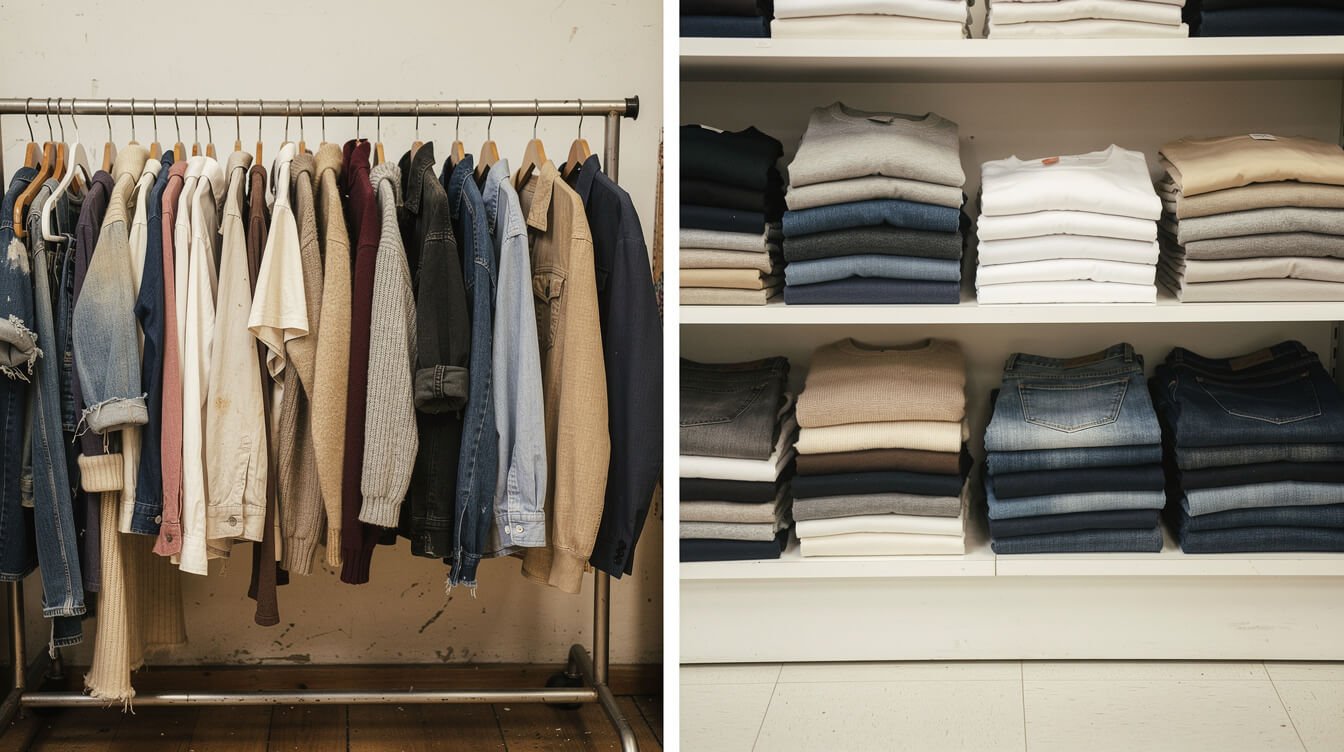
Search the term and the first page is almost entirely commerce: resale shops with real secondhand stock, and “retro style” shops selling brand-new reproductions cut to look old. Both use the word “vintage” as a label, and both are, in their own way, telling the truth about what they’re selling. What neither one tells you is that “vintage” was never a style choice at the time. It’s a word that got attached to the decade afterward, by people selling it back to us, because “the clothes we had” doesn’t fit on a category page.
The resale side is at least honest about being random. You get what came in that week — a real jacket, worn by a real stranger, at a real size that may or may not fit you. It has no curated theme because it was never curated in the first place; it’s just what survived. The costume side is honest in a different way: it knows it’s selling a theme, and it commits to the theme all the way, because a customer buying “the 80s look” for one night wants the whole outfit solved in one click.
Neither one is wrong to exist. But neither one is the actual texture of the decade, which was never a theme and was never curated — it was whatever was clean that morning, plus one piece you actually liked.
There’s also a quiet irony in how the resale side prices things: the more “iconic” a piece looks, the more it costs, on the assumption that iconic-looking things were rare at the time. Usually the opposite is true. The loud stuff was cheap and everywhere, which is exactly why it got worn hard and mostly didn’t survive to be resold at all. What did survive, disproportionately, is the stuff nobody wanted enough to wear out — which means today’s “iconic vintage” price tag is often attached to the least-loved garments of the actual decade, not the most.
What was actually in the closet
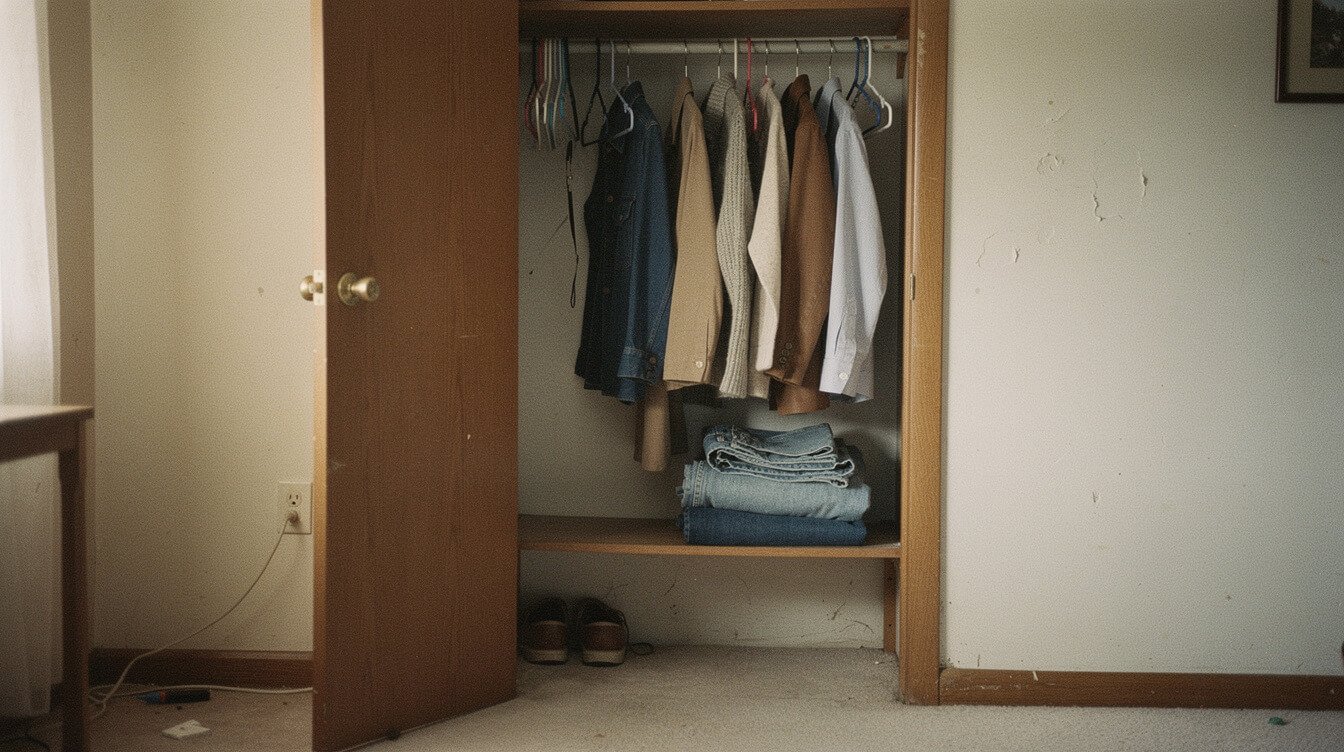
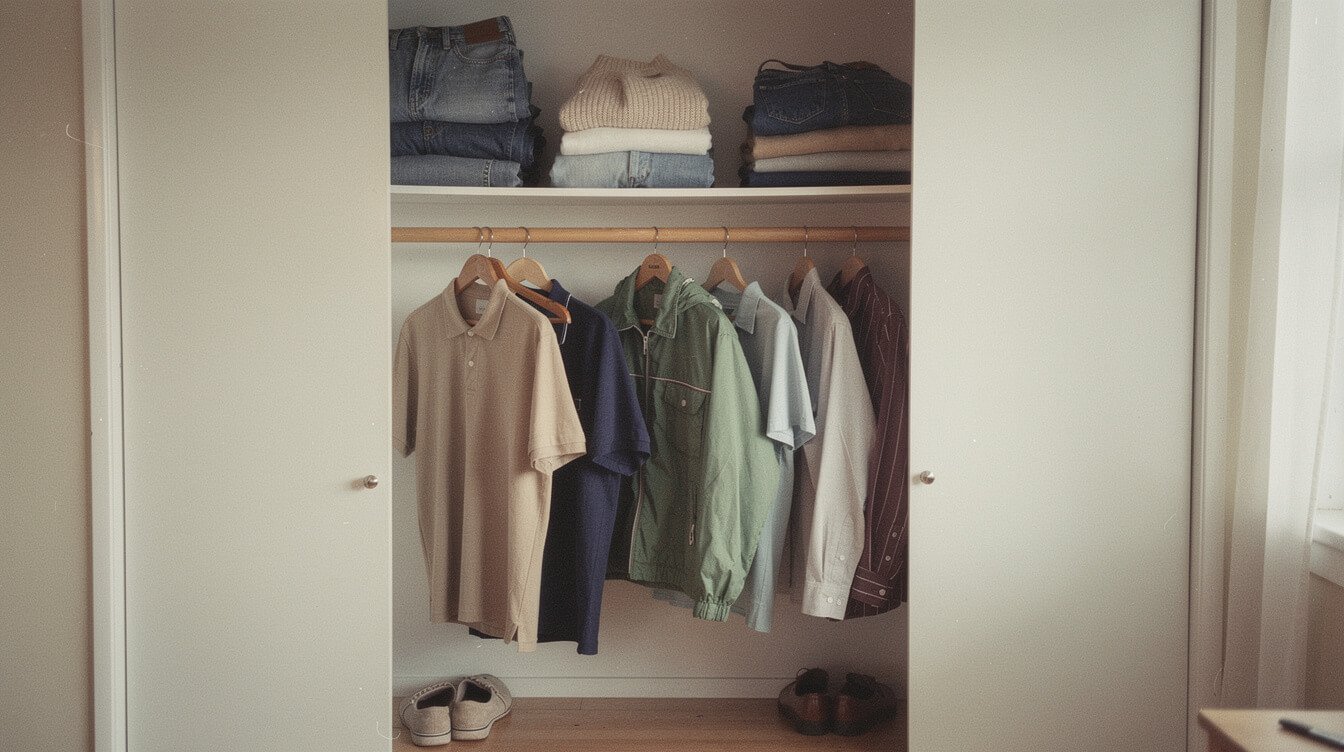
The boring 90% of any real 80s wardrobe doesn’t show up in either kind of search result, because nobody photographs it and nobody resells it on purpose. It’s a plain polo in a color that doesn’t have a name. A pair of jeans that fit fine in the store and wrong by the second wash. A windbreaker that lived on a hook by the door for two winters because it was warm enough and nobody was rating it. None of that reads as “80s” in a thumbnail. All of it was the actual decade, worn by actual people who were not dressing for a photo.
Then there was the one piece — everybody had exactly one — that you’d saved allowance or a summer job’s worth of cash for, and wore until it fell apart, because it was the only thing in the closet you’d chosen on purpose instead of having handed to you. That piece is what people remember. It’s also, not coincidentally, the one piece that’s hardest to find on a resale site now, because the people who owned it wore it until there was nothing left to sell.
We wrote about this same math in 80s kid t-shirts — the gap between the thing that got worn into the ground and the thing that got kept as a costume. The stuff that mattered was never the stuff that survived to be resold. That’s most of why the resale racks and the closet you actually remember don’t match.
And most of the closet wasn’t even a choice. A decent amount of it was decided for you — school clothes bought a size up so they’d “last,” chore clothes that were already somebody else’s before they were yours, a going-out shirt reserved for the one or two nights a month that counted as an occasion. The rotation was smaller and more repetitive than any “80s capsule wardrobe” article would ever admit, because nobody was optimizing a wardrobe. You were working with what you had, and most weeks that was fine.
The mall already ran on the same logic
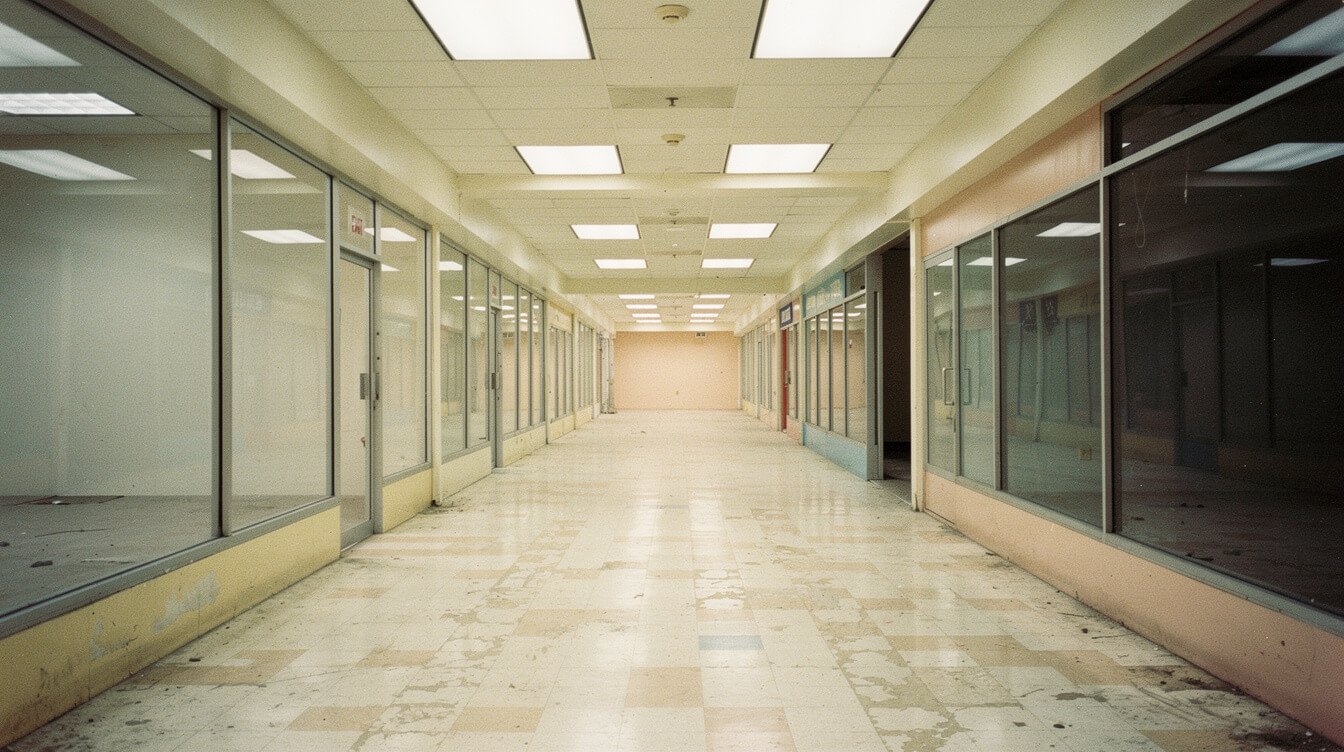
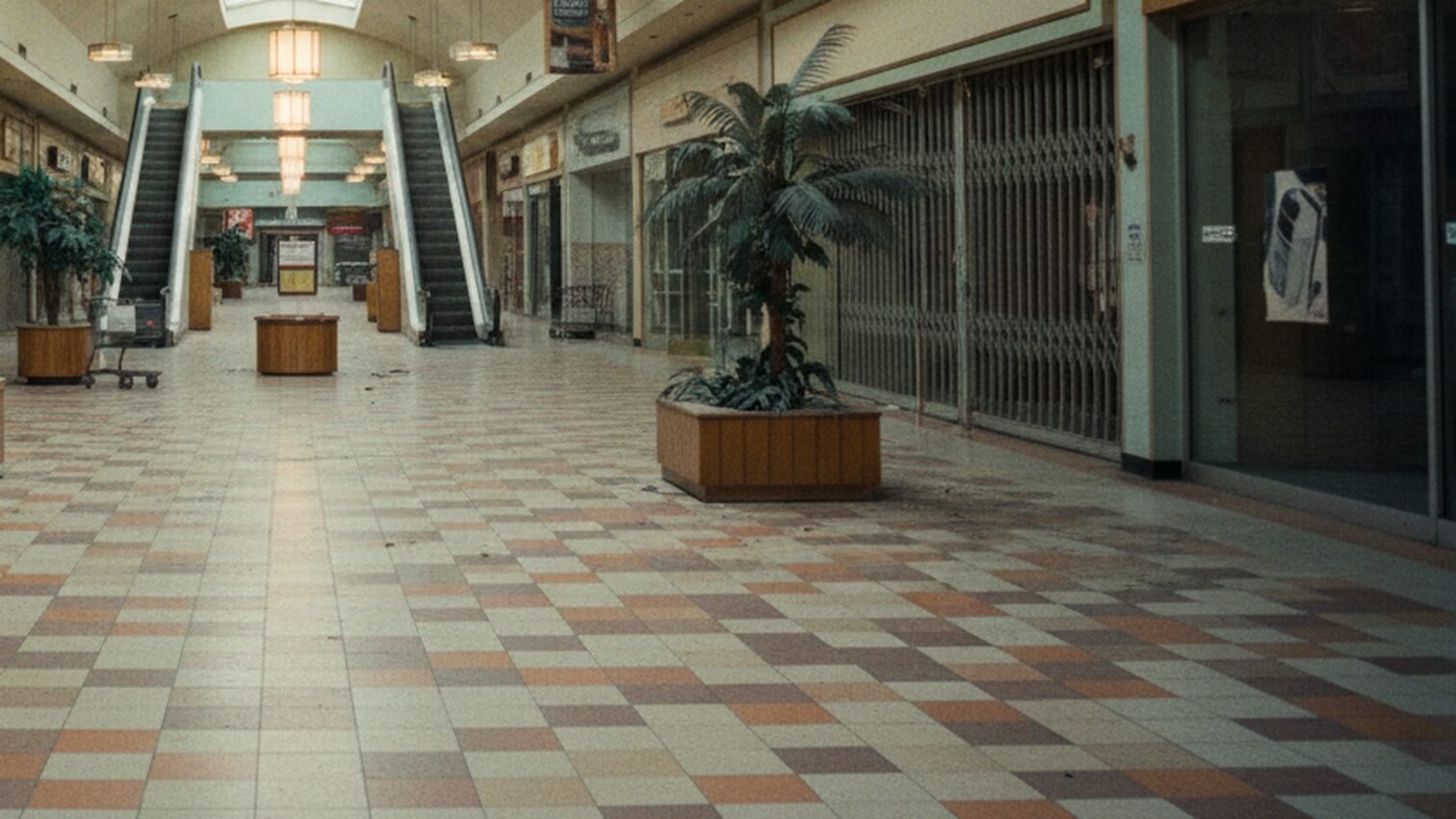
If there’s one place that could have turned “the 80s look” into a curated theme while it was still happening, it was the mall — the one retail environment built entirely around the decade in real time. It didn’t. A trip to the mall wasn’t a themed shopping expedition; it was three or four stores, a food court stop, and whatever ended up in the bag, which was rarely a coordinated outfit and almost always just “the shirt that was on sale” plus “the thing you’d been eyeing since last time.”
We’ve covered the mechanics of that ritual in the actual 80s mall — the wandering, the food court, the store you circled back to three times before buying anything. The same logic applies here: nobody involved was building a matched decade-defining look. They were building a Tuesday, one purchase at a time, out of whatever the mall happened to be stocking that season. The “aesthetic” only exists in hindsight, assembled by people looking back at thousands of those unrelated Tuesdays and mistaking the pattern for a plan.
Old is a fact. Vintage is a costume department.
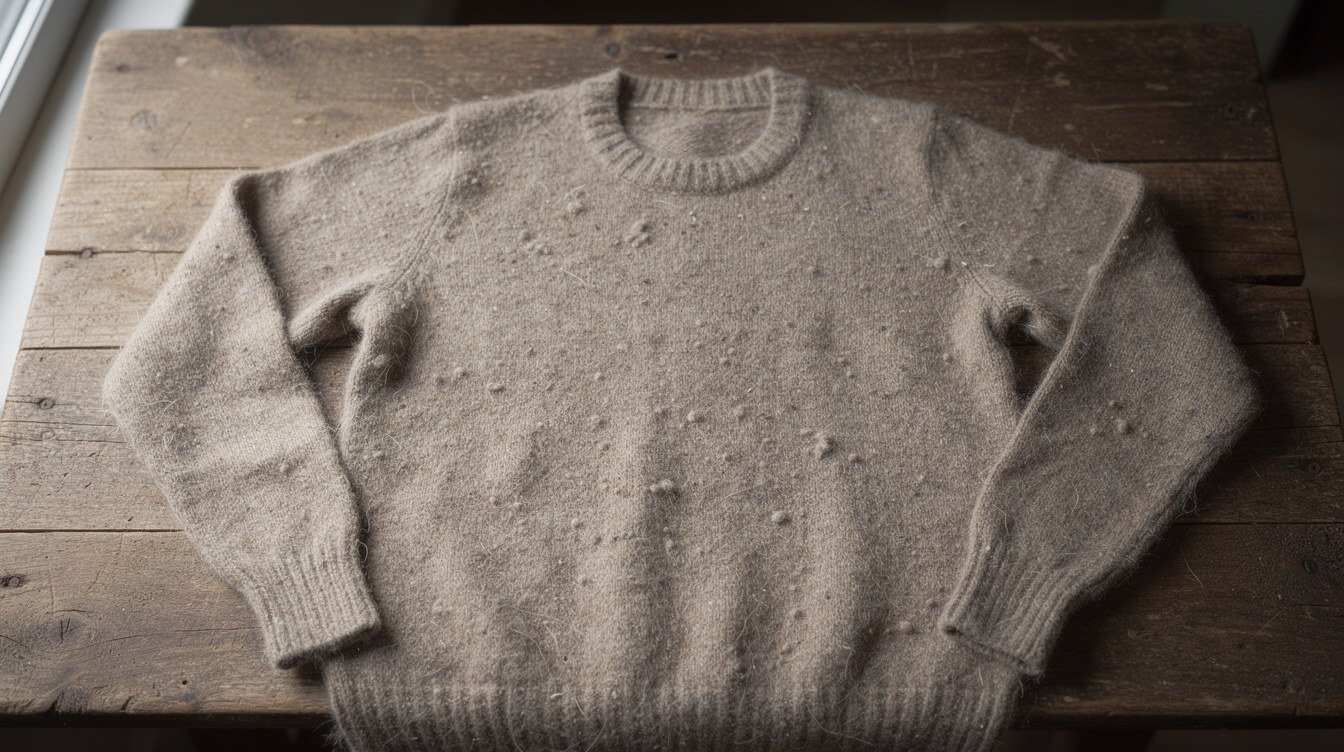
“Old” is simple: a garment made in the 80s that is still, today, a garment. It has a real history, usually a boring one — a spill it survived, a hem someone’s mother took up, a stretched-out collar from being pulled over a head one too many times. None of that is styled. It’s just wear, accumulated the ordinary way, on a thing nobody expected anyone to care about later.
“Vintage,” as it’s marketed now, is a genre with rules: a specific silhouette, a specific palette, worn as a full outfit so the decade reads instantly from across a room. That’s costume logic, not closet logic. Nobody in 1985 was thinking about whether their look “read as 80s” — the decade was just the only one available, so everything by definition matched it, the same way everything you wear right now automatically “reads” as whatever decade this is.
The tell, once you’re looking for it, is confidence. A genuinely old garment doesn’t perform its age — it’s just been around a while and it shows. A garment built to be “vintage” performs its age on purpose, usually a little too hard, because performing is the entire product.
The mending gives it away too. A truly old piece usually has a repair in it somewhere — a re-sewn button, a patch over a hole that wasn’t decorative when it went on, a hem taken up by someone who wanted the thing to last another season rather than replace it. That’s not distressing. That’s just what happens to clothes that were expected to survive being worn, back when replacing something wasn’t a same-day decision. A costume reproduction can fake a lot of things, but it can’t fake a repair that happened because someone needed the garment to keep working.
We made a version of this same argument about retro cassette design — an object doesn’t need to perform its age to have it. It just needs to have actually lived through the years instead of being built to look like it did. The same test applies here: does the wear tell a true, specific story, or is it printed on at the factory to save you the decades?
The tell is always “head to toe”
Nobody dressed head-to-toe as one decade on purpose, because there was no reason to — you weren’t in competition with a different decade for the honor. You wore last year’s jacket with this year’s shoes with whatever shirt was clean, and the mix wasn’t a fashion statement, it was just what existed in the room. A full, matched, top-to-bottom “80s look” is a costume-party idea. It’s efficient for a photo. It has nothing to do with how an actual closet worked.
That’s the gap our own designs are built to sit in, for what it’s worth — a single shirt that gets a specific detail exactly right, meant to be worn with whatever else is already in your closet, not a themed outfit sold as a set. If you want to see what that looks like instead of a costume rack, our shop is built entirely on getting the one piece right and leaving the rest of the outfit to you, the way it actually worked the first time.
The head-to-toe version isn’t dishonest, exactly. It’s just answering a different question — “how do I look like the 80s tonight” instead of “what did people actually put on that year.” Only one of those questions has a real answer, and it isn’t the fun one.
The one piece that carries a whole outfit

If the whole decade wasn’t a matched set, the actual unit of “getting dressed” was smaller: one piece, worn constantly, doing more work than everything else combined. A jacket. A pair of boots. A shirt you’d rotate back into every third day whether or not it was clean, because it was the one thing that felt like yours. Everything else in the outfit was just whatever else was near it on the floor.
That’s a different design problem than “recreate the decade,” and it’s the one we think is actually worth solving. One piece, one detail, done exactly right, worn with whatever you already own — that’s closer to how it worked than any full costume rack will ever get, because it never asked you to solve an entire outfit in the first place. It asked you to own one thing you actually liked.
It also explains why a single well-chosen piece ages better, in every sense, than a matched set. A themed outfit stops making sense the second the theme’s over. One good, specific piece just keeps being a jacket, or a shirt, or a pair of boots — worn on its own terms, long after the “look” it supposedly belonged to has stopped mattering to anyone but you.
You can test this against your own memory pretty easily. Try to picture a specific outfit from that decade, head to toe, all at once — most people can’t, not in detail. Now try to picture one specific piece: a jacket, a pair of shoes, a shirt with a particular wear pattern on the collar. That one comes back instantly, in detail, usually attached to a specific place or person. Memory kept the piece and let the rest of the outfit go, which is a pretty strong hint about which one actually mattered.
What we mean by vintage when we build something new
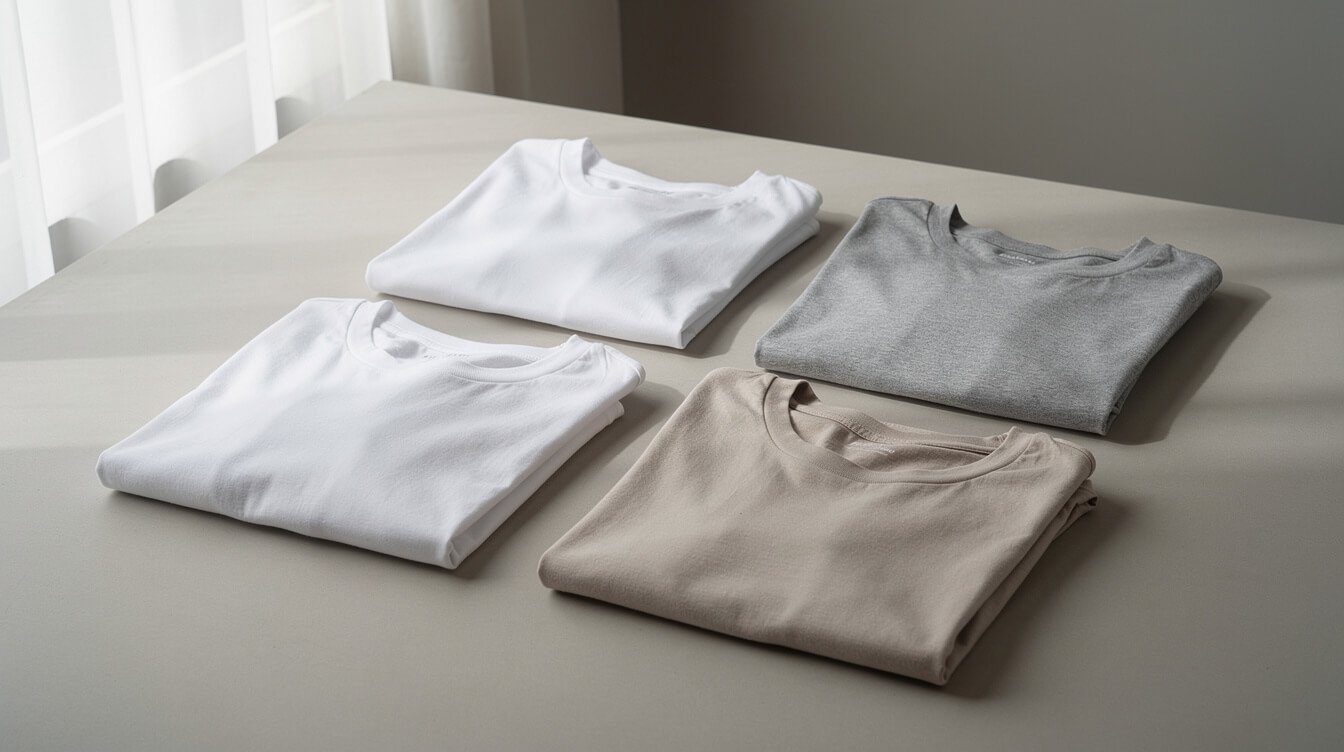
We’re not reselling actual 1984 garments — we can’t, and wouldn’t pretend to. What we’re after is the other half of “vintage” that the resale racks and the costume aisles both miss: the specific, ordinary, ungeneric detail that made the decade recognizable to someone who was actually in it, put on a shirt that’s new, well-made, and meant to be worn today, not glued to a mannequin as a “look.”
That means no head-to-toe theme, no full costume set, no font doing the work a real memory should be doing. It means one detail, gotten exactly right, on a shirt you can wear with whatever’s already in your closet — the same way the one piece you actually loved back then got worn with whatever else was around, not with a matching set built to sell as a bundle.
“Vintage” shouldn’t mean either “decades old and randomly sized” or “costume-department loud.” It should mean: whoever made this actually knew the specific, unglamorous detail — and didn’t need to explain it to you.
Quick answers about vintage 80s apparel
What’s the real difference between “old” and “vintage”?
Old is a fact about a garment’s age. Vintage, as it’s sold today, is a marketing genre with its own rules — a specific silhouette and palette, styled to read as a decade at a glance. A genuinely old garment doesn’t have to perform its age. A “vintage” one usually does.
Why does actual resale vintage rarely match what people remember wearing?
Because the pieces people actually loved got worn until there was nothing left to resell. What survives on resale racks tends to be the stuff nobody wore hard enough to destroy — which skews the whole category toward what was forgettable, not what was loved.
Is head-to-toe “80s style” historically accurate?
Not really. Nobody dressed as a full, matched decade on purpose — you wore whatever combination of old and new happened to be clean. A complete themed outfit is a costume-party idea, built for a photo, not a memory of an actual closet.
What should I actually look for in vintage 80s apparel?
One well-made piece with a specific, honest detail — not a full matched look, not a licensed graphic doing the emotional work, not a costume set. The single piece worn constantly is closer to how it really worked than any complete “recreate the decade” outfit.
Do you sell actual vintage clothing?
No — we design new pieces that get a specific detail from the era exactly right, meant to be worn with whatever’s already in your closet, not sold as a themed set.
Final thoughts
Nobody in 1984 thought they were wearing “vintage 80s apparel.” They were wearing a windbreaker that was fine, jeans that fit wrong in a way they’d stopped noticing, and one piece they’d actually chosen. The decade only became a costume category later, sold back in two flavors: random and old, or matched and loud. Neither one was ever the point.
The point was smaller than that, and it still is. One piece, gotten right, worn on your own terms. Everything else was just whatever was already in the room.
One piece. Gotten right. No costume required.
Shop the drop
Original designs made by people who were actually there — no matched sets, no costume racks, just the specific detail done right.
Raised on static. Fluent in sarcasm.
Reply and tell me your era
One good link, no forced enthusiasm, straight to your inbox.