Here is the part that gets left out of nearly every school picture day nostalgia piece on the internet: the day itself was not the event. The day was the deadline. The event had started weeks earlier, with a piece of paper that came home in your backpack and asked you to make a series of binding decisions about your own face.
You picked a backdrop. You picked a package. You picked how many small copies of yourself would be mailed to relatives you saw twice a year. You did all of it in advance, in pencil, at a desk, with no idea what you would be wearing on the morning in question or what your hair would be doing about it. Then you handed the slip in and waited, and the machine took over.
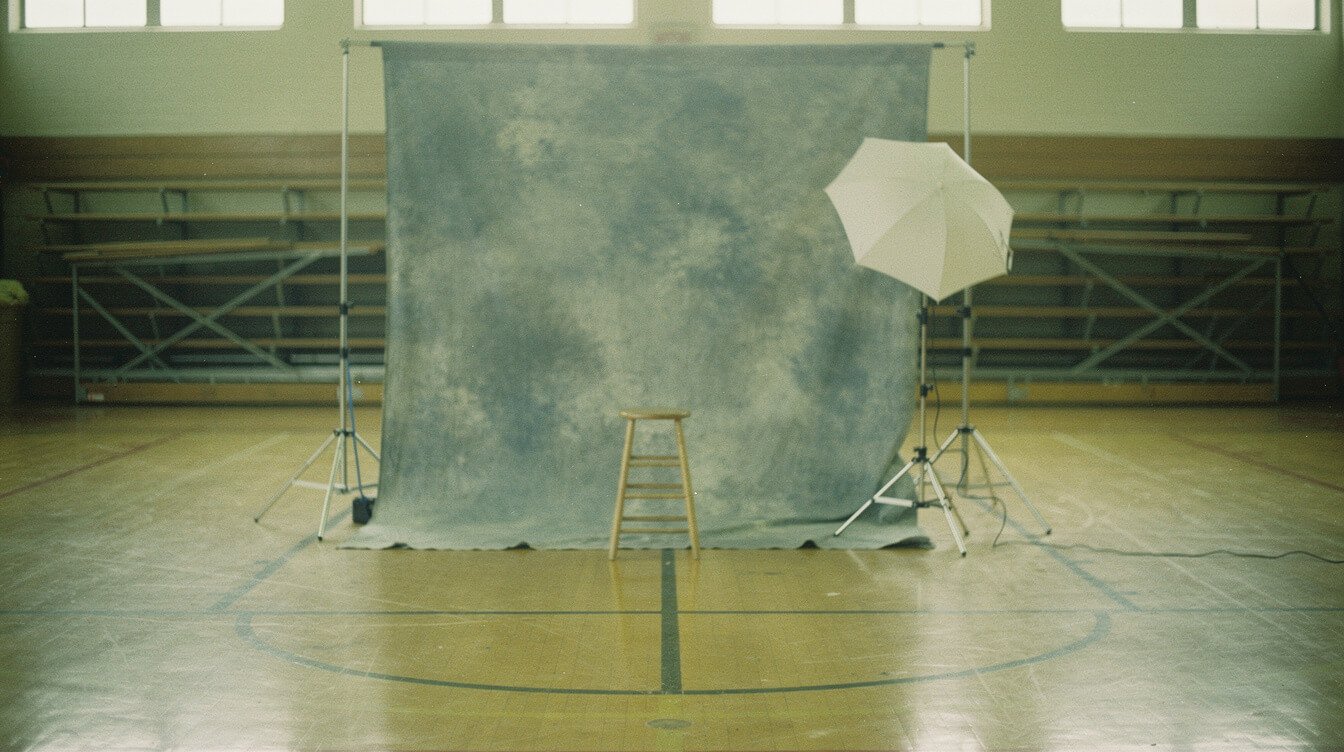
That is the story, and it is not the photos. The photos are everywhere — galleries of them, scraped and captioned by people who were not there. What is missing is the mechanics: how an entire generation got routed through a folding table and a mottled backdrop in a gymnasium, one take each, no preview, and received the verdict six weeks later in a sealed envelope with no appeal.
School picture day nostalgia starts with a paper slip and a decision you were not qualified to make
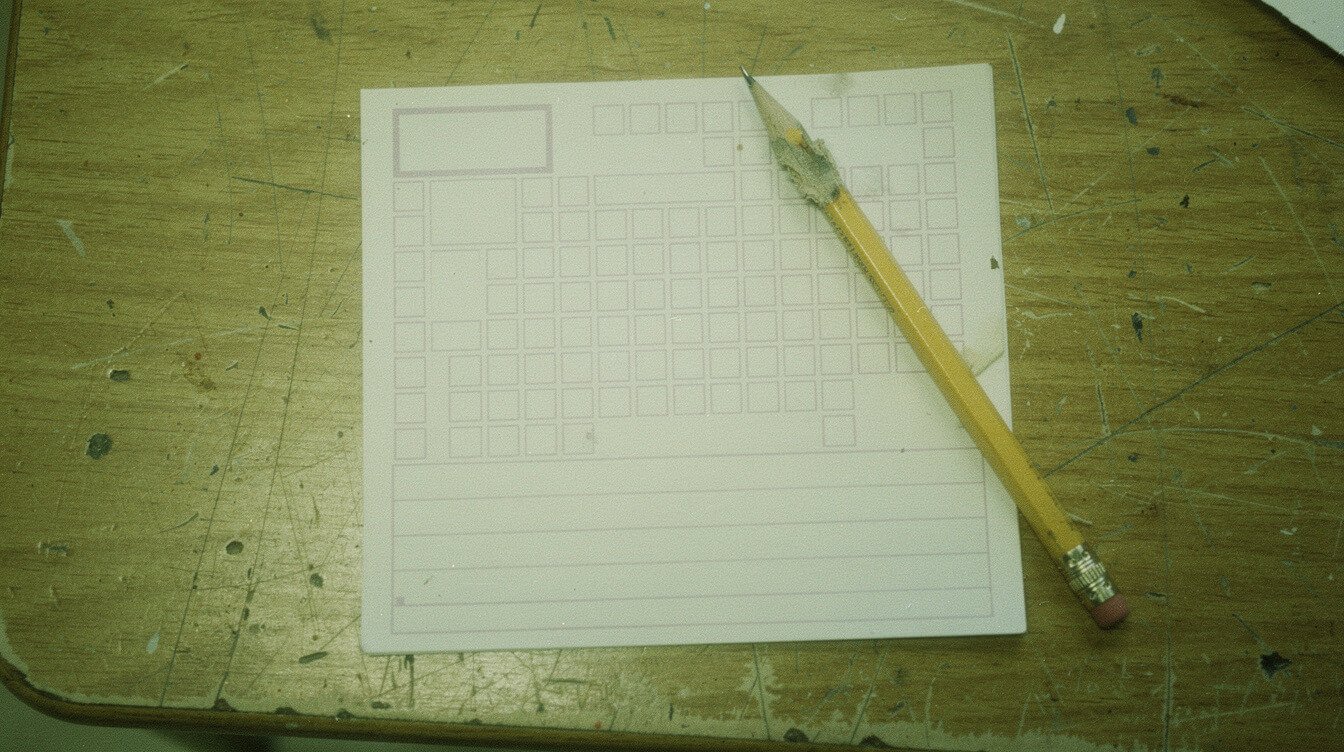
The slip came home weeks out. It was small, printed on the cheap, and it had squares on it. Some years the ink was that soft purple that came off on your fingers and smelled faintly of solvent. You were expected to fill it out, get money attached to it, and return it — three separate acts of executive function assigned to a nine-year-old with no calendar.
The first decision was the backdrop, and the backdrop was a real choice with real consequences. There was the plain one, in a blue or gray that had been mottled by someone whose job was mottling. There was the outdoor one, a soft-focus meadow or a split-rail fence in autumn, which implied you had been photographed somewhere pleasant rather than in a gym that smelled like floor wax. And in certain years there was the laser: a black field with colored beams shooting across it like the opening credits of a show about the future.
You were choosing this from a quarter-inch color swatch on a piece of newsprint. Nobody explained the implications. Nobody mentioned that the meadow would make your navy sweater disappear, or that the laser backdrop would date the photograph within eighteen months so precisely that a stranger could pin the year off a thumbnail. You picked the one that looked coolest on the slip, which is how most of us made most decisions, and you were held to it.
The second decision was the package, laid out in tiers with letters instead of names. Package A was the modest one. Package D had wallets, an 8×10, and something called a memory mate. The pricing was designed to make the middle option look like restraint, which it was not. Whichever one your parent circled was the one you got, and the circle happened at the kitchen table, at night, during a conversation you were not invited to.
There was also a deadline, and the deadline was enforced by a system with no reminders in it. No email went home. No app pinged anyone. The slip existed in exactly one copy, in your backpack, among the graded worksheets and the permission form you had also not handed in, and if it did not resurface in time you were photographed anyway — you just did not get to pick anything, and whatever the default package was is what arrived. Several of us found out about the default package the hard way.
Then you gave the slip to your teacher, and the whole thing went quiet for a month.
The comb was communal and nobody thought about it
On the morning itself, there was a line. There was always a line, because picture day ran by homeroom, and homeroom ran by whatever the office had decided at 7 a.m. You stood in a hallway in your good shirt, holding your place, for somewhere between four minutes and an entire period.
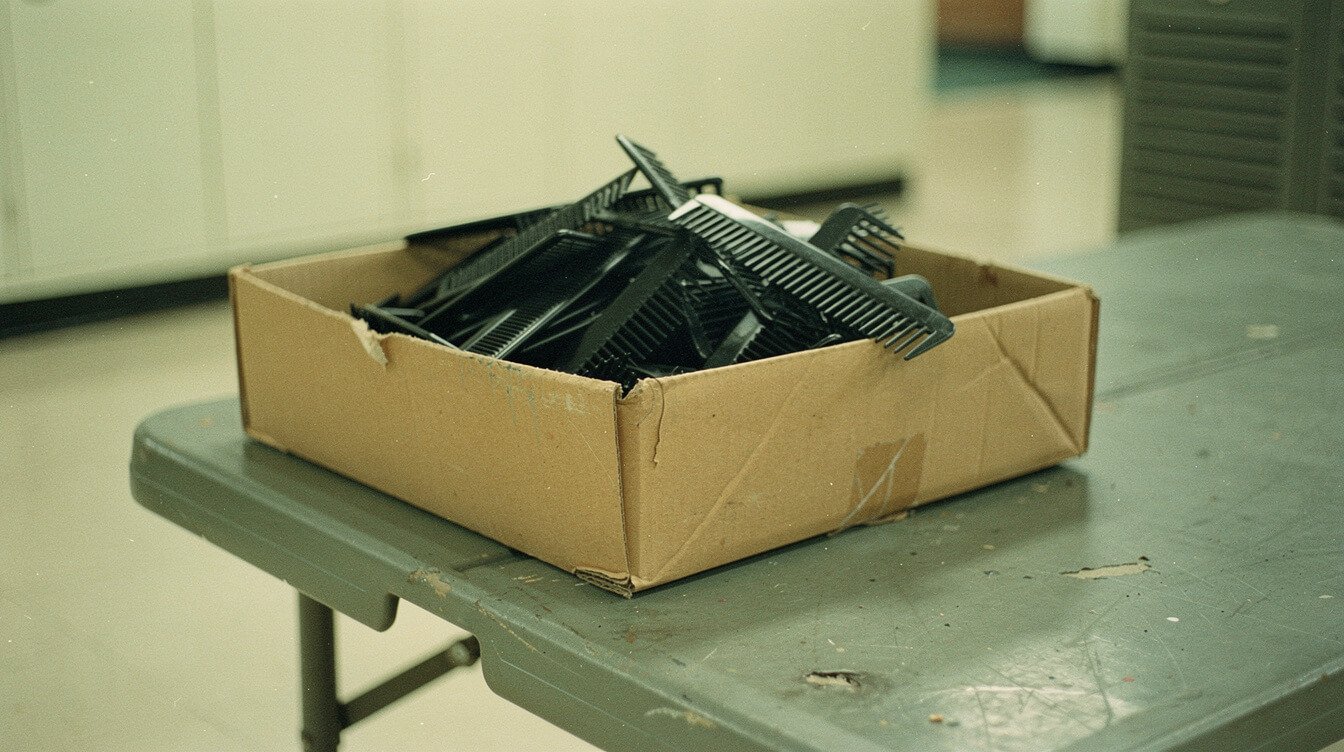
At the front of the line there was a table, and on the table there was a box, and in the box there were combs. Thin black plastic ones, the kind that snapped if you looked at them wrong. They were not individually wrapped. They had been used by an unknown number of children that morning and would be used by an unknown number after you, and an adult handed you one and said “fix your hair” and you did, and then you put it back.
Nobody flinched at this. Not the kids, not the teachers, not the parents who found out about it later, if they ever did. It belonged to the same category as drinking out of the garden hose and riding in the way-back with the tailgate window down: a thing that was simply done, evaluated by nobody, and survived by everyone present. If you want a single artifact that explains the characteristics that get attributed to this generation, it is a shared comb in a cardboard box next to a gym door.
The scheduling was its own quiet cruelty. Picture day did not reorganize the day around itself; it slotted into the day the day was already having. Which meant some homerooms went at 8:40, scrubbed and intact, and some went at 11:15, directly after gym, with the hair to prove it. Nobody built in a buffer. Nobody considered that a kid who had just run laps might want four minutes. You went when your class went, in whatever condition your morning had left you in, and that was the photograph.
The comb never helped. It redistributed your hair without improving it, and it did so ninety seconds before the only photograph of you that year. Some kids had been styled at home and arrived sealed, untouchable. The rest of us went in with whatever the hallway had done to us.
One take, and the photographer was on a schedule
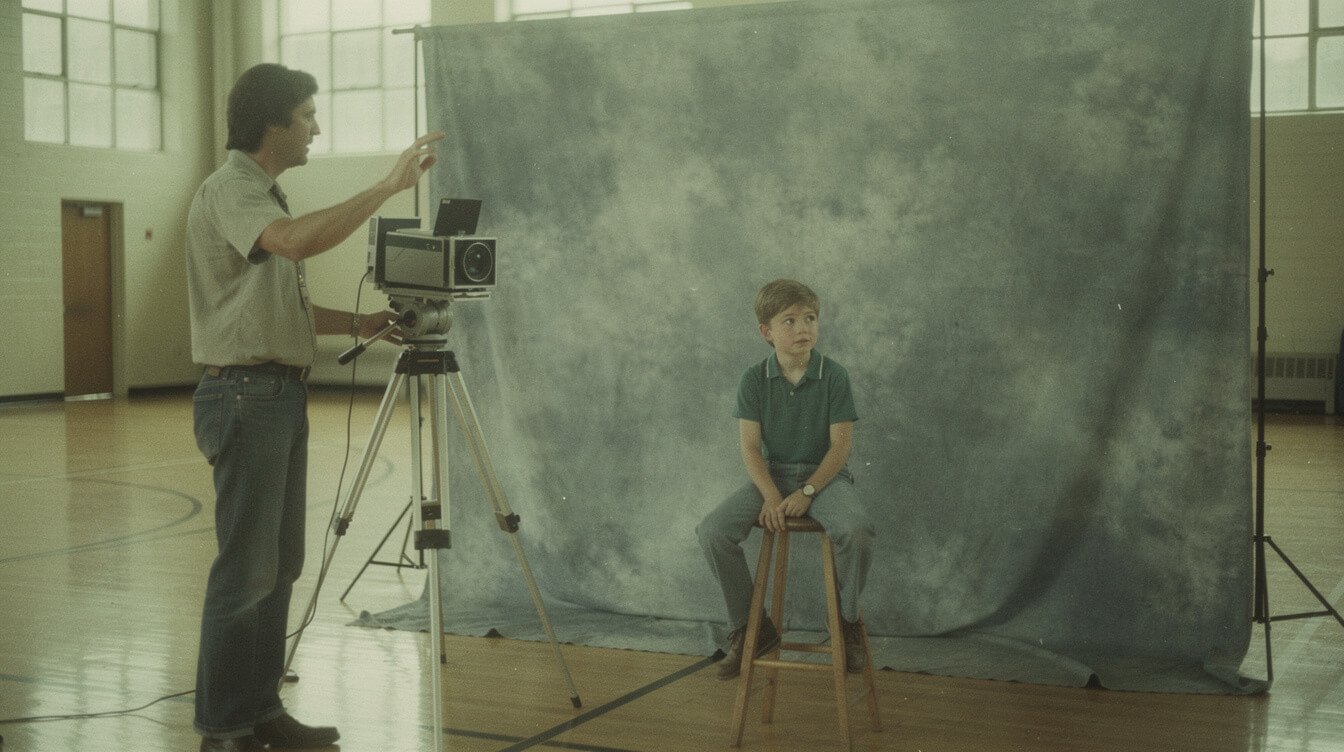
The photographer was not there for you. The photographer was there for roughly four hundred of you, in one day, with a bus to catch. This is the detail that reframes the entire memory: you were not having your portrait taken. You were being processed, and the operator was working against a clock.
The instructions came in a clipped shorthand that never varied. Sit. Knees that way, shoulders this way, chin. Hands in your lap. Not that much. The shoulder turn was non-negotiable and physically unnatural — no human being has ever sat that way voluntarily — and it was corrected by a stranger’s hand on your arm, moving you into position like furniture.
Then: one frame. Maybe two, if you blinked visibly and the photographer caught it and cared. There was no screen to check. There was no checking at all. The shutter went, the strobe went, and a person you would never see again said “next” while you were still resetting your face.
The flash itself was a genuine event — a strobe in an umbrella, at close range, in a room that was otherwise lit by whatever the gym had. It went off once and left a green rectangle floating in your vision for the next thirty seconds, which you took back to your seat with you. That afterimage is the closest thing to a preview anyone got.
You walked back to class with absolutely no information. You did not know whether your eyes were open. You did not know whether the smile you had rehearsed in the bathroom mirror had arrived on time or had turned into the other thing, the wide one with too much gum. That uncertainty had a six-week half-life, and it went into a drawer in the back of your head and stayed there.
Some kids solved this by refusing to smile at all. Look through enough photos from 1982 and you will find them: the flat stare, the closed mouth, the small deliberate withholding. That was not sullenness. That was the only editorial control available in the entire process, exercised by a twelve-year-old who had correctly identified that the one thing nobody could make you do was perform.
The sheet of wallets, and the relatives who got them
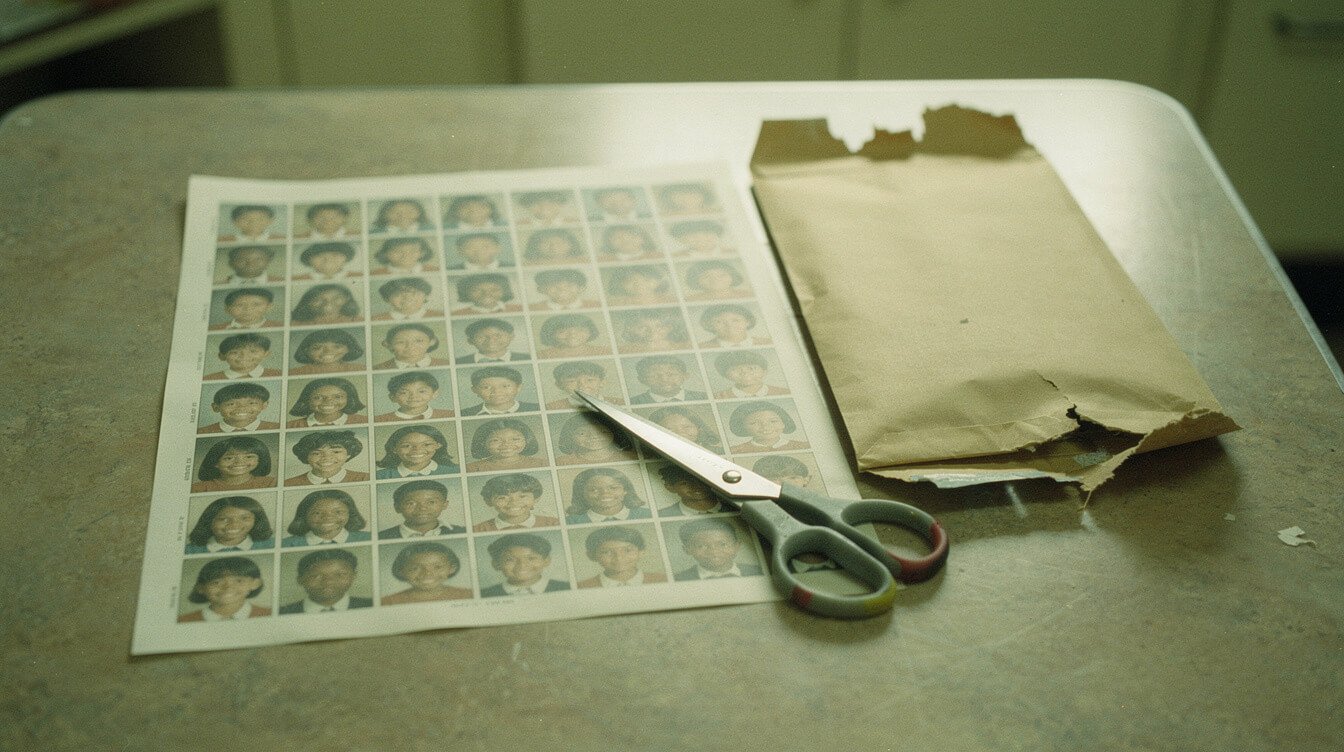
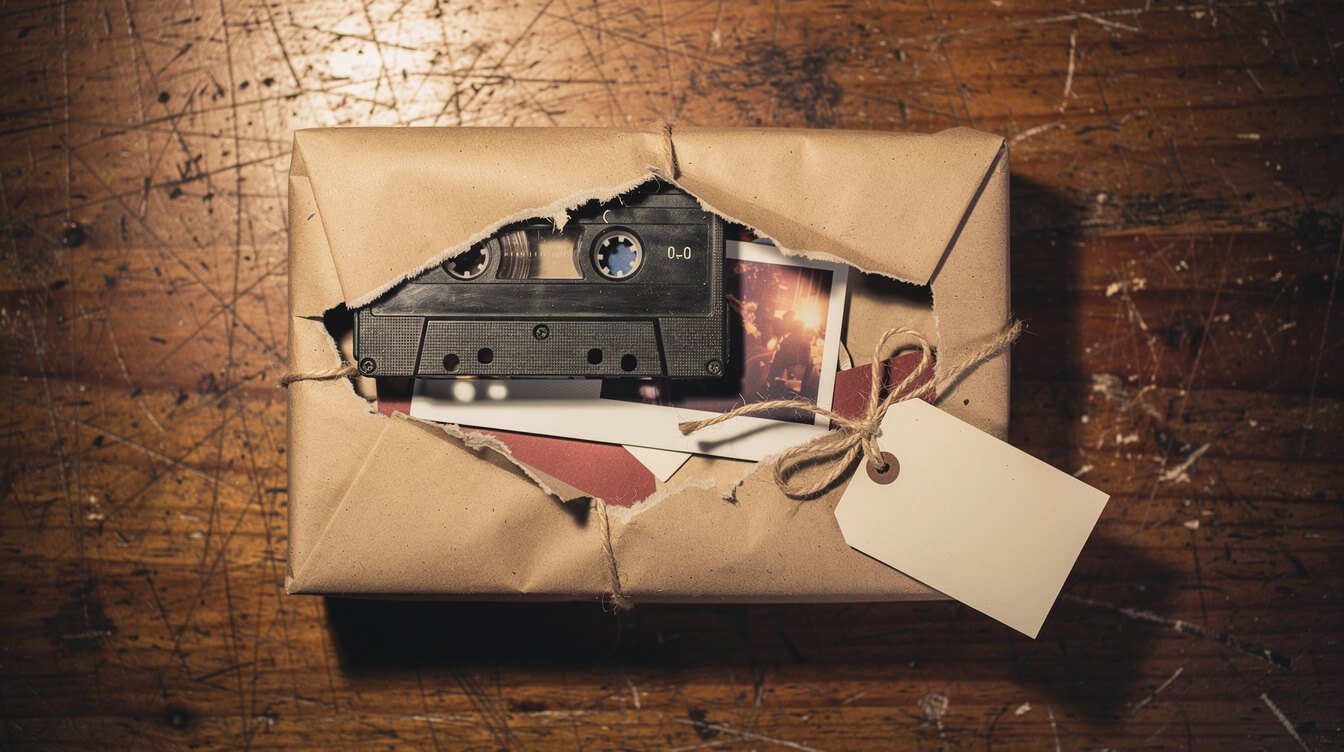
Weeks later, the packages arrived, and with them the strangest object in the whole system: the uncut sheet of wallets.
Thirty-two small identical versions of your head, printed on one piece of stiff paper with thin white guidelines between them, to be separated with household scissors by someone at the kitchen table who was not being careful. The cutting was always slightly off. There is not a Gen-Xer alive whose wallet photos did not have one crooked edge and a sliver of the neighboring copy still attached to it.
Then came distribution, and distribution had a hierarchy. Grandparents first, non-negotiable, two each. An aunt who would put it on the refrigerator. A great-aunt who would put it in a Bible. One went in your mother’s wallet behind the license, where it would stay, unreplaced, until roughly 1996.
And a handful — the good ones, the ones where you looked like yourself — got taken to school for trading, which is a ritual that sounds insane now and was completely normal then. You gave a small photograph of your face to a friend, and they gave you theirs, and you both wrote something on the back that was supposed to be funny. Half the kids who said they had forgotten theirs had not forgotten anything. They had seen the photo and made a decision.
The whole economy ran on a currency nobody controlled the supply of. You could not print more good ones. You got what the machine gave you, and you spent it carefully. It is the same instinct that shows up in how this generation learned to talk — the value was never in the object, it was in the delivery, and everyone understood the difference without being told. We put that instinct on a handful of shirts, which is roughly the extent of the sales pitch here.
The newsletter
Like a mixtape, but it shows up on its own
One email a week. The good posts, new designs, zero exclamation points. Unsubscribe whenever. We won't take it personally.
Finding out how you looked at the same time as everyone else
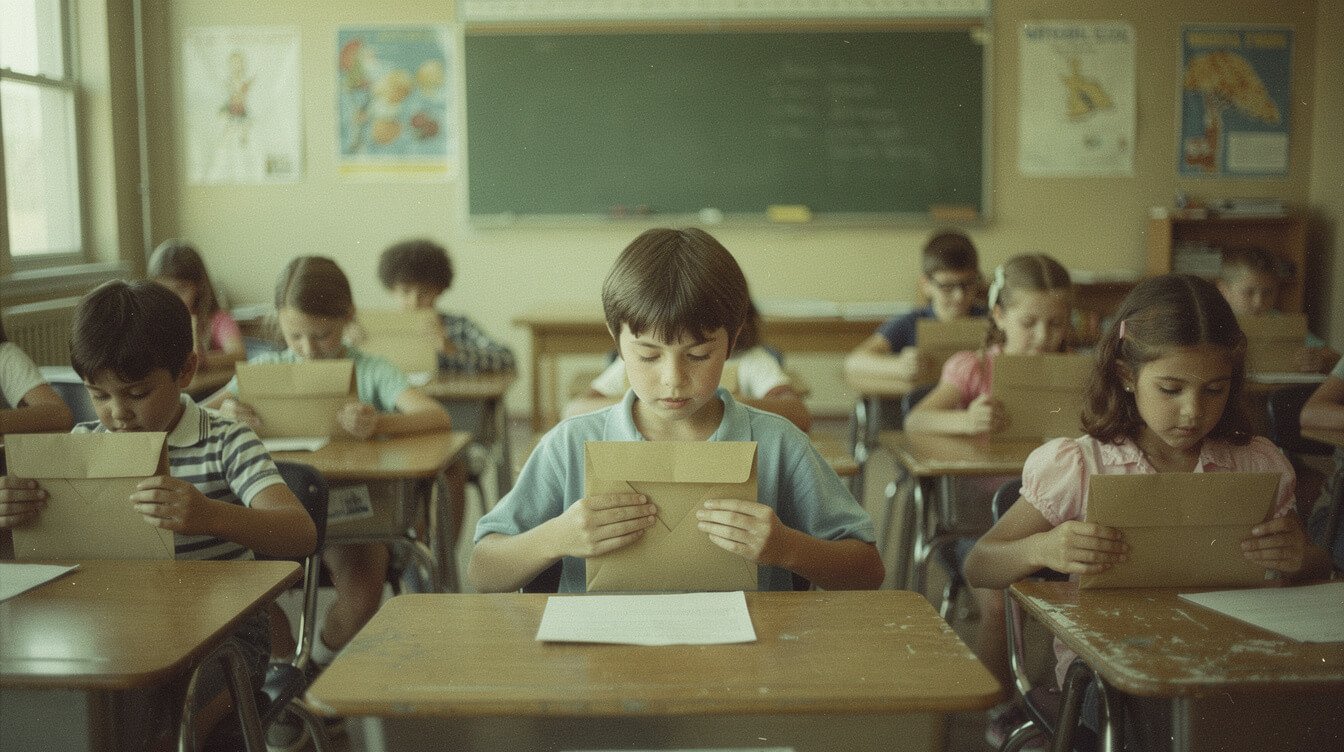
The envelopes came back to the classroom in a box, and the teacher read names off, and this is the part the galleries cannot capture, because it is not a photograph. It is a room.
You got a stiff cardboard envelope with a window in it, or sometimes a window that showed just enough, and you opened it at your desk, in public, surrounded by thirty people who were opening theirs at the same moment. You learned how you looked in a photograph at the exact instant that everyone you knew learned how you looked in a photograph. There was no private review. There was no trying again. The information was released to the entire population simultaneously, like a school-wide broadcast of your own face.
The reactions divided cleanly. Some kids held the envelope flat against their chest and would not show anyone, which of course guaranteed everyone saw it by lunch. Some kids went straight to comparison, holding theirs up against a friend’s to establish who had done worse. And a few opened theirs, looked at it for one second, and put it in their desk with no expression at all, which was the most Gen X response available and the one that aged the best.
Then you took it home in your backpack, where it got bent, and handed it to a parent who looked at it for longer than you were comfortable with and said something like “well, that’s you.”
Which it was. That was the ruling.
One take, no retakes, no notes
We make the stuff you would actually wear, for people who were there. No footnotes, no explaining.
The permanent record nobody asked you to approve
Here is where it stops being funny for about four sentences, and then goes back to being funny.
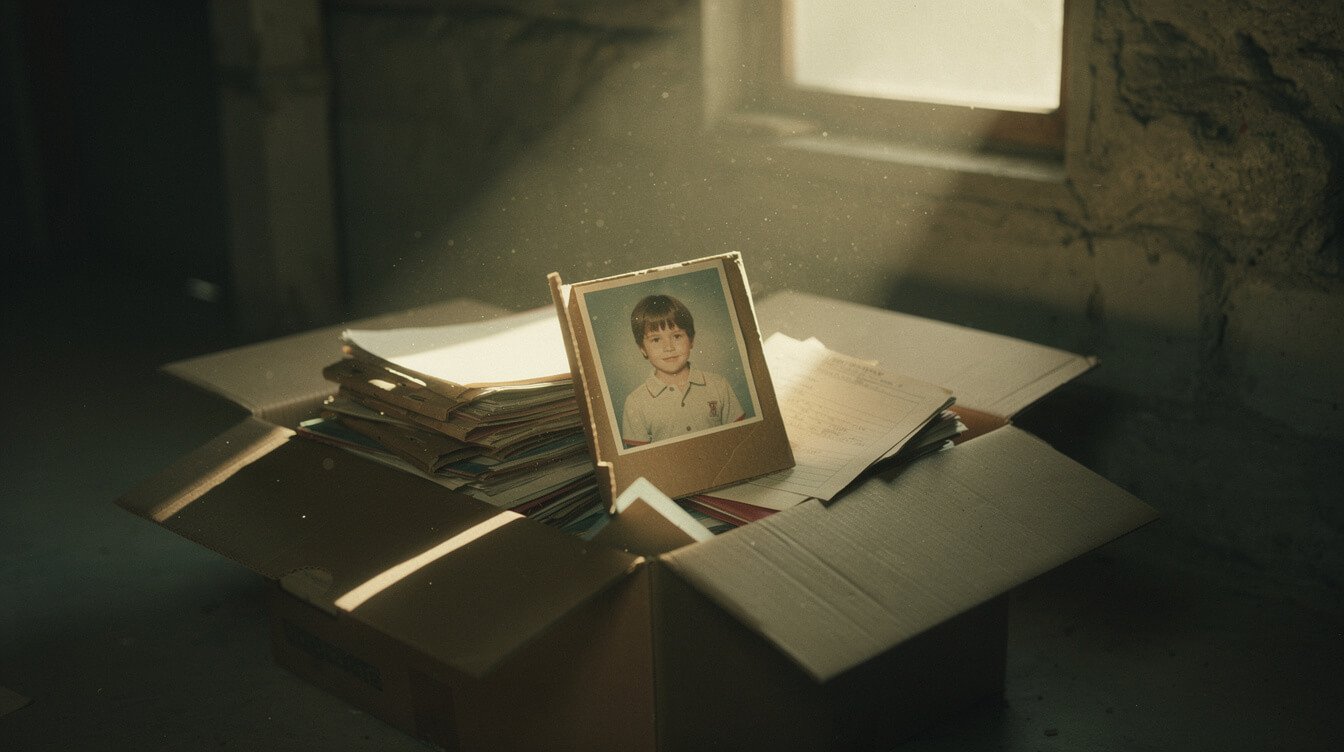
That photograph became the official record of that year of your life. It went in the yearbook. It went in the file. It went to the relatives, and it went into the album, and decades later it is the image that surfaces when anyone needs to know what you looked like when you were eleven. One frame, shot in under four seconds by a contractor on a schedule, with hallway hair and a shoulder turn you did not choose, is now load-bearing.
Nobody asked whether you approved it. The question did not exist as a concept. The idea that the subject of a photograph might have a say in whether it represented them was not withheld from us — it simply had not been invented yet in any practical form, and would not be until a camera and a screen ended up in the same object.
And the strange thing, the thing worth actually sitting with, is that this produced a more honest archive than anything that came after it. There was no selection. Nobody got to curate their own record. The photograph that survives from your sixth-grade year is not the best of forty attempts; it is the only one, and it shows a kid who had just been combed by a stranger and told to turn.
That is a more accurate document of being eleven than any version you would have chosen. We have written before about how this stuff is not a highlight reel, and school photos are the cleanest proof available. The archive is unflattering because it was never optimized. It was just taken.
School picture day nostalgia: the questions that still come up
Why does everyone remember the laser backdrop?
Because it was the only backdrop that announced itself. The mottled blue was furniture; the laser was a decision. It also dates a photo with near-forensic precision, which is why it is the one detail that reliably surfaces whenever a thread about this starts.
Did anyone actually get retakes?
Retake day existed, and it was real, and almost nobody used it for its intended purpose. It was for the kids who had been absent. Using it because you did not like your face required an act of self-advocacy that most of us did not possess and most of our parents would have found funny.
Why were the outfits like that?
Because the outfit was chosen the night before by a parent operating on limited information, or twenty minutes before by a kid operating on none. Some of us were sent in a sweater in October that was photographed as though it were August. The systems were not integrated.
Is school picture day nostalgia just embarrassment with better lighting?
Partly. But embarrassment fades and the structure does not. What holds up is the sheer number of small indignities the day required you to absorb without complaint — the line, the comb, the hand on your shoulder, the public unsealing — and the fact that nobody at the time considered any of it remarkable. That is not embarrassment. That is a shared operating environment.
Why do the articles about this always feel off?
Because most of them are written about the wrong decade, by someone reaching for a lesson. The version from the late seventies and eighties had no screen anywhere in it, no proof sheet, and no second chance, and that absence is the entire subject. Once a preview exists, it is a different day.
From the shop
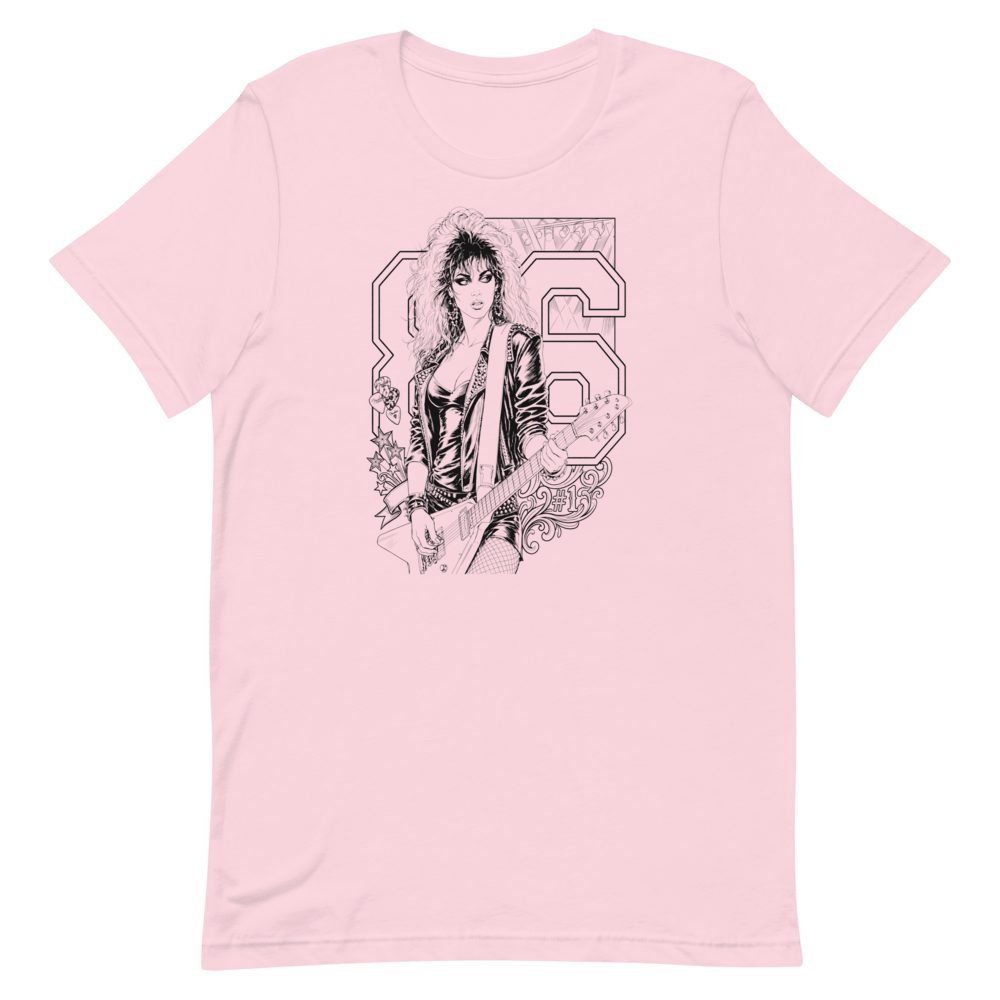
Susanna Hoffs Bedroom Eyes Fan Art T-Shirt | 1986 Tribute
Price range: $24.99 through $26.99
Shop this designWhat we actually kept
Most of the wallets are gone. They went into Bibles and refrigerator doors and wallets behind licenses, and they dispersed the way small paper things do. What is left is usually one bent cardboard folder in a box in a basement, and the box belongs to someone else now.
But the thing the day installed is still running. A generation learned, by direct repetition, that you get one take, that the result is not up to you, that you find out how it went at the same time as everyone else, and that the correct response is to put it in your desk and get on with the period. That is not a small lesson. It shows up later, in how we handle jobs and weather and bad news, and in why we are suspicious of anyone who needs eleven attempts to look natural.
You survived the comb. You survived the shoulder turn. Somewhere there is a photograph of you at eleven with your hair doing something inexplicable, and it is the official version, and nobody is going to change it now. The kids who let themselves into an empty house at 3:15 were not going to be rattled by a bad print.
No notes. Just the one take.
Before you go
You made it to the end. Respect.
Get the best of these in one short weekly email, plus whatever we just printed. No spam. We were raised better than that. Mostly.