Search 90s video games and the internet hands you a ranking. Twenty titles in order, a countdown video, a forum thread of favorites, every list completely sure of itself. They’re good lists. They’re also, almost without exception, written by somebody who was nine. The 90s video games they remember came wrapped for a birthday, got played on a TV in a wood-paneled den, and went back in the cabinet when the bus came.
That’s a real childhood. It just isn’t ours. Gen X spent the 90s somewhere between fifteen and thirty-four, and from where we were sitting, the most interesting thing about the decade’s games isn’t any title on any list. It’s that we didn’t quit. Every generation before us put the controller down around tenth grade, the way you put down a skateboard or a model kit. We got to the age where you were supposed to stop, looked around, and kept going. Slightly embarrassed. Mostly after dark.
So this isn’t a ranking. It’s the other 90s: the roommate couch, the office network after six, the free disc in the magazine, and the game hidden on the family computer between the spreadsheets.
Every 90s video games list is somebody’s childhood, and it isn’t ours
Read enough 90s video games lists and you can date the writer. The favorite is always the first console under the tree, the cartoon tie-in, the cartridge a cousin left behind. The memories come with a bedtime. That’s not wrong. It’s just a view from the carpet, and in the 90s most of Gen X had already moved up to the couch, and some of us were paying for the couch.
Here’s what the lists leave out. In September 1995, a new console that played games off discs went on sale in the US for $299. At a trade show that spring, one of the company’s executives had walked up to the microphone, said “Two ninety-nine,” and walked off to applause. That’s the whole speech. And $299 in 1995 wasn’t birthday money. It was a car payment. Nobody at a sales meeting thought a fourth grader was writing that check.
They weren’t. The machine’s early buyers skewed adult, and its marketing people had worked out something the rest of the industry hadn’t: the young adults who’d grown up on the previous generation of consoles felt ignored by ads aimed at kids and teenagers. They were right. We had been ignored. We were used to it. We bought the thing anyway, and then we bought a memory card, which was also not cheap, and a second controller, which was the real tell.
The rating that gave it away
A year earlier, in September 1994, the industry had set up a ratings board, after a round of congressional hearings in 1993 about what was showing up on home screens. Officially, the ratings were about keeping the rough stuff away from kids, which was fair. But you don’t print a rating for mature players on a box unless a lot of people old enough for it are buying the box. The rating was a census. It counted us.
And still, the culture hadn’t caught up. Video games were a kids’ thing, which meant an adult playing one was, at best, a guy who hadn’t finished growing up. So we played, and we didn’t bring it up. The console lived inside the entertainment center, behind a little door, and the door got closed when someone new came over. If anyone asked, it was for a nephew. There was no nephew.
That small embarrassment is the most Gen X thing about 90s video games. We weren’t going to stop doing something just because we were told it was for children. We just weren’t going to talk about it at work.
The couch had two controllers and a lease

The first thing a lot of us bought for a shared apartment wasn’t a second set of towels. It was a second controller. The towels could wait. The controller meant the game wasn’t one person’s hobby anymore. It was the household’s, which meant it needed rules, and for the first time in anybody’s life, there was no parent in the next room to make them.
When you were a kid, turns got settled by a mom yelling from the kitchen (the full sibling treaty is in our retro gaming piece). At twenty-three, nobody yelled. You had to legislate. Winner stays on. Loser does the dishes. Whoever bought the console gets the good controller, unless they lost the last three, in which case they forfeit it until Thursday. These rules were written down nowhere and enforced harder than the lease.
The split-screen grudge
Then the screens split. By the late 90s, a 27-inch TV could be carved into four quarters, one per person, and four adults would sit on a couch built for three, each leaning toward their own corner. Looking at somebody else’s quarter to see where they were hiding was a moral failing. People who’d happily cheat on their taxes would not tolerate it. A 1997 spy shooter in particular turned thousands of living rooms into a standing grudge that some friend groups are honestly still settling.
The grudges were the point. A Friday at home with four controllers cost nothing, while a Friday out cost a cover charge, two drinks, and parking. The math was simple and we were broke. Somebody brought chips. Somebody always picked the tiny character, and everyone complained, and nobody made a rule against it, because then you’d have to admit it was working.
And when the lease ended, there was the custody question. The console belonged to whoever paid for it. The third controller belonged to whoever was staying, unless the person leaving had bought it, in which case there were negotiations. Some friendships made it through that conversation. Most of them did, really. It’s just that everyone remembers who kept the good one.
After six, the office network was ours

Meanwhile, a lot of us had first jobs in offices full of beige computers that, for the first time, were all wired to each other. During the day, the network moved spreadsheets and memos. After six, when the boss had gone home and the hallway lights clicked off on their timer, it moved something else.
The before-hours version was quieter. The card game that came with the computer got played one-handed, with the other hand resting near the key that would make it disappear. Some games actually shipped with a boss key: one press and the screen swapped to a fake spreadsheet. Somebody designed that feature. Somebody knew exactly who was playing, and where, and what time it was.
The night it broke a campus
The after-hours version got loud. At midnight on December 10, 1993, a small Texas studio uploaded the first episode of its new shooter to a university server, free, with the rest of the game for sale. So many people tried to download it at once that the university’s network went down. Within hours, college networks were banning multiplayer games of it outright, because packets from four-player matches were clogging systems that people needed for actual work. The studio put out a fix for the congestion the next morning.
Offices took a little longer to notice, mostly because the people who ran offices had gone home. Somebody in IT set it up, which is why the guy in IT was always the best player. Four people at four desks, sound off or headphones on, swearing across the cubicle walls in a way they’d never swear in a meeting. The cleaning crew came through with the vacuum and didn’t ask. The next morning the network was slow and the report was late, and everybody involved was weirdly well rested.
That’s where the adult version of 90s video games really lived: not on a bedroom carpet, but on equipment that technically belonged to a company with a dress code. It was the same instinct we’d had at twelve, only now with a parking pass and a dental plan.
The disc that came free with a magazine
Here’s the part nobody under forty believes: you usually played a game before you bought it, and you usually played only a sliver of it. We were the first generation to have a job and still not have enough money for games, so we sampled.
The first sampler was a floppy. Shareware put the first chunk of a game out for free, and you could copy it and hand it to a friend, which was the whole idea. If you liked it, you mailed a check and got the rest. That 1993 shooter is the famous case. Its makers figured only about one percent of the people who played the free episode would ever buy the full game, and one percent was still enough to make it a hit. The other ninety-nine percent of us played the free episode until we could do it blindfolded, and then started it again on a harder setting, for reasons we couldn’t fully explain.
One level, forty times
By the mid-90s, some magazines came with a disc, and the disc was the reason you bought the magazine. Five demos, a couple of videos, a level from something that wouldn’t come out until spring. You knew that one level better than any full game you owned. You knew where every enemy stood. You learned exactly how much of the map they’d let you see before an invisible wall stopped you. Then the screen thanked you for playing and told you where to buy it, and you went back to the start.
The arcade had been the original demo, one quarter at a time, and that room is its own story. The other way to try before you bought was the rental counter, which had its own rules and its own late fees (we’ve walked that aisle already). And by the end of the decade you could download a demo yourself, if you had an afternoon and nobody needed the phone line.
There’s something to be said for knowing one level that well. Modern games show you everything up front, and that’s fine. But there’s a type of player who still spends twenty minutes on the first room of anything new, checking every corner. That player had a magazine disc. They just never mention it.
The newsletter
Like a mixtape, but it shows up on its own
One email a week. The good posts, new designs, zero exclamation points. Unsubscribe whenever. We won't take it personally.
The game on the family computer

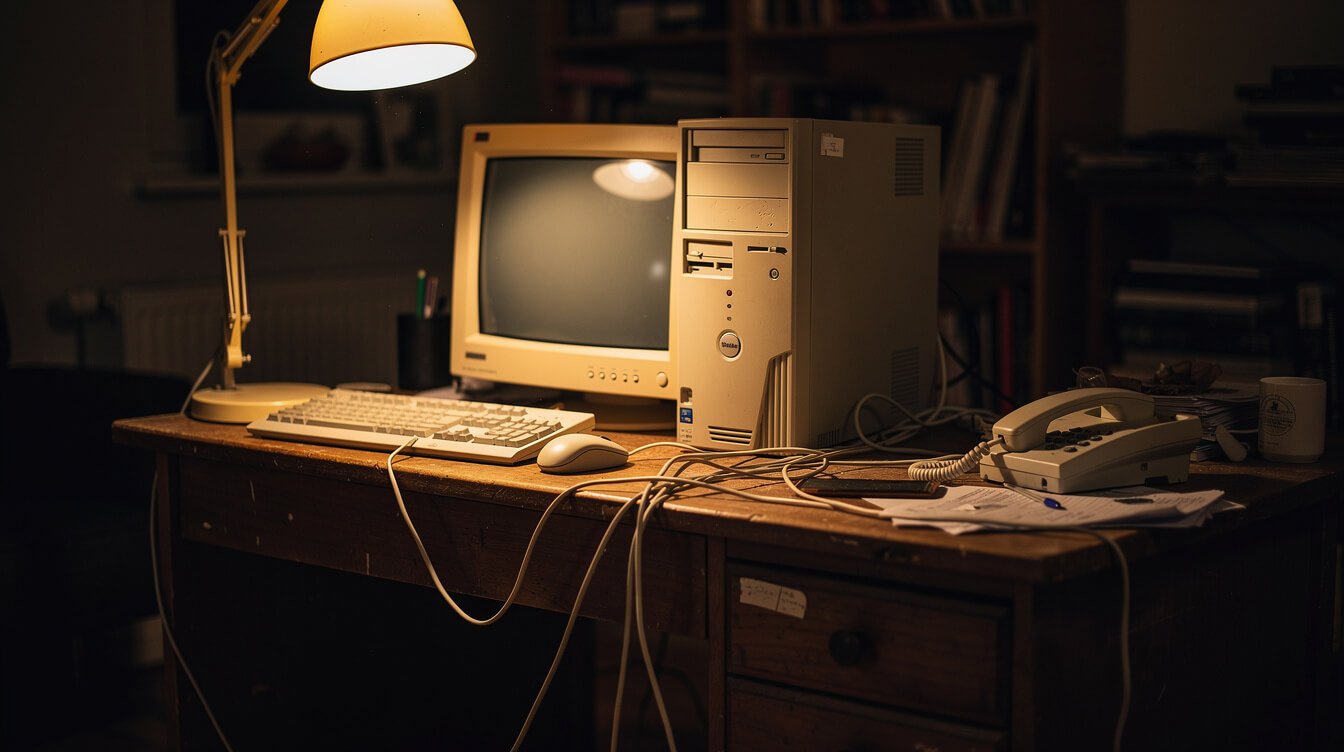
Then there was the family computer, which was never bought for games. It was bought for homework, for the household budget, and for the vague feeling that a family in the 90s ought to own one. Games got on it anyway. They lived in a folder with a dull name, next to the spreadsheets, where a parent wouldn’t click.
Getting a PC game to run in the early 90s was its own game. The machine had plenty of memory on paper, but a game needed most of the first 640K of it, and the computer had already filled that up with drivers for things nobody in the house used. So you made a boot disk: a floppy that started the computer with nothing loaded but the mouse driver and maybe the sound card, freeing up just enough room. You put it in the drive, restarted, and if the stars aligned, the game launched. If they didn’t, you spent the evening editing two startup files you didn’t fully understand, one line at a time.
The household help desk
Learn to do that once and you were the house’s tech support, permanently. Parents who couldn’t program the VCR now asked you why the printer had stopped. That job never ended. Ask any Gen Xer who still gets the call when a parent’s tablet “deleted everything.” It started with a boot disk in about 1992. (It’s on the list of Gen X characteristics no survey ever gets right, under competence nobody asked for.)
Every spring, you got thrown off. The family computer had one job in April, and the job was the taxes, and your save file could wait. You learned to play in short sessions and to save every chance you got, because at any moment a parent could appear in the doorway holding a shoebox of receipts.
The twist is that a lot of Gen X did this from both sides of the desk. You were the teenager sneaking a game onto your parents’ machine in 1992. By 1999, you were the adult who’d bought the machine, sitting next to your own kid and showing them how to save, and recognizing the posture. Same hunch, same glow, same small voice saying “five more minutes.” That’s also roughly why the shop doesn’t print title screens. The part you remember was never the title screen.
Never put it down
For the one who still owns the second controller and has opinions about who gets it. No mascot, no title screen, nothing that needs a manual.
90s video games: quick answers

The questions people actually type, answered without a countdown.
What gaming system was popular in the 90s?
It depends on the year, and on whether you’re asking a kid or a twenty-five-year-old. The early 90s belonged to the 16-bit rivalry between two cartridge consoles, along with a playground argument about which one was faster. The handheld with the green-tinted screen, launched in 1989, went everywhere a kid did. From September 1995, the disc console that launched at $299 took over and became the decade’s best seller, with an audience that started out older than anyone expected. Late in the decade, the cartridge holdout with four controller ports owned the couch. And the PC, which was mostly bought for other reasons, quietly ran more games than anyone admitted.
What video games existed in 1992?
Plenty. Arcades were in the middle of a fighting-game boom, and home consoles were running the 16-bit platformers and sports games that fill most 90s video games lists. On PCs, point-and-click adventures and early strategy games were big, and the first-person shooter had just shown up. CD-ROM drives were starting to appear, but most games still came on a stack of floppies, and installing one meant feeding disks to the computer for twenty minutes.
Were 90s video games for kids or adults?
Both, which is the point. The industry’s own ratings board, set up in September 1994, created a category for mature players. That only makes sense if mature players are buying. Kids got the lunchbox version of the decade. Adults got the after-hours version, with a little less marketing and a lot more network traffic.
What did people do before they could look up a game online?
For most of the 90s, the same thing kids did in the 80s, but with better sources: magazines, a friend who’d finished it, and calling around. We wrote up how that whole information network worked in 80s video games. By the late 90s, text walkthroughs started circulating online, which ended a lot of arguments and started some new ones.
Is it weird to still play video games in your 50s?
We’re the first generation to find out, so we get to decide. So far, the answer is no, though your back will have notes about the couch. The same people who hid the console behind the cabinet door now play on their phones in the dentist’s waiting room, and nobody asks about the nephew.

From the shop
Huey Lewis I Wanna New Drug Fan Art T-Shirt
Price range: $24.99 through $26.99
Shop this designFinal thoughts: nobody told us to stop, so we didn’t
Every list of 90s video games is a list of titles, and that’s fine. Titles are easy to rank and easy to argue about. But if you spent the decade as a young adult, the titles aren’t really what you remember. You remember the second controller you bought before the towels, the rule about the dishes, the office after six with the vacuum running, the one demo level you could play in your sleep, and the boot disk with your handwriting on the label.
Nobody gave Gen X permission to keep playing. No one sent a memo saying games were fine for grown-ups now, and no one was marketing to us until a company noticed we’d been buying the whole time. We just didn’t stop, mostly because no one stopped us, which has more or less been the story of this generation from the start. If any of this sounds like your 90s, there’s more in why 90s nostalgia isn’t really pitched at us, and in the 90s stuff we were the ones paying for.
There’s still a second controller in a drawer somewhere. You know which drawer.
Before you go
You made it to the end. Respect.
Get the best of these in one short weekly email, plus whatever we just printed. No spam. We were raised better than that. Mostly.