The 80s mall had no clocks. That wasn’t an oversight. It was a decision, made by people who had run the numbers on exactly how long you would stay in a building where you couldn’t tell it was getting dark.
We stayed anyway. Four hours minimum, on about eleven dollars, inside a machine engineered down to the floor tile to separate us from money we did not have.
Here’s the part the photo galleries leave out: the 80s mall was never built for us. It was built to move inventory, it was financed by a quirk in the tax code, and it was designed by a man who spent his last years trying to get his name off the whole idea. We showed up anyway and turned it into the only unsupervised country we ever got.
What follows is how the machine actually worked, and how thoroughly we used it wrong.
The 80s mall was designed to get you lost
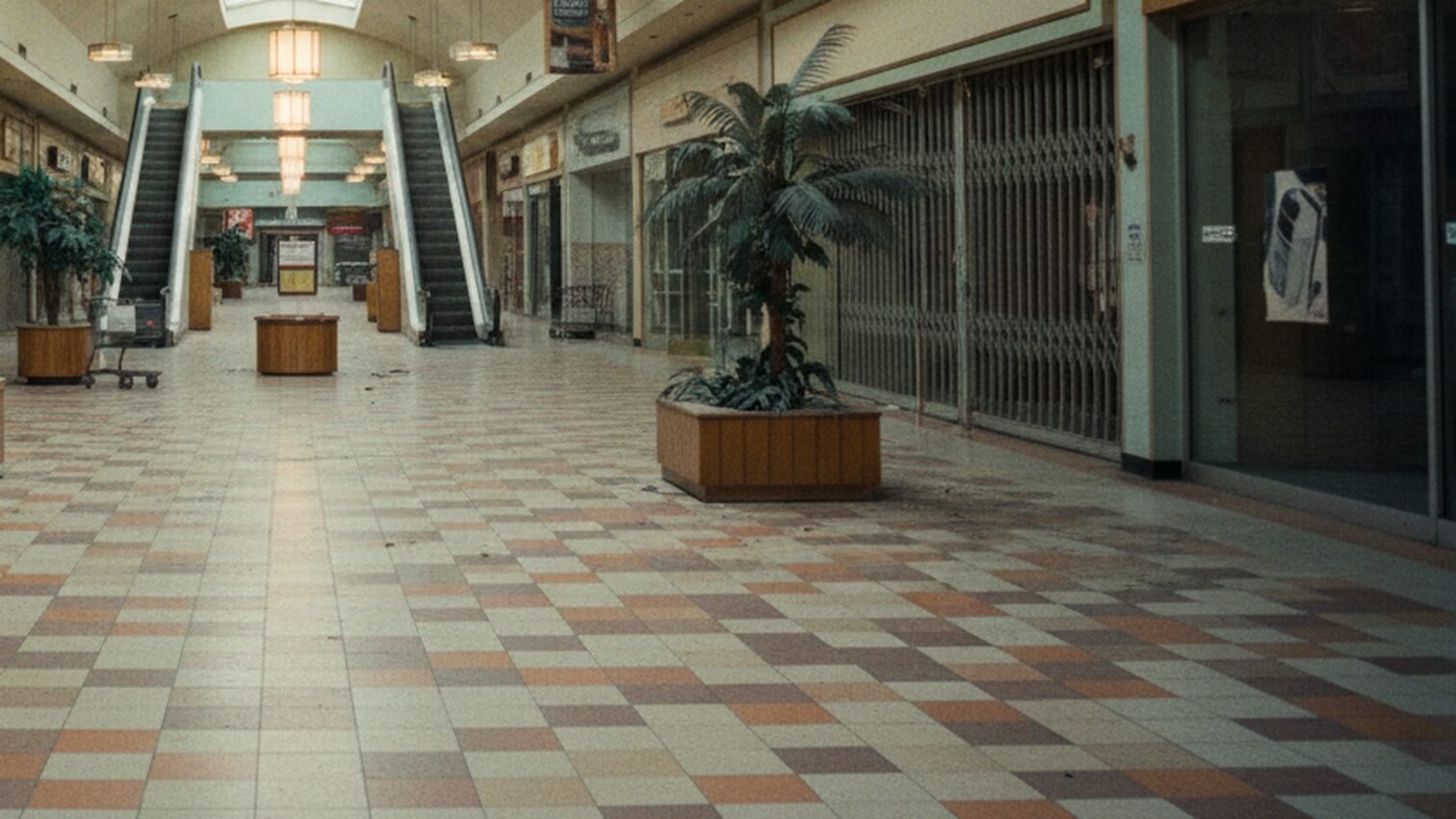
Start with what isn’t there. No clocks. No windows along the concourse — the only daylight came through skylights, which are useless for telling time and excellent for making 4:45 in February feel like the middle of the afternoon. The temperature sat around seventy degrees in January and around seventy degrees in July, which is why walking in from the parking lot felt less like entering a store and more like being let in somewhere.
None of that was decoration. The enclosed mall was an instrument, and every part of it had a job.
The big one was the floor plan. Put the two department stores at opposite ends of the building, as far apart as the site allows. Anyone walking from one to the other has to cover the entire length of the mall and pass every small tenant in it. Those small tenants paid a premium for the privilege of standing in that current. The anchors, in exchange, often paid remarkably little — some were handed their land on terms that look, in hindsight, like a bribe. They weren’t really tenants. They were bait, installed at both ends.
Then there’s the drift, which has a name. It’s called the Gruen transfer, after the architect who drew the first enclosed one, and it describes the exact moment a purposeful walk turns aimless — when you came in for one specific thing, lost the thread, and started browsing. The wide sightlines, the repeating storefronts, the total absence of any outside reference point, the fountain sitting precisely where a person’s legs start to complain: all of it exists to manufacture that moment and then stretch it out.
It worked, too. It worked on our mothers and it worked on us, except we were running a version of it nobody had budgeted for. We arrived with no purpose to lose. We were pre-drifted. The building’s entire persuasive apparatus — the lighting, the sightlines, the seventy degrees, the strategically exhausting distances — was engineered to convert intent into impulse, and we walked in carrying no intent whatsoever, just a bus schedule and a five-dollar bill.
So the 80s mall spent an enormous amount of money disorienting people who had somewhere to be. We had nowhere to be. We were immune to the building’s main effect and completely dependent on the building regardless.
There was a mall in your town because of a tax break
Ask why the mall existed and the intuitive answer is demand — the suburbs filled up, people needed somewhere to shop, developers obliged. That’s tidy and it’s mostly wrong. The real answer is duller and considerably funnier: a change to the federal tax code in 1954.
Before that, a commercial building depreciated on a straight line — a steady, boring deduction spread evenly across decades. The Internal Revenue Code of 1954 introduced accelerated depreciation, which let an owner take enormous paper losses in a new building’s earliest years. Those paper losses could wipe out the real rental income the building was generating. A profitable property could, on the return, lose money for years.
That turned new commercial construction into a tax shelter, and the provision applied to putting up something new rather than to fixing up something old. So capital that might once have gone into repairing a downtown went to the edge of town instead, where the dirt was cheap and the building could be brand new. The historian Thomas Hanchett traced all of this in the American Historical Review in 1996, and the result is not subtle: by 1970, roughly fifteen years later, the country had over ten thousand shopping centers.
Nobody polled us about this. Nobody polled anybody. The mall in your town was, in a fairly literal sense, a depreciation schedule that happened to have a fountain in the middle of it.
Which means the physical center of an entire generation’s social life — the place we learned to talk to each other, loiter, flirt badly, and be bored in company — was a side effect. We spent our formative Saturdays inside a financial instrument and thought we’d found a hangout. Every 80s mall in America traces back to the same few paragraphs of tax law.
The drop-off: how an 80s mall Saturday actually ran
The logistics are the part that sounds invented now.
You got dropped off. Noon, generally. The car pulled up at a specific set of doors — not “the mall,” a specific entrance, agreed on in the driveway before you left, because that agreement was the entire communications infrastructure for the next five hours. Pickup was at five, same doors.
There was no amending it. Nothing in your pocket could reach anybody. If the plan changed, it didn’t. If your ride ran late you stood by the doors in the cold and waited, because leaving the agreed spot was how people got genuinely lost. If you ran late, you heard about it for the entire drive home, and then again at dinner.
A payphone existed, somewhere near the restrooms. Using it required a quarter you probably needed for something else and a phone number you knew by heart, and calling home mid-afternoon was a public admission that something had gone wrong. It was a fire alarm, not a feature.
What made the whole arrangement work — the reason a reasonable adult would hand a thirteen-year-old five unaccompanied hours in a commercial building — is that the mall was indoors, warm, enclosed, patrolled by a man in a uniform, and completely free. Nobody had to drive anybody anywhere until five. In a decade when both parents worked, after-school programs were thin, and the scheduled playdate had not yet been invented, that was a staggering amount of solved problem for zero dollars.
That’s the latchkey arithmetic, and the 80s mall sat right in the middle of it. We were the generation that got handed a key, an empty house, and a general expectation that we’d sort the afternoon out ourselves. Mostly we did. The same instinct shows up everywhere you look at what that generation made without instructions — including, as it happens, the unwritten rules of the mixtape, which nobody taught anybody either.
The unwritten rules of the loop
Every 80s mall ran on the same unwritten code, and nobody anywhere had ever posted a word of it. Nobody needed to.
You did the loop. The full circuit of the concourse, both levels if the building had two, at a pace slow enough to see everything and brisk enough to suggest you were headed somewhere specific. Direction mattered. Reversing direction in the middle of a loop was a statement, and everybody read it correctly.
You had a spot. It got established once, early, by nobody in particular, and was never discussed again or relocated. If you arrived and your people weren’t there, you went to the spot and waited, and that was the whole system, and the system never failed because there was no alternative to it.
The food court ran on a rule the mall itself had never agreed to: one order bought a table for as long as you wanted it. Four people, one drink, two hours. A soft pretzel could hold a booth through an entire afternoon. Nobody working there cared enough to test it, and we understood exactly how far the arrangement could be pushed, which was remarkably far.
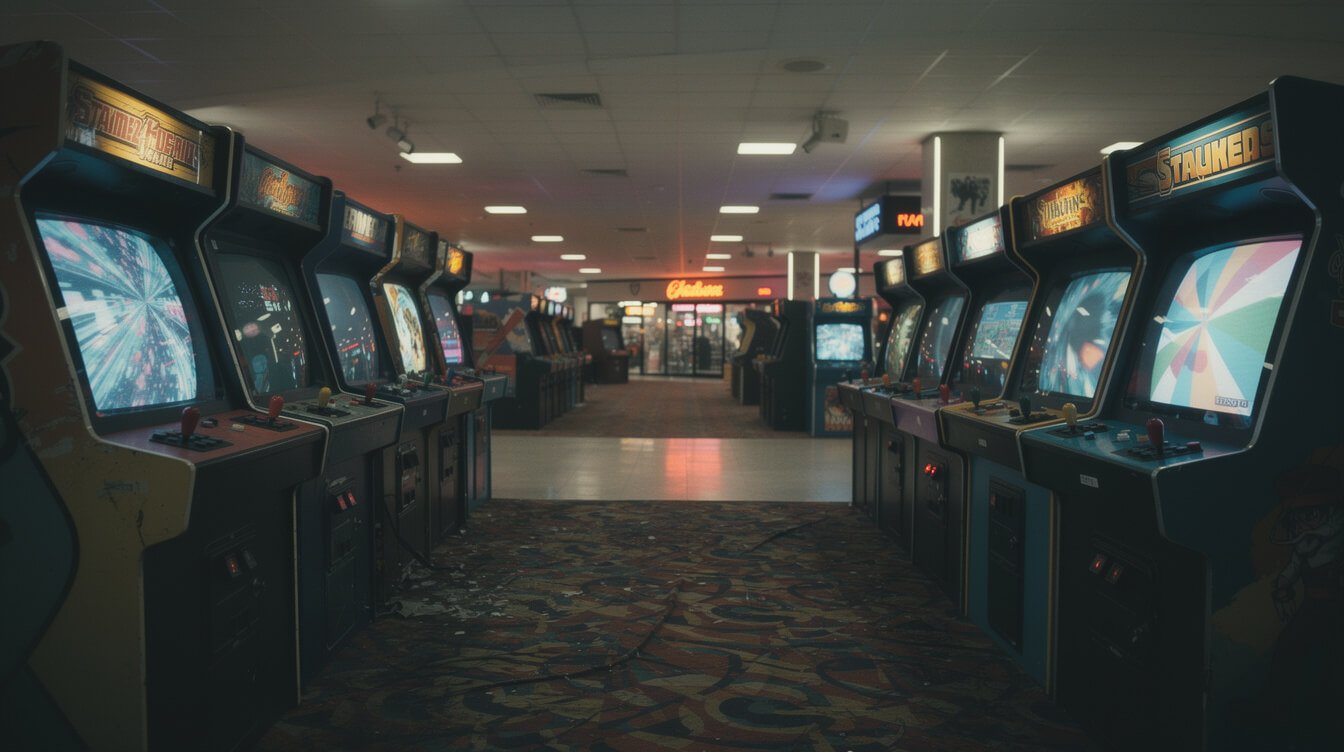
The arcade was the clubhouse, and its great virtue was that watching counted. You could stand behind somebody’s shoulder for forty minutes without putting in a quarter and be fully, legitimately present. The record store had a listening station with no obligation attached to it. The poster shop had a back section, and lingering in it was its own kind of statement.
And there was always one store you walked past slightly more often than the loop strictly required, because somebody worked there. This was never discussed. Everyone knew. Nobody said it out loud, then or since.
Then there was security. The guard was the only enforcement mechanism in the building, and the encounter was pure theater on both sides: he told you to move along, you moved along about thirty feet, he continued his rounds, and the whole arrangement reset. Neither party believed anything had occurred. He had a radio and no real authority; we had nowhere else to be and knew it.
If you’ve read this far nodding along at rules nobody ever wrote down, that instinct — landing a reference exactly rather than approximately — is the entire premise behind the things we print. No footnote attached.
Commercially, meanwhile, we were a catastrophe. Malls measure themselves in sales per square foot, and against that number a teenager holding one drink for two hours is a rounding error with a haircut. We bought a pretzel, an orange drink, a cassette a month if the allowance held, and otherwise we bought nothing at all.
But a concourse full of teenagers photographs as a thriving mall. An empty concourse photographs as a hallway. We were unpaid extras in somebody’s leasing brochure, generating the exact atmosphere that made the building feel worth visiting, and generating almost no revenue while we did it. The place needed us in the wide shot and resented us at the register, and both of those things were true every single Saturday.
The man who invented the mall spent his last years disowning it
Victor Gruen was a Viennese architect and a committed socialist who fled the Nazis in 1938 and turned up in New York with almost nothing. This is not the biography anyone expects to find at the bottom of the American shopping mall, and yet.
His idea for the enclosed shopping center was not, at the start, a retail idea at all. It was a civic one. American suburbs were going up at tremendous speed with no center to them — no square, no plaza, nowhere to simply be that wasn’t a private house or a car. Gruen’s proposals included apartments, schools, medical offices, and a library. The shops were meant to pay for the rest of it. He was trying to build a town center and using retail as the funding mechanism.
The first fully enclosed one opened in Edina, Minnesota, in October 1956 — climate controlled, two levels, a garden court in the middle with a skylight over it. It succeeded immediately, and what got copied across the country was the profitable half. Developers kept the retail box and the parking, and quietly declined to build the schools, the housing, and the library.
By 1978, giving a talk in London, Gruen had had enough of being credited. “I refuse to pay alimony for those bastard developments,” he said, and formally disclaimed paternity of the shopping mall once and for all. He went back to Vienna and died in 1980.
Here’s what he appears to have missed, though.
The civic thing he wanted did happen. Not on any plan, not on any developer’s schedule, and not to anyone’s financial benefit — but it happened. It happened at the fountain and in the food court and on the loop, every Saturday, free of charge, conducted almost entirely by people too young to buy anything worth counting. The town square Gruen couldn’t get financed got built anyway, by teenagers, inside the retail box, without asking.
The operators noticed. Through the 90s came the curfews, the parental escort policies, the ordinances — a sustained effort to keep the atmosphere while removing the people generating it, which is to say the exact thing that made an 80s mall feel alive on a Saturday. It went about as well as that always goes.
Then the whole category went the way it had arrived: as a financial instrument. The enclosed mall peaked in the early 1990s at roughly 1,500 of them nationwide and is down to something like 700 now. It’s convenient to blame the internet, and the internet certainly helped, but malls were closing on the same arithmetic that opened them. When the depreciation ran out and the anchors stopped paying, the math simply stopped working, and the math was always the point.
We make the ones you’d actually wear
Designs for people who were there, printed on blanks worth keeping. No explanation included, because none is required.
80s mall questions people still ask
What was the first enclosed shopping mall?
Southdale Center in Edina, Minnesota, which opened in October 1956. It was designed by Victor Gruen and was the first fully enclosed, climate-controlled, two-level regional shopping center — the template every 80s mall in the country was working from, whether its developers knew it or not.
What is the Gruen transfer?
It’s the moment a shopper stops walking with a purpose and starts drifting — the switch from “I came here for one thing” to “I’ll just have a look around.” It’s named after Gruen because his layouts produced the effect so reliably, though he disliked the association intensely. The wide sightlines, the missing clocks and windows, and the deliberately long walk between anchor stores are all in service of it.
Why were so many malls built in the 70s and 80s?
Largely because of accelerated depreciation, introduced in the Internal Revenue Code of 1954. It let developers take huge early paper losses on new construction, which turned new suburban building into an effective tax shelter — and because it applied to new construction rather than renovation, it pushed capital out of existing downtowns and onto cheap land at the edge of town. The country went from a handful of shopping centers to more than ten thousand by 1970.
Why did teenagers hang out at the 80s mall so much?
Because it was indoors, heated, free, supervised in the loosest possible sense, and reachable by a parent’s car or a bus. For a generation where both parents typically worked and organized after-school activities were scarce, it was the only place you could be dropped off for five hours at no cost and no scheduling burden to anyone.
How many enclosed malls are left in the US?
Around 700, down from a peak of roughly 1,500 in the early 1990s. Essentially no new conventional enclosed malls have been built in the US since about 2007. Plenty of the survivors have been converted into offices, apartments, medical centers, or distribution space — which, depending on how you look at it, is either a sad ending or Gruen finally getting the mixed-use development he originally asked for.
Final thoughts: nobody told us it was rented
We genuinely thought the place was ours. It wasn’t, obviously. It was leased, insured, patrolled, and depreciated on a schedule drawn up before most of us were born. Every hour we spent at the fountain was somebody’s line item, and if the line item had ever been examined closely we’d have been the first expense cut.
And the 80s mall was still the best public space anyone ever handed us, which says considerably less about the mall than it does about what else was on offer.
The strange part isn’t that it’s mostly gone. Buildings go. Retail moves. Nobody sensible is arguing that the correct home for American civic life was a leased box off the interstate with a food court in it.
The strange part is that the thing worth missing was never for sale in there in the first place. Not the stores, not the pretzels, not the posters. What holds up about the 80s mall is five unsupervised hours, a building that stayed warm, a meeting spot nobody had to confirm, and absolutely no way for anyone to reach us until five o’clock.
You can’t buy that back. You can, at most, catch it on somebody’s face when it comes up — the quick flicker of oh, you too. Which was always the actual transaction, and it never once required a receipt.
One email. No confetti.
New designs, the occasional piece like this one, and nothing else. Unsubscribe whenever — we’re not going to make it weird.