Type retro Halloween costumes into a search bar in October and you get a very specific kind of result: twenty-seven photographs of children in 1931 wearing burlap sacks with the eyes cut out, arranged in a gallery under a headline promising they will haunt you. They do, a little. Nobody is disputing that a hand-stitched 1940s clown head photographed in black and white is unsettling.
But look at what’s actually being filed under “retro” there. Every one of those pictures predates the memory of anyone currently alive to be nostalgic about it. It’s archaeology with a spooky caption. Meanwhile there is an entire era of costume — mass-produced, sold by the millions, personally worn by a few tens of millions of people who are right now in their forties and fifties and reading this — that gets written about by basically nobody.
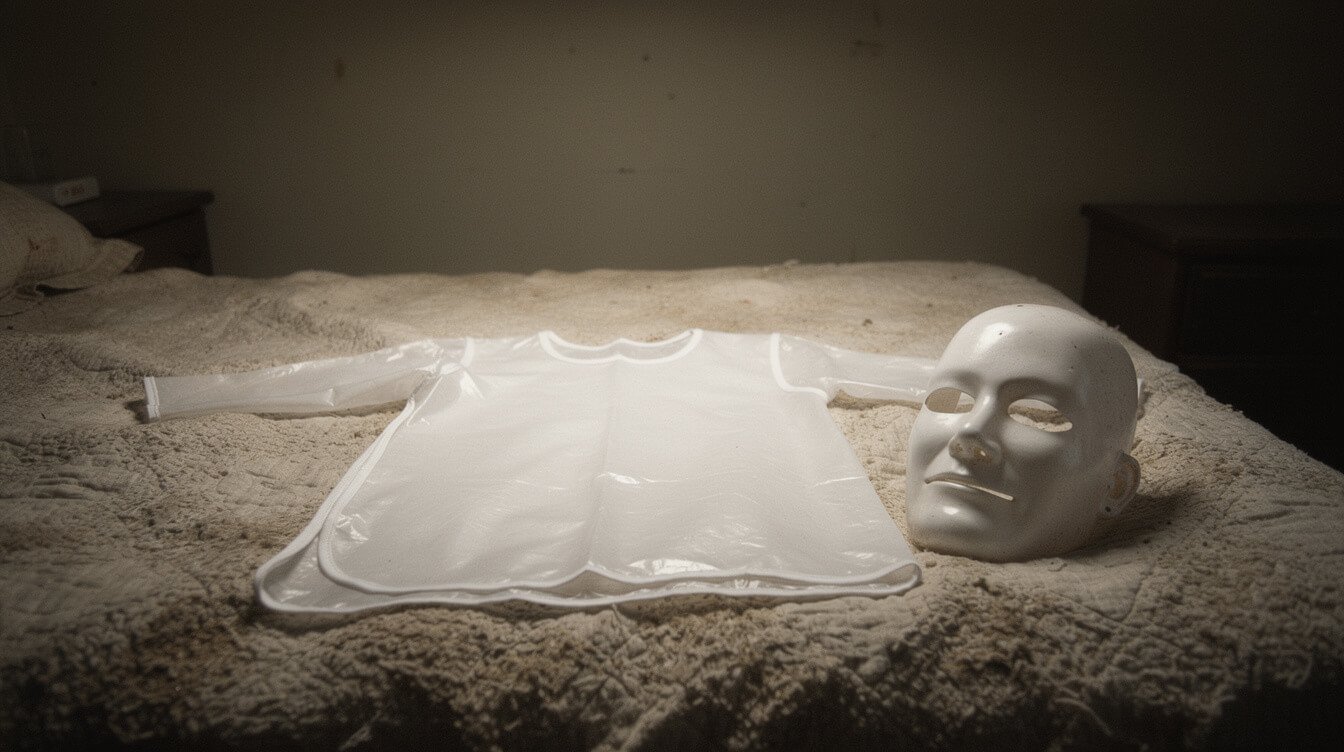
The real retro Halloween costumes are the ones in the attic. Flat cardboard box, cellophane window, a thin plastic smock and a hard mask with an elastic string stapled to each side. We were the last kids to wear it, and it is the missing link between the creepy old photographs and the forty-five-dollar lined polyester thing you can have delivered by Thursday.
What the internet thinks retro Halloween costumes are

Go look at the first page yourself. It is pinboards, a thrift-store question, a photo thread, and two galleries of other people’s great-grandparents. The deepest article on the entire subject runs about twelve hundred words and its most recent entry is from 1956.
There’s a reason for that, and it isn’t laziness. Those photographs are free, they’re out of copyright, they’re genuinely strange, and they cost nothing to assemble into a post. Twenty images, a sentence apiece, done by lunch. The format rewards itself.
What’s odd is the word doing the work. “Retro” usually means recently enough to be a reference — close enough that invoking it gets you a flicker of recognition rather than a history lesson. Nobody calls a butter churn retro. But on this one topic, the whole internet skipped straight past living memory and landed in 1931, where the costumes belong to people nobody can ask.
So there’s a hole roughly fifty years wide, and it happens to be exactly the stretch we were standing in. The costume that defined Halloween for American kids from the mid-sixties through the mid-eighties doesn’t appear on that first page at all. Not in the galleries, not on the boards, not in the thrift thread. It is sitting unexamined in a few million attics, and anyone who wore one can describe it in forensic detail from memory, including the smell.
Which is a strange thing to be sitting on, and a better subject than the burlap sack.
The box, the smock, and the mask

Start with the box, because the box was the first part of the experience and the part nobody mentions. Every description of retro Halloween costumes starts at the mask. It should start six feet earlier, at the rack.
It was flat — maybe an inch and a half deep, the footprint of a small pizza — and it had a window cut into the lid with a sheet of cellophane glued behind it. The mask faced up through that window. That was the entire sales pitch: a molded plastic face looking at the ceiling of a drugstore, stacked eight deep on a wire rack in the seasonal aisle, which through most of September had been school supplies and by the second week of November would be something else entirely.
You went in the first week of October, because the good ones were gone by the third. Picking yours was a thirty-second transaction conducted at waist height, by a person whose opinion on the matter was final and whose budget was whatever was in the coat pocket.
Inside the box were two things. Not a kit. Not a set. Two things.
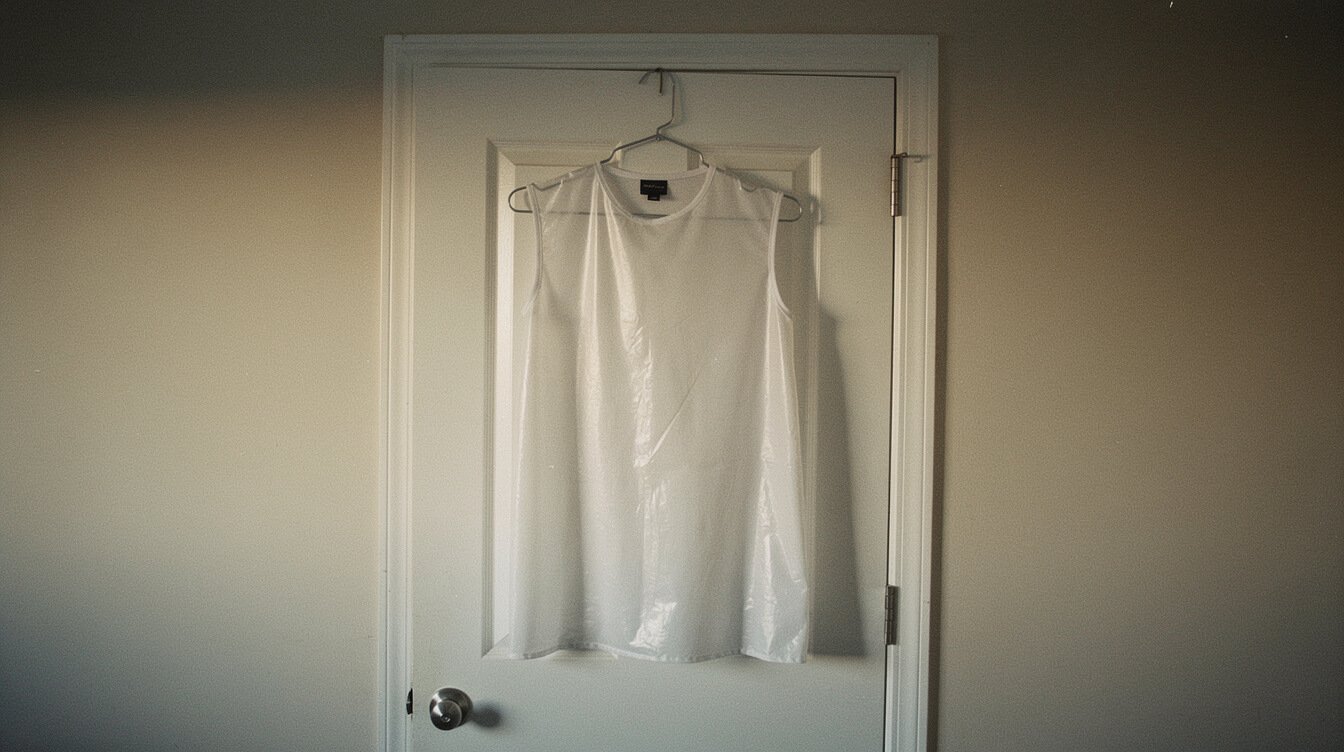
The smock: a sleeveless rectangle of thin printed vinyl with a hole for your head and a tie or a bit of elastic at the back of the neck. It wasn’t shaped like a garment. It was shaped like a tabard — a front panel, a back panel, a seam at the shoulders. It was slick and cold against your arms for the first minute, then clammy for the rest of the night.
The mask: vacuum-formed styrene about as thick as a yogurt lid, painted on the inside so the color couldn’t scuff off the outside. Two eye holes, a slit at the mouth, sometimes two pinholes at the nose that did nothing. Two more holes punched at the temples, and through them a loop of flat elastic, secured at each end with a single metal staple.
That was it. No pants. No gloves. No shoes. Whatever you were, you were it from the neck up and the chest out, and from the waist down you were a kid in jeans.
We’ve written elsewhere about how the night itself actually ran — the pillowcase, the inspection at the kitchen table, the porch lights. This is narrower than that. This is just the object, taken seriously for once.
Known failure modes, in roughly the order they happened

Treat retro Halloween costumes as a product and they review poorly. Treat it as a product designed to cost under two dollars and survive four hours, and the picture changes. Either way, it failed in a fixed sequence, and anyone who wore one can recite it.
The staple went first. One staple, through one layer of elastic, through one layer of brittle plastic, at the exact point where all the tension in the system was concentrated. It was the only fastener in the whole assembly and it had no backup. When it let go — and it let go, usually somewhere around the fourth house — the mask came loose on one side and swung. From then on you held it to your face with one hand, which was the hand you needed for the bag, so you did math at every porch.
The eye holes were never yours. They were molded for an average head that no actual head matched, so you spent the evening looking at the world through two ovals positioned a half-inch high or low, which meant tilting your chin to see the sidewalk and getting a view of the sky for free. Peripheral vision: none. Curbs: a genuine hazard.
The mouth slit turned into weather. Four hours of breathing through a two-inch gap in a sealed plastic shell produced a microclimate — warm, wet, and smelling distinctly of hot styrene and whatever paint was on the inside. Condensation collected along the bottom edge. Eventually it ran. That specific smell is the single most reliable memory trigger in the entire format, and it has never once been described in a gallery of 1931 photographs.
The smock tore at the armhole, or along the shoulder seam, or at the back where the tie pulled. Vinyl that thin doesn’t rip so much as unzip: once it starts, it runs. Most of them came home with at least one, and most of them went in the trash in early November because what exactly were you going to do, mend it?
None of that was a defect. A defect implies the thing was supposed to do something else. It was built to be bought in October, worn once, and thrown away, and it hit that specification exactly.
Why the costume had to tell people what you were
Here’s the part that’s actually interesting, and the part that makes these things permanently funny to anyone who thinks about design for a living.
The mask couldn’t do the job. A molded plastic face, seen at night, from ten feet away, by a stranger who has the porch light behind them, reads as one thing: a face. Maybe a green face. The nuances that were obvious on the rack under fluorescent light disappeared completely in the actual operating conditions, which were darkness and a hurry.
So the smock did the identifying. And the way it identified you was to print, across your torso, a picture of the character you were currently dressed as — plus, very often, the name of that character in large letters directly underneath it.
Sit with that for a second. You were wearing a costume that had its own caption sewn into it. A picture of the thing, labeled, worn by you, while you were also being the thing. If a neighbor couldn’t tell, the garment answered on your behalf, in writing, at chest height.
That’s the exact move this brand spends most of its time arguing against. If a joke needs a footnote it isn’t a joke, and a shirt that has to announce what it is has already lost the room. We’ve made that case about shirts that print the word rather than the idea, and we’d make it again tomorrow.
But the smock gets an exemption, and it’s worth being precise about why. The caption was load-bearing. A seven-year-old crossing a dark lawn with four seconds of a stranger’s attention does not have time to establish context — the read has to happen before the door opens, or there’s no read at all. The label wasn’t insecurity. It was a hard engineering constraint, solved in the cheapest available way.
That exemption expires the moment you’re an adult standing in daylight with a full conversation available to you. Which is most of the rest of your life, and precisely why nothing else gets to borrow it.
The newsletter
Like a mixtape, but it shows up on its own
One email a week. The good posts, new designs, zero exclamation points. Unsubscribe whenever. We won't take it personally.
Worn over a winter coat, which is the part nobody photographs

October 31 in most of this country is not costume weather. It’s thirty-eight degrees and getting dark at six, and the entire costume is a sleeveless sheet of vinyl with the insulating value of a sandwich bag.
So there was a negotiation at the door, and it had exactly one outcome. The coat went on. The costume went over the coat. The silhouette you had spent two weeks imagining became a puffy nylon torso with a thin plastic rectangle flapping on the front of it, arms entirely the wrong color, hood up under the mask strap. Whatever you were supposed to be, you were now that thing — but bulkier, and visibly cold.
The alternative was to win the argument, go out in just the smock, and be back on the porch forty minutes later with your lips a shade of blue your mother would bring up for the next decade.
Here’s why this matters beyond the complaint. The photographic record of these costumes is a lie, and it’s a lie with a simple mechanism. The one picture that exists was taken indoors, on the stairs or in front of the fireplace, before the coat went on, because that was the only moment with enough light for the flash and the only moment anyone thought to reach for the camera. Film cost money. You got one frame, maybe two.
So the costume as photographed — crisp, unlayered, posed — appeared in that configuration for about ninety seconds of its entire existence. The costume as it actually walked around the neighborhood, over a parka, held together by one hand, has almost no documentation at all. It’s the same gap that makes every school picture a work of fiction: one frame, staged, standing in for a whole year nobody shot.
Which means the honest version of these retro Halloween costumes survives almost entirely in the memory of the people who wore them, and nowhere else. That’s a reasonable argument for writing it down.
The last generation to buy retro Halloween costumes off a rack
Retro Halloween costumes didn’t die dramatically. The format got squeezed out by boring, sensible forces, the way most things do.
Safety expectations tightened — flammability, visibility, the basic observation that a rigid mask with two misaligned holes is not an ideal thing to send into traffic after dark. Costume makers moved toward fabric, toward face paint, toward hoods you can actually see out of. Reasonable, all of it.
At the same time the money moved. Licensing got more organized and more expensive, the costume aisle discovered that adults will outspend children by a wide margin, and a category that used to top out at a couple of dollars found it could comfortably charge forty. You can’t fund that with a vinyl tabard.
And the modern result is, by every measurable standard, better. The costume your kid wears now is a real garment. It’s lined. It fits. It survives the night, goes in the wash, and gets worn again next year or handed down. Nobody is seriously arguing we should go back.
What went with it was the economics, and the economics were the whole character of the thing. Two dollars meant the decision was low-stakes, which meant it was yours — you picked off the rack in thirty seconds and nobody held a family meeting about it. Disposable meant nobody protected it. You could sweat in it, drag it through wet leaves, and tear it on a hedge, and the correct response from every adult present was a shrug.
That’s the hinge we’re sitting on. If you were trick-or-treating between about 1965 and 1985, “costume” meant that box by default, and anything else was an exception. Kids ten years behind us had a different default, and kids today have never seen one outside a photograph. We’re the last cohort for whom this was simply what the word meant — which is a familiar position for us, and one we’ve gotten used to occupying with the mall, the decor, and most of the rest of it.
We make designs out of this exact material — the object reported straight, with nobody standing next to it explaining what you’re looking at. If that’s your register, the shop is right here. No costume required.
No caption printed underneath
Same idea as the smock, minus the part where it tells everyone what it is. One reference, set down, for the people who were already there. Holds up better than vinyl, too.
Retro Halloween costumes: the questions that keep coming up

What years actually count as retro?
Depends who’s asking. The galleries dominating the search for retro Halloween costumes mean roughly 1900 to 1960 — hand-made, photographed in black and white, nobody alive to confirm the details. We mean the mass-produced boxed costume, call it 1965 to 1985, which is the window where the format was the default rather than one option among several. Both are defensible. Only one of them has witnesses.
Why were the masks that uncomfortable?
Because they were one piece of thin vacuum-formed plastic made in one size, and a human face is not one size. Everything that bothered you — the eye holes in the wrong place, the sharp edge along the jaw, the elastic cutting behind your ears, the condensation — follows from manufacturing a rigid shell to a price point of pennies and expecting it to fit every kid in the country. It wasn’t malice. It was tooling.
Is the old stuff worth anything now?
A sealed box in clean condition has a real collector market and can do surprisingly well; a loose smock with a torn armhole and no mask mostly does not. Condition and completeness drive the whole thing, and specific values move around enough that anybody quoting you a firm number is guessing. Check what comparable boxes have actually sold for recently and work from that.
Can you still get an original?
Estate sales, attics, and the usual secondhand channels — they turn up, generally without the box, usually in October when everyone else is also looking. Reproductions of the format exist too. The plastic is forty-odd years old either way, so treat any original as a display piece and not as something to put on a child.
Is this the same thing as the homemade costume?
No, and that’s a separate piece of the story. Plenty of us never got the boxed version at all and went out as something assembled from the hall closet twenty minutes before dark. That’s covered in the piece on the night itself. This one is specifically about the thing that came in a box, because it’s the thing with no written record.

From the shop
Nirvana In Utero Chinese Fan Art Vintage T-Shirt
Price range: $24.99 through $26.99
Shop this designWhat’s worth keeping from the format
Not the vinyl. The vinyl was bad. The mask was worse, and the staple was an engineering decision made by somebody who knew exactly what they were doing and had eighteen cents to do it with.
What’s worth keeping is the posture. The boxed costume committed. It picked one thing, said it at full volume, and didn’t hedge — no modern twist, no ironic layer, no backup plan if the neighbors didn’t respond. It was in on nothing. It just went out into the cold and was a thing for four hours and then stopped existing. There’s something to be said for that, especially from a generation that has since gotten extremely good at never being caught trying.
What’s worth leaving behind is the caption on the chest. That was a concession to darkness and a four-second attention window, and we are not currently operating under either constraint. The grown-up version of these retro Halloween costumes is the one that gets recognized without having to introduce itself — the look across a room from the one other person who knows, and nothing printed underneath for anyone else.
Same joke. Better mask.
Before you go
You made it to the end. Respect.
Get the best of these in one short weekly email, plus whatever we just printed. No spam. We were raised better than that. Mostly.