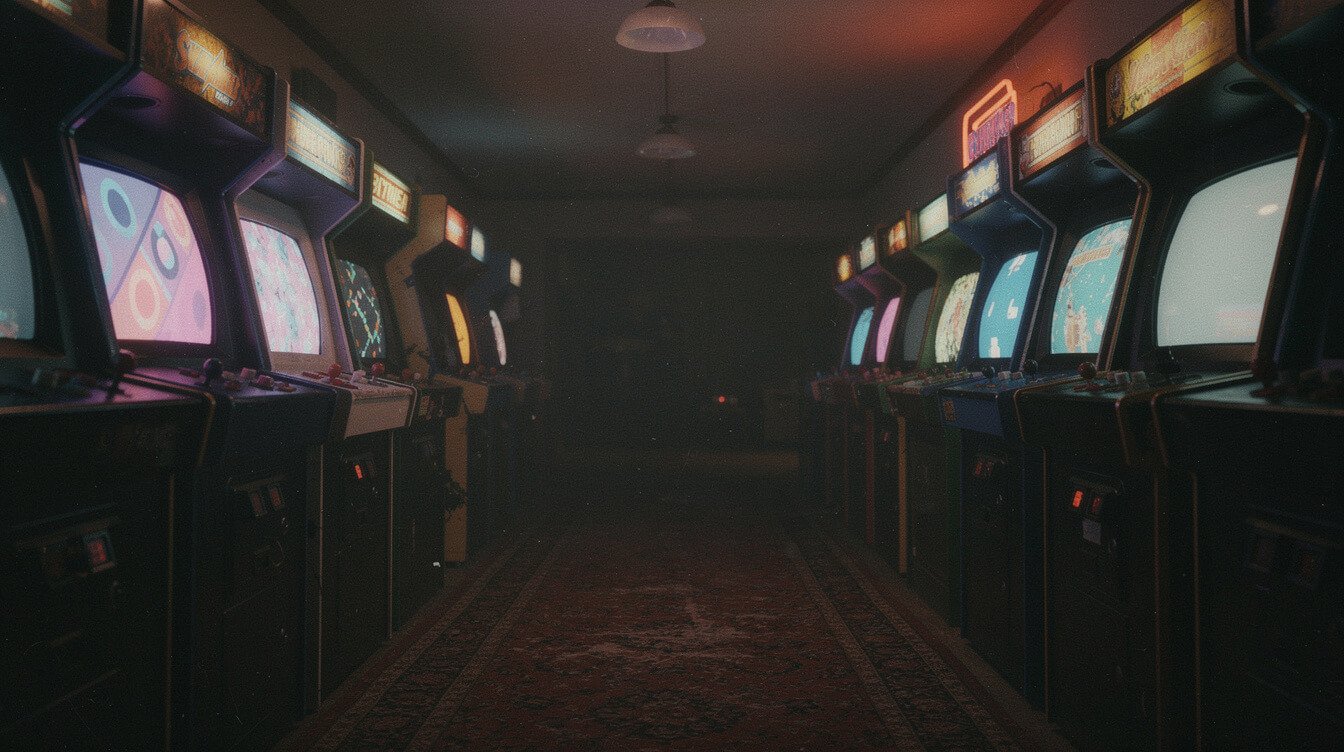
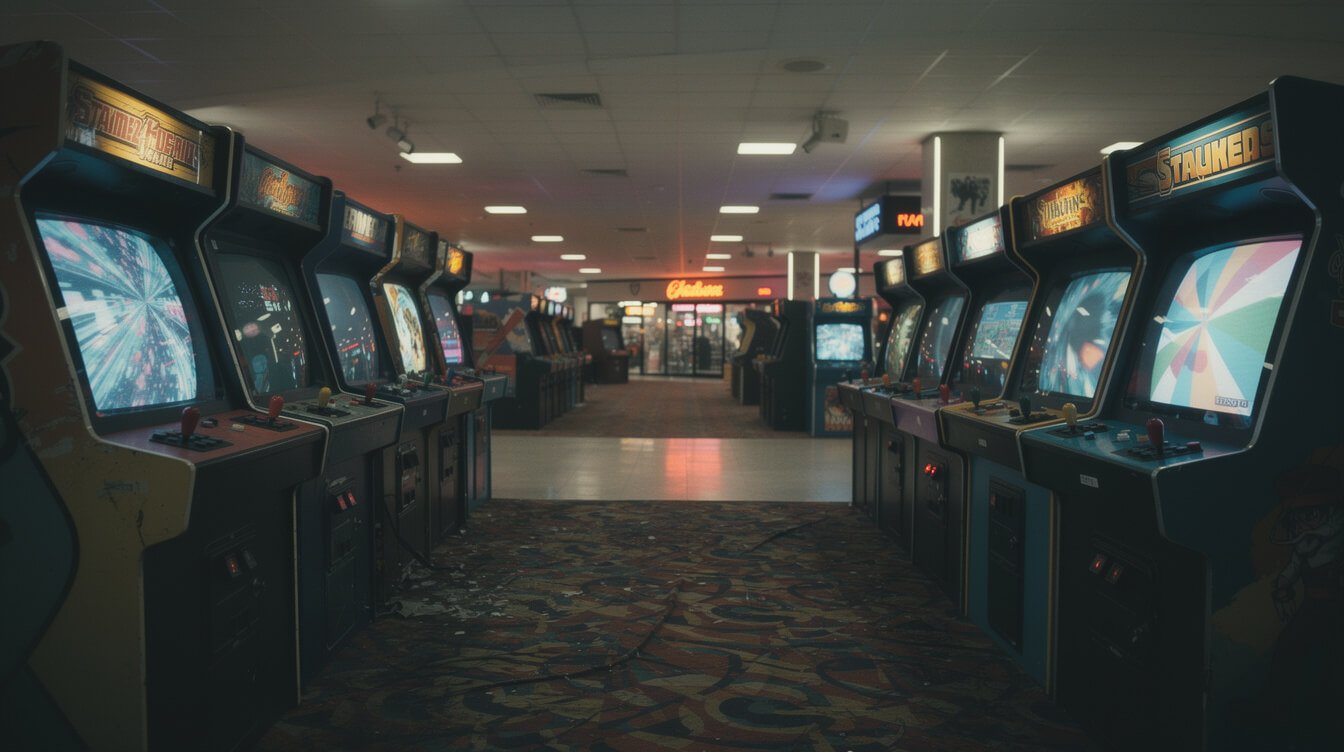
You smelled it before you saw it. Carpet that had absorbed a decade of spilled blue-raspberry slush, hot electronics, and that ozone crackle off the cabinet fans. Then the sound — forty machines all doing their attract-mode loop at once, a wall of chiptune arguing with itself. You had exactly one thing in your pocket that mattered, and it wasn’t a phone.
That’s the memory. Not a character, not a franchise, not a high score you can still recite (though, be honest, you probably can). The memory is the room. And that’s exactly what most “retro arcade” merch gets backwards — it slaps a game’s mascot on a shirt and calls it nostalgia, when the actual nostalgia was never about who was on the screen. It was about the quarter in your hand and the kid breathing down your neck waiting for you to lose.
The sound before you saw the screen
Every arcade had a signature sound before it had a signature game. You’d hear it from the food court, muffled through a half-open set of double doors — a low electronic hum with sharp little explosions poking through, like the building itself was digesting something. You picked up your pace. Your friends picked up theirs. Nobody said “let’s hurry,” you just all started walking faster, because the sound meant the machines were on and someone else’s quarters were already disappearing into them.
This is the part the licensed T-shirts never capture, because it’s not a screenshot. It’s not brandable. You can’t put “the sound before you saw the screen” on a hang tag and expect a fourteen-year-old floor employee to understand why it matters. But if you grew up going to an arcade — a real one, with a change machine that ate more bills than it fed and a “no loitering” sign that nobody enforced because loitering was the entire point — you know exactly what that hum sounded like. You could probably still hum it back.
There was also a very specific light in there, somewhere between “aquarium” and “emergency exit,” bouncing off every reflective surface at once. Your eyes needed a second to adjust walking in from a parking lot at 2 p.m. in July, and that adjustment period was part of the ritual too — a little decompression chamber between the outside world, where you were somebody’s kid, and the inside one, where you were just a name on a leaderboard if you were good enough to leave one.
We think that’s the actual design brief. Not “put a joystick on it.” The sound. The smell. The particular flavor of anticipation that only exists when you’re a kid with finite money and infinite time, which is a combination nobody gets to have twice. You can chase that feeling in a lot of places as an adult — none of them cost a quarter, and none of them quite work the same.
The token economy: waiting your turn, the unwritten rules
Nobody handed you a rulebook, but every arcade ran on the same quiet code. You put your quarter on the cabinet’s marquee ledge — or lined it up on the screen glass if the ledge was too crowded — and that meant you had next game, full stop, no debate. Cutting the line was a genuine social crime. Somebody’s older brother would materialize out of nowhere to enforce it.
You learned to read a stranger’s play style in about four seconds. Was this kid good, meaning your quarter was about to buy you five minutes of standing there, or was this kid about to die embarrassingly fast, meaning you’d be up before you’d finished your candy? You learned patience you didn’t know you had, and you learned it from a machine, not a parent — which, if you think about it for more than a second, is a pretty accurate summary of the whole latchkey experience.
There was a hierarchy, too, unofficial but absolute. The kid whose initials were on three different machines. The one who could get an extra life out of a machine everyone else thought was un-gettable. Nobody voted on this status, it just existed, the way it does among kids left mostly to govern themselves. You either had a rep at your arcade or you didn’t, and either way, you never explained it to your parents, because there was no explaining it. You just went back the next Saturday with another pocketful of quarters and did it again.
The economics of it were their own education, too. A five-dollar bill from a summer job or an allowance had to be rationed across an entire afternoon, which meant math you didn’t realize you were doing — how many games can I actually afford if I want this five bucks to last past 4 p.m., and is it worth spending two quarters in a row on the machine I’m bad at, or one quarter each on two I might actually win. Nobody called it budgeting. It was budgeting.
And there was always at least one machine nobody could beat — the one with a high score table that hadn’t changed in months, initials frozen at the top like a small permanent monument to somebody who’d probably moved away or just gotten bored and never came back. You’d try anyway. Everybody tried anyway. That’s the part that doesn’t photograph well but explains half of why this stuff still means something.
What a shirt can say that the game never could
Here’s the thing about putting an actual game character on a shirt: it says “I liked this specific product,” which is true but small. It’s a fact about your purchase history, not a fact about your childhood. It’s the difference between wearing a logo and wearing a memory, and Gen X can tell the two apart at fifty paces — we were the test audience for every ad campaign of the 20th century, we know exactly what’s being sold to us and when.
Think about how little of the actual memory involves the character on screen. You remember the exact height of the joystick relative to your ten-year-old elbow. You remember the specific give of the buttons — some machines had buttons worn soft and mushy from ten thousand thumbs, others were stiff enough to leave a mark. You remember whose turn it was and whether they were going to hog it. None of that is copyrightable, none of it belongs to a studio, and none of it shows up on the licensed shirt. It’s yours in a way the character never was.
A design that gets it right skips the character entirely and goes straight for the ritual — the cabinet glow, the token, the particular hush of a room full of strangers all silently rooting for whoever’s currently playing to lose so it’ll be their turn. That’s a shared memory instead of a shared purchase. Anyone who was actually there reads it in half a second. Anyone who wasn’t just sees a nice design, and that’s fine too — the joke was never for them, it was never supposed to need a footnote.
That’s the whole idea behind what we put on our shirts — designs built around the feeling, not a rights deal. No franchise logos, no “as seen in” claims, nothing that needs a lawyer’s sign-off before it goes to print. Just the parts that were actually ours: the quarter, the carpet, the sound, the wait.
It’s a harder brief to design against, honestly. Slapping a beloved character on a chest is easy — the recognition is already built in, somebody else did that work decades ago. Building recognition out of a coin slot and a countdown timer, with nothing else to lean on, means the design has to actually be good. There’s no franchise loyalty to coast on. Either the shape and the composition land the memory, or they don’t, and you find out fast which one happened.
How to spot a shirt that gets it right vs. a licensed cash-in
Search “retro arcade shirt” anywhere and you’ll get two very different products wearing the same label. One category is officially licensed merchandise — a real character or logo from a real franchise, cleared through a real rights department, priced accordingly. Nothing wrong with that if that’s what you want; some of those games earned the loyalty. But it’s not nostalgia, it’s fandom, and those are different things wearing the same T-shirt shape.
You’ll also notice the licensed stuff tends to cluster around the two or three franchises that survived into modern pop culture — the ones with a streaming reboot or a mobile port keeping the name alive. Which means if your actual memory is of some scrappier, less iconic cabinet that never got a franchise deal at all, the officially licensed shelf has nothing for you anyway. That gap is exactly where a feeling-first design earns its keep — it doesn’t need a surviving IP to work from, just the room.
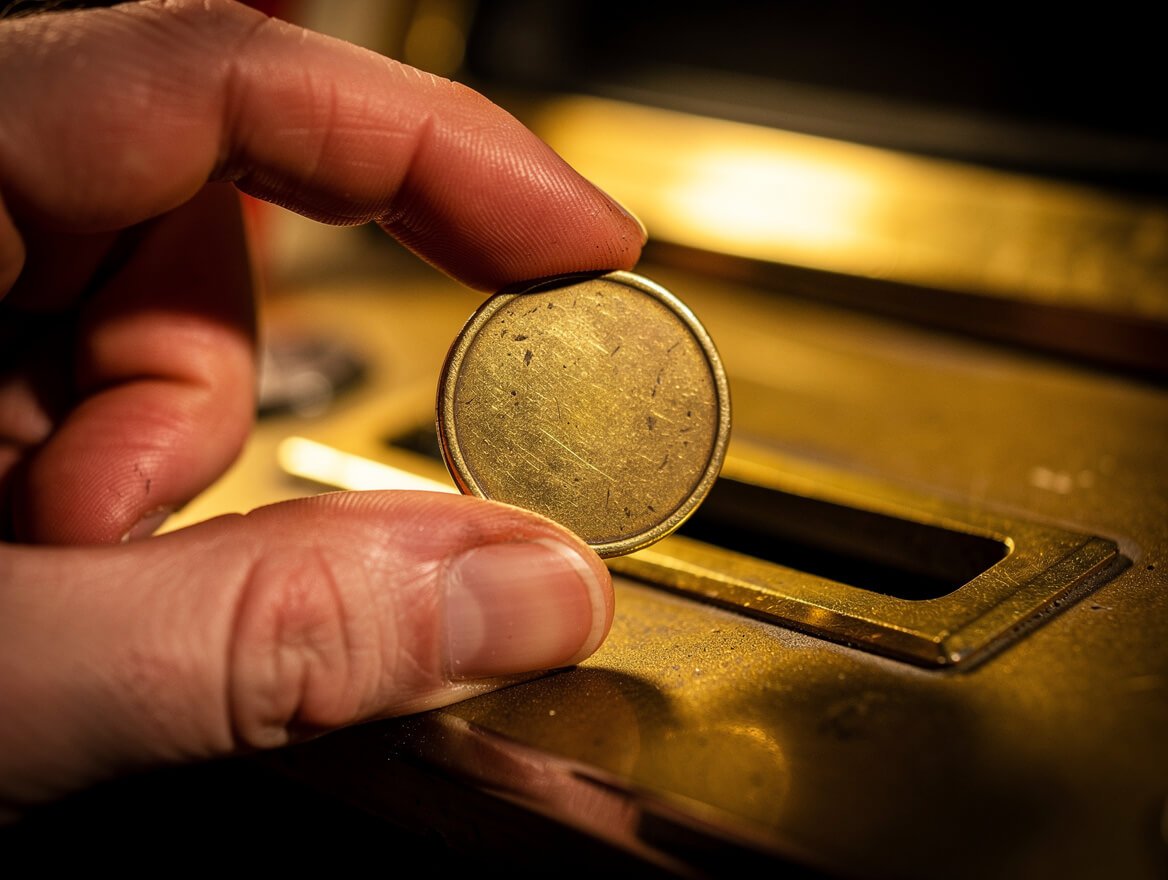
The other category — the smaller, harder-to-find one — is designed around the experience instead of the property. No character, no title, no logo you’d recognize from a cabinet. Just the token, the joystick shape, the marquee glow, the countdown timer, rendered in a way that makes anyone who spent actual quarters in an actual arcade go quiet for a second before they laugh. That second of recognition is the entire product. If a design has to explain itself with a caption, it already lost.
A quick gut check before you buy either kind: does the design need you to have played one specific game, or does it need you to have been somewhere? The first is fandom merch, perfectly fine, not what this piece is about. The second is what we’re actually talking about — and it’s the harder one to find, because it’s the harder one to make.
There’s a print-quality tell, too, and it’s worth knowing before you buy from either category. A lot of the cash-in designs — licensed or not — are built off a low-resolution game screenshot blown up way past its native size, so the pixels go soft and muddy on fabric instead of staying crisp. A design actually made for print, not lifted from a screen capture, holds its edges. It sounds like a small thing until you’ve owned both kinds and only one of them still looks good after a year of washes.
Get the reference right, on purpose
No rented mascots, no explaining the joke. Just the detail done exactly right, for the person who’ll actually catch it.
Who this is actually for
Not the kid at the mall arcade, obviously — that kid’s forty-five to sixty now, has a mortgage and possibly a kid of their own who’s never once dropped a physical coin into a machine and finds the concept mildly hilarious. This is for the person who can still describe, in specific and slightly too much detail, the exact walk from the food court to the arcade entrance at their local mall. Who to this day flinches a little at the phrase “GAME OVER” in that particular blocky font. Who has, at some point in adult life, explained the token economy to a Millennial coworker and watched their eyes glaze over.
It’s not a costume. Nobody’s dressing up as an arcade. It’s closer to a coordinate — a way of signaling “I was there, this was mine” to the three other people in any given room who were also there, without saying a word to the rest. That’s the whole mechanism. It either lands or it doesn’t, and if it doesn’t land for you, it wasn’t made for you, and that’s fine. It wasn’t supposed to be.
It also tends to be a decent conversation trap in the best way. Wear it somewhere and every so often a total stranger will catch it, get a look on their face like they just remembered a phone number from 1988, and say something like “wait, did you have one of those too?” You did. You both did. Neither of you needs to say another word about it, and that’s kind of the point — the shirt already said it for you.

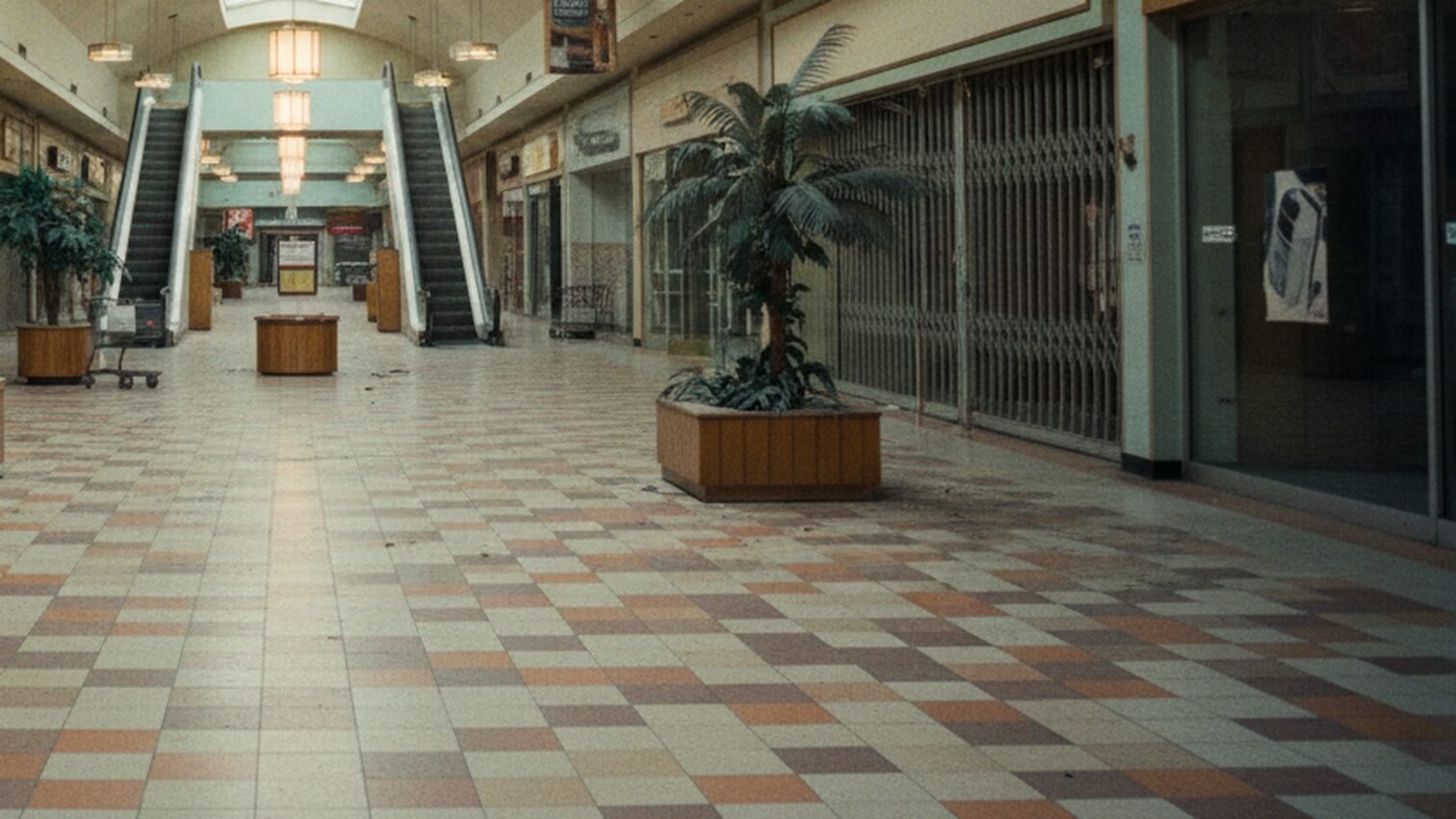
If any of that sounds like you, the mall this arcade lived inside of probably looked a lot like the one we wrote about separately — same fluorescent lighting, same total lack of adult supervision, same feeling that you’d found the one place in your town that was actually built for you.
Quick answers
Is a retro arcade t-shirt the same as a retro gaming shirt?
Close cousins, not the same thing. Retro gaming leans console — what you played at home. Arcade nostalgia is about a specific public place: the mall arcade, the token machine, the crowd. We covered the broader console angle in our piece on retro gaming shirts if that’s closer to what you’re after.
Why don’t your designs use real game names or characters?
Because that’s a rights deal we’re not in the business of pretending to have. We evoke the era and the feeling — the cabinet, the token, the ritual — never a specific licensed title. It also means the design ages better: the feeling doesn’t expire when a franchise does.
What if I actually want a shirt with my favorite game’s character on it?
Totally valid, just a different product category — look for something explicitly labeled “officially licensed,” and expect to pay for that license. What we make is a different thing: the memory of the room, not the merchandise of the machine.
Do arcades like that still exist?
A handful, mostly rebranded as “barcades” for an adult crowd with a beer list. Different vibe, same bones. The mall arcade specifically — attached to a food court, staffed by someone’s disaffected older cousin — is mostly gone, which is probably part of why the memory hits as hard as it does.
Final thoughts
Nobody needs another shirt with somebody else’s copyrighted mascot on it. What’s actually rare — rare enough that it’s worth hunting for — is a design that skips the character and gets the room right. The hum before you walked in. The ledge where you lined up your quarter. The kid behind you, silently willing you to die.
It’s a small thing to ask for, and it turns out to be a hard thing to find, mostly because it’s easier to license a mascot than to actually sit with the memory long enough to render it honestly. But the version that gets it right doesn’t need a rights department or a franchise renewal. It just needs somebody who remembers exactly what that hallway smelled like, and the patience to leave the character out of it.
That’s not a costume and it was never a franchise. It’s a coordinate for the handful of people who’ll clock it instantly and never need it explained. Wear it or don’t. Either way, you know exactly what it’s for.
One good email, no fake hype
New designs and the occasional true story from the desk. No hashtags, no confetti emoji, we promise.