
Every list of 80s christmas memories is written from the same seat: the floor in front of the tree, looking up. The catalog with the circled pages. The foil-wrapped chocolate. The bulb that took the whole strand down with it. Search the phrase today and the top result is a fifty-eight-item photo gallery of exactly that, and it’s a good gallery. You’ll recognize the ashtray.
But the gallery leaves out what most of us actually did in December, which was work. Not real work. Kid work. An 80s christmas came with a job description, and nobody asked whether you wanted the position. You bought presents with money that wasn’t yours. You sang in a gym in front of two hundred folding chairs. You followed a strict set of rules about the stairs. You delivered packages. You wrote a formal letter of thanks to a woman you’d met twice. The forty minutes of tearing paper were the bonus. The rest of the month was the shift.
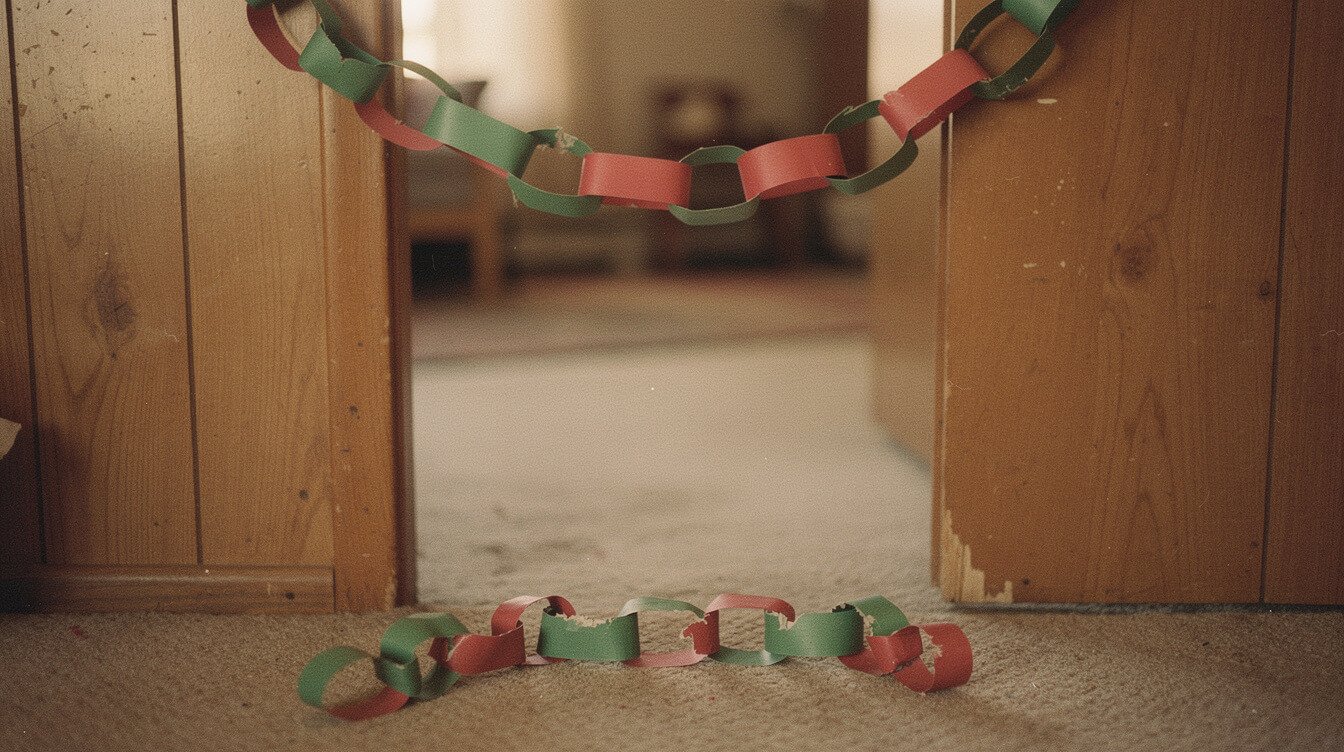
It started with a paper chain. Somewhere around the first of December, a teacher handed out strips of red and green construction paper and a jar of paste that half the class considered a snack, and you built a chain with one loop for every day left until break. It went home and hung in a doorway. Every night after dinner, you tore off a link. That was your job. Nobody else was allowed to do it, and on the nights you forgot, you tore off two the next day and felt a little guilty about it, like you’d cheated time.
That was the whole countdown technology. No app, no daily reveal, no little door with a surprise behind it in most houses. Just a chain that got shorter and a doorway you had to duck under less every week. It was the most honest calendar ever made. It didn’t promise anything. It just shrank.
Then the duties stacked up. There was the class gift exchange, where you drew a name out of a coffee can and spent a week trying to figure out what a boy you’d never spoken to wanted for three dollars. There was the classroom party, for which somebody’s mom had to be talked into sending cupcakes, and that somebody was often you. There was the cotton-ball snowman for the bulletin board, which was graded, in the sense that it went on the wall or it didn’t.
None of this was optional, and none of it was explained. That’s the part worth noticing. Adults ran the holiday, but they ran it the way a manager runs a store: they handed out tasks and assumed you’d figure it out. You usually did. If you were nine, you were staff.
The holiday shop in the school library
For one week in December, the school library stopped being a library. The PTA pushed the reading tables against the wall, threw butcher paper over a row of card tables, and stocked them with the strangest merchandise you’d ever see in one place. Then they let a few hundred children loose in there with cash.
The cash came in an envelope. Your mother had written your name on the front, the amount inside, and a list on the back. Mom, Dad, Grandma, and your brother, with “not over $2” next to your brother. You carried that envelope down the hall like it held launch codes.
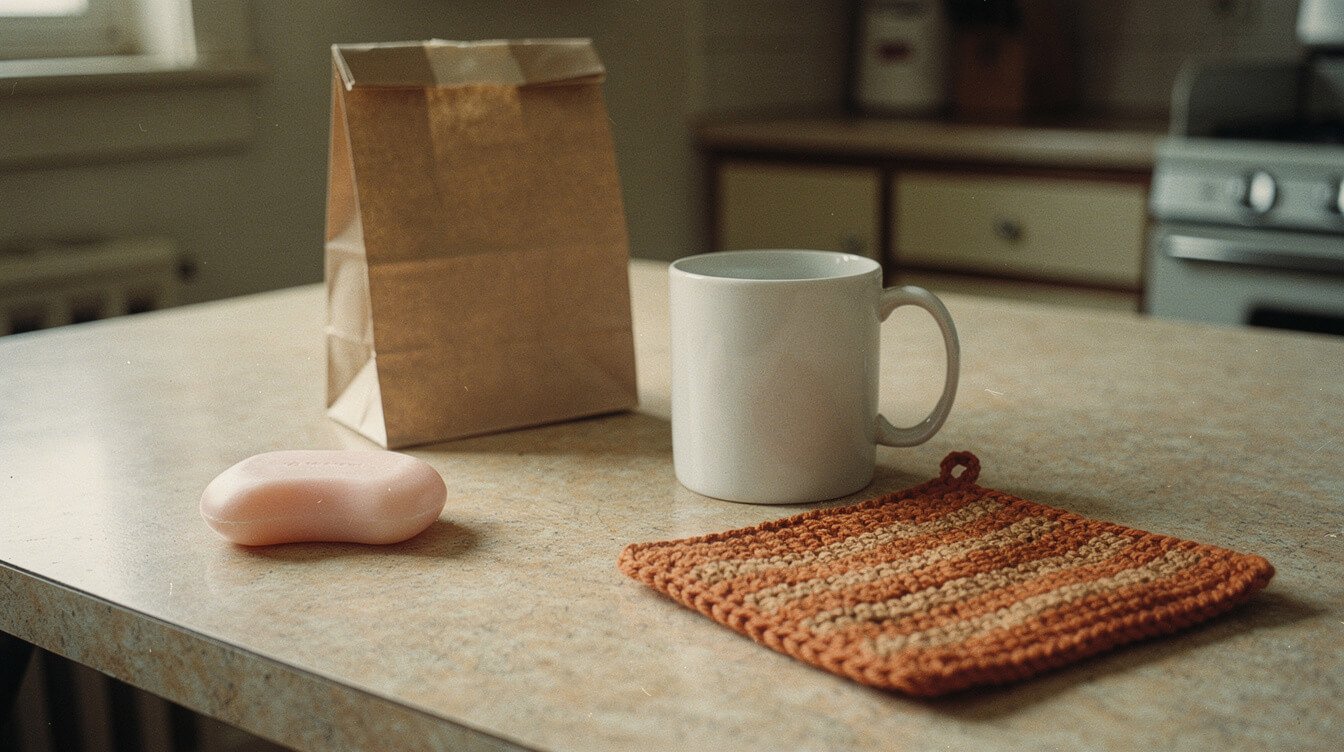
The stock was the same everywhere. A mug with a superlative on it: best, greatest, number one, in a font that looked tired. A bar of soap shaped like something soap had no reason to be shaped like. A keychain. A potholder. A tiny ceramic animal wearing a scarf. A pen with a feather on it. Something for Dad that might have been a golf item and might have been a paperweight; the volunteer at the card table wasn’t sure either. Everything cost somewhere between a quarter and five dollars, and everything looked like it cost a quarter.
Here’s the thing. You agonized over it anyway. You stood in front of the soap for a long time. You did math on your fingers. You put the mug back and picked it up again. At the end, the volunteer stapled your purchases into a paper bag with your name on it so you couldn’t peek, which made no sense, since you’d picked them. You’d buy a book for yourself at the school book fair without a second thought. This was different. This was the first time anyone had trusted you to buy something for somebody else, and the weight of it was real, even if the merchandise wasn’t.
And the parents’ side of the deal was to receive the gift on Christmas morning as if it had come from a good store. “Oh, I love it.” Then the seashell soap went into the guest bathroom, where it stayed for eleven years, too precious to use and too ugly to throw away. The mug became the pencil cup. Somewhere in a kitchen drawer in your parents’ house right now, there’s a good chance the keychain is still holding two keys to nothing.
The homemade gifts ran on the same principle. A plaster handprint with your name scratched in the back. A picture frame made from glued macaroni and sprayed gold, shedding a noodle per year. A clay pot that came out of the kiln at an angle. Nobody pretended these were good. Everybody kept them. That was the trade.
The winter concert in the gym
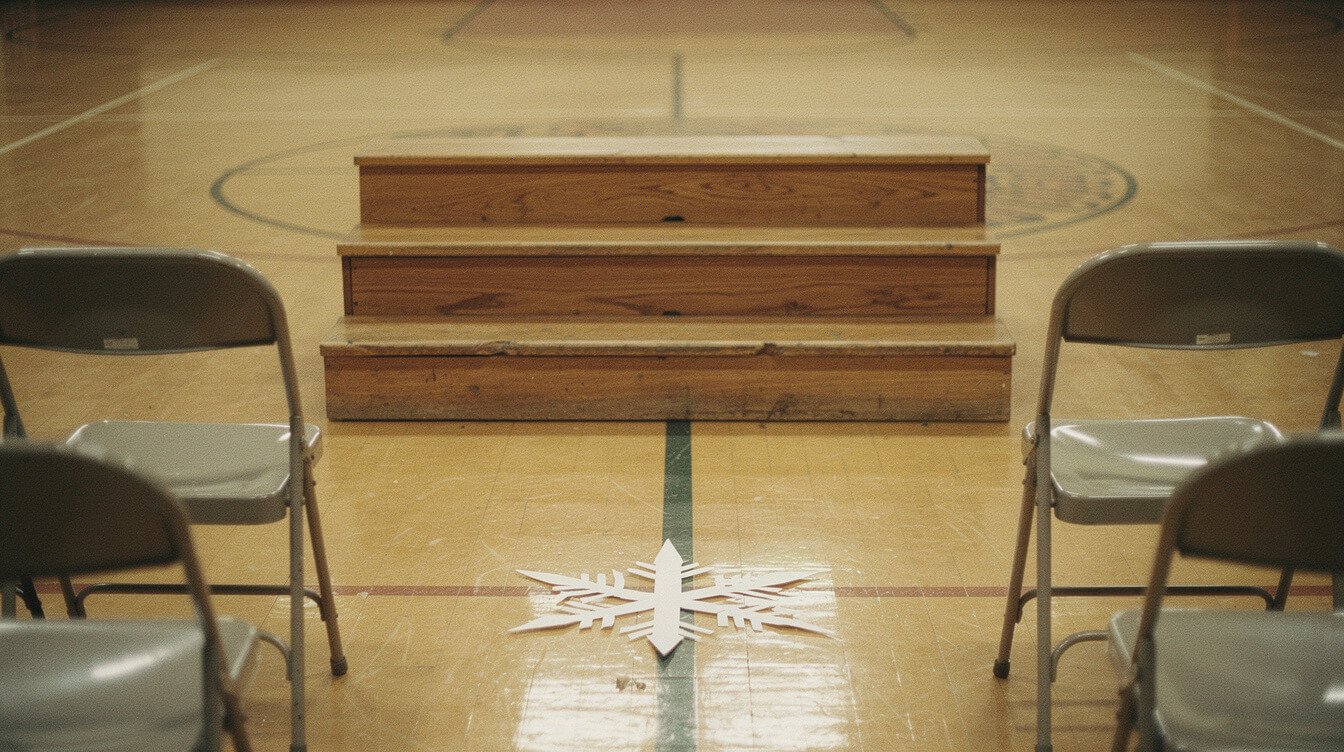
The second big job of the season was the concert, and you didn’t audition. If you were enrolled, you were cast.
It happened in the gym, because the gym was the only room big enough, which meant every 80s christmas concert smelled faintly of floor wax and dodgeballs. The custodian set out the risers and a few hundred metal folding chairs that screeched every time a parent shifted. Your mother had dressed you that evening in clothes chosen to be photographed: a white shirt, a clip-on tie or a velvet dress, shoes that pinched. You stood on the risers under the basketball hoop, sweating, while the music teacher at the upright piano gave you the eyebrow that meant start.
Then you sang. The program was a geography lesson nobody had signed up for: one song about snow, one about bells, one in a language you’d learned phonetically from a mimeographed sheet three weeks earlier and still couldn’t translate. There was always a song with hand motions. There was always a kid in the front row who waved at his parents the entire time, and a kid in the back row who didn’t move his mouth once and somehow never got caught.
The audience did its own jobs. Somebody’s grandmother sat in the first row with her coat on. A baby cried, on cue, during the quiet song. Somebody’s dad stood in the side aisle with a flash camera, and later in the decade, a different dad stood in the same spot with a camcorder the size of a bread box on his shoulder and a battery pack on his belt, blocking the view of every family behind him. That tape exists somewhere. Nobody has watched it since 1988.
Afterward there was punch in the cafeteria. The red kind, in a bowl, with a ladle, served in paper cups that went soft in about a minute. You drank it in your tie. You were seven, and you’d just given a public performance, and nobody made a big deal out of it, which was fine. It was the job.
80s christmas eve was a shift you worked lying down

Christmas Eve came with the strictest policy of the year, and it was enforced from downstairs.
Bedtime was early. Not the regular early. Christmas Eve early, announced with a tone that didn’t invite negotiation. The reasoning was never fully stated, and you were smart enough not to ask. You went upstairs. You lay in the dark with your eyes wide open, doing the least restful thing a human body can do, which is try very hard to fall asleep.
Downstairs, things happened. You could hear them. A cabinet door. Paper. A grown-up voice saying something sharp and then laughing. The house had its own acoustics, and every kid knew them: which floor vent carried sound, which stair creaked, where you could stand in the hallway and see a slice of the living room without being seen. Most of us had our own spot. Most of us never used it on Christmas Eve, out of a superstitious respect for the operation.
Then came the morning, and the rules about the stairs. Every house had them, and every house’s were slightly different. Nobody comes down before six. Nobody comes down until Dad has had his coffee. Nobody comes down until everybody is up, which put the youngest kid, who was usually first awake, in charge of waking everyone else. Siblings who hadn’t spoken civilly since Thanksgiving held a summit meeting in the hallway at 5:15, sitting on the carpet in a row, whispering, building a case for waking up the parents now.
Somebody always got sent in as the delegate. It was always the smallest one, because a parent is less likely to yell at the smallest one. The delegate came back with a ruling, usually “fifteen more minutes,” and those fifteen minutes were the longest in the year. You sat on the top step and listened to the furnace kick on. That’s an 80s christmas, too, maybe the truest one. Not the presents. The top step.
If you still have a sibling who’ll sit on a step with you for no reason, we make shirts for exactly that kind of person. The GenerationX shop is mostly one joke per shirt, no instructions included. You either get it at the top of the stairs or you don’t.
Tag duty, paper detail, and the morning protocol
When you finally got downstairs, the work continued, just faster.
The first job was distribution. In a lot of houses, one kid got appointed to play elf, crawling under the tree, reading the little stick-on tags, and delivering each package to its owner. This was a position of real power. You knew who had the most boxes before anyone else did. You could also, if you were reading a tag that said “To: Mom, From: Santa” in your father’s unmistakable handwriting, begin to put certain things together. A lot of us retired from a long-running belief while working tag duty.
Then came the order of operations. Some houses ran a free-for-all. More ran a system. One present at a time, youngest first, everyone watches. That meant your gift was a performance, too, opened in front of a seated audience that expected a reaction. You were expected to hold the thing up so the room could see it, say who it was from, and say thank you to that person by name before anyone else got a turn. Grandma was keeping score.
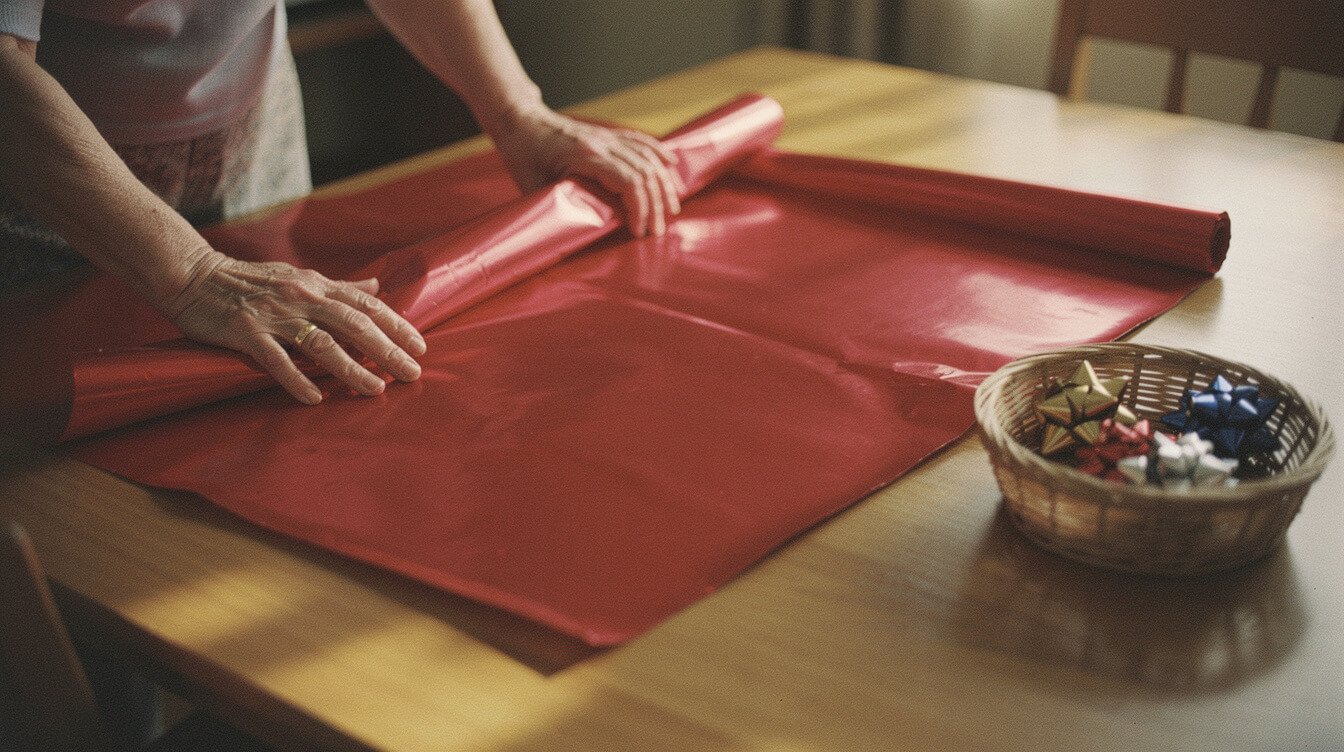
And then there was the paper detail. Somebody held the trash bag, and that somebody was you. Somebody else, usually the oldest woman in the room, was quietly saving the paper. Not all of it. The good sheets. The ones that came off clean, smoothed flat on her lap and folded into a square for next year. The bows went into a basket and came back the next December, flattened, the adhesive gone, held on with a strip of tape. A good bow in an 80s house could have a five-year career. Everyone thought this was a little ridiculous. Everyone now does some version of it.
The toys themselves had their own afternoon. We’ve written about what happened to 80s toys after the box came off, so we’ll leave the batteries out of this one. What mattered on the morning itself was that by eight, the job was mostly done. The floor was a field of torn foil. The trash bag was full. Somebody was already reading the instructions to something. And somebody else, out of the corner of their eye, saw the stack of blank notecards on the kitchen table and knew what was coming.
Not from the holiday shop. Promise.
Shirts for the kid who worked tag duty and figured out the handwriting. No feather pen. No superlative mug.
The newsletter
Like a mixtape, but it shows up on its own
One email a week. The good posts, new designs, zero exclamation points. Unsubscribe whenever. We won't take it personally.
Thank-you notes and the long week after

The 26th belonged to the thank-you note. It was a legal requirement in most households, and the statute of limitations was short. You sat at the kitchen table with a stack of folded cards and a pencil (pen if you were trusted), and you wrote to every relative who’d sent anything, including the great-aunt whose gift was a five-dollar bill folded into a card with a cat on it.
The form never changed. “Dear Aunt Linda, Thank you for the sweater. It is very warm. I will wear it a lot. I hope you had a nice Christmas. Love,” and your name, in your best cursive, which was not very good. Three sentences of sincerity and one of fiction. You did six of them in a row, and by the fourth they were all for sweaters, regardless of what the gift had been. A parent checked them before they went in the mail. Nothing was getting past quality control.
It was, in hindsight, solid training. It taught you to say thank you in writing for something you didn’t want, to someone you barely knew, on deadline. That’s half of adult correspondence. Gen X learned it at a kitchen table at age eight, with a cookie for motivation.
Then came the dead week, the stretch between the 26th and New Year’s when nothing happened at all. The parents were either back at work or recovering. The new stuff was already normal by the 28th. Whatever was left on the paper chain had been torn down, and nobody had made a new one for New Year’s, because there was nothing to count down to that a kid cared about. You were told to go outside. You went outside. You came in when your fingers stopped working, ate leftover ham standing at the refrigerator, and went back out. It was, honestly, kind of great. It was the one week of the season with no assignment.
80s christmas: quick answers
What was an 80s christmas actually like for kids?
Busier than the photo galleries suggest. The famous parts are the catalog, the tree, and the morning, and those were real. But most of December was a string of small jobs: the paper chain, the class gift exchange, the school holiday shop, the winter concert, the rules about the stairs, tag duty, and the thank-you notes after. Kids weren’t the audience for an 80s christmas so much as the part-time crew.
What was the most popular Christmas gift in 1983?
The soft-faced doll that came with adoption papers, which you’d know on sight. It was the year’s must-find toy, and the shortage turned store aisles into contact sports. We covered the toy stampedes in our piece on the decade that turned them into movie plots, so we’ll just say this: most of the kids who wanted one got a sweater.
What were school holiday shops?
A pop-up store, usually run by the PTA in the library or the cafeteria, where kids bought presents for their families with an envelope of cash from home. Prices ran from about a quarter to a few dollars. The stock was mugs, soaps, keychains, and ornaments of uncertain purpose. Versions of it still run in a lot of elementary schools today, which means somewhere a parent is about to receive a very small ceramic owl.
What were Christmas specials like in the 80s?
They aired once a year on a network schedule, and if you missed one, you missed it until next December. Some households had a VCR and a timer and a grown-up willing to program it, which was its own small miracle. We’ve written about the once-a-year special as an appointment and about the 80s christmas movies that didn’t soften anything.
How was an 80s christmas different from a 90s one?
Mostly in where Gen X was standing. In the 80s, most of us were kids on the risers and the top step. By the 90s, a lot of us were the teenager on the couch or the one coming home with a duffel bag. Same holiday, different job.
How do you give kids an 80s christmas now?
Give them a job. Not a craft, a job. Let them hand out the presents and read the tags. Send them to a holiday shop with an envelope and a list, and then wear whatever they bring home. Make them write the thank-you notes on the 26th. They’ll complain, which is also traditional.

From the shop
Susanna Hoffs Bedroom Eyes Fan Art T-Shirt | 1986 Tribute
Price range: $24.99 through $26.99
Shop this designFinal thoughts: we were staff
There’s a version of 80s christmas nostalgia that’s all wonder and twinkle lights, and nobody’s saying it’s wrong. The wonder was real. But it wasn’t the whole of it, and it’s not the part most of us actually remember in our bodies. We remember the envelope. The risers. The top step at 5:15 and the delegate coming back with “fifteen more minutes.” The cramp in your hand by the fourth thank-you note.
Nobody called it work, and nobody paid us, unless you count the cookie. But an 80s christmas handed every kid a small set of responsibilities and then walked away, trusting us to handle them. Mostly we did. That’s a pretty good description of the whole generation, honestly. The 80s have been revived so many times by now that the decade’s mostly a mood board. The jobs, though, didn’t make the mood board. They’re still ours.
So this year, when someone hands you a mug with a superlative on it, say you love it. You know the drill. You learned it at a card table in a school library.
Before you go
You made it to the end. Respect.
Get the best of these in one short weekly email, plus whatever we just printed. No spam. We were raised better than that. Mostly.