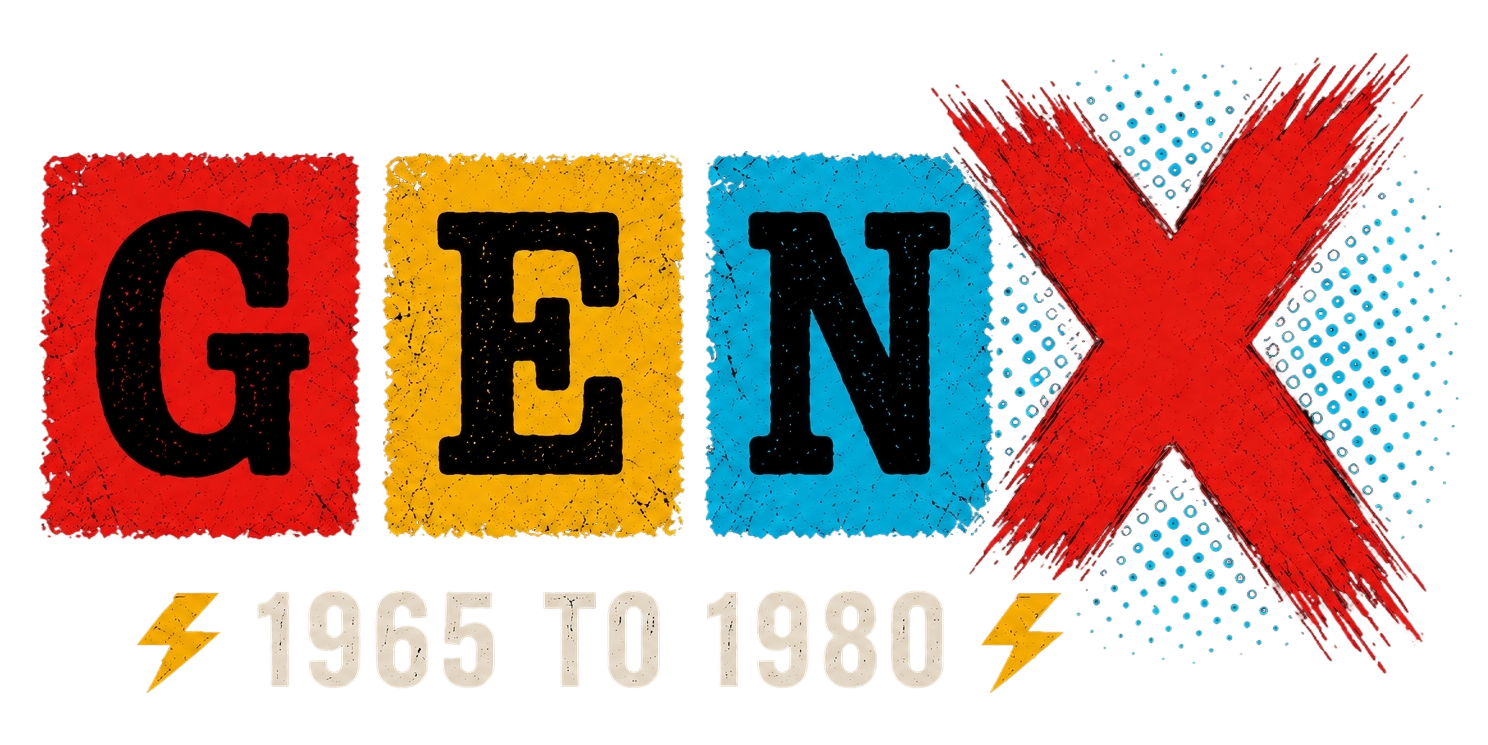

You looked it up. That is the part worth sitting with for a second. Somebody asked what comes after Gen X — a coworker, a kid at dinner, or nobody at all, just the question surfacing on its own at eleven at night — and you, a person who lived through the entire sequence in real time, had to go and check.
So here is the answer first, because holding it back for three hundred words would be a bit, and we don’t do bits: Millennials, then Gen Z, then Gen Alpha, then Gen Beta. Dates below, along with the news that nobody agrees on them.
The more interesting question is the one underneath. Not what comes after us. Why we’re the one you had to look up.
What comes after Gen X: the short answer, so you can get on with your day

In order, using the most widely cited American definition, from Pew Research Center:
- Generation X — born 1965 to 1980. That’s us.
- Millennials, also called Generation Y — born 1981 to 1996.
- Generation Z — born 1997 onward. Pew set the start and never formally committed to an end; most people use 2012.
- Generation Alpha — born 2010 to 2024, per the Australian research firm McCrindle, which coined the name.
- Generation Beta — born 2025 to 2039. Same firm. They announced it in January 2025, which means there are people reading this who have a Gen Beta grandchild and have not been informed.
That’s the whole answer. If that’s what you came for, you’re free to go, and we mean that sincerely — this is one of maybe four pages on the internet about this question that isn’t trying to keep you here.
Two things worth noticing before you do, though. The first is that the generation immediately after us is named with a letter that only makes sense as “the one after X.” The second is that two generations later, the people doing the naming hit the end of the alphabet and had to switch to a different one entirely. Sixty years of demographic categories, and the system ran out of runway in about thirty.
Why nobody asks what comes after the Boomers

Try it. Say the words “what comes after the Baby Boomers” out loud and notice how strange it feels. Nobody asks that. Not because the answer is obvious — it’s us, and plenty of people would stall on that too — but because the question never forms in the first place. The Boomers are load-bearing. They’re the fixed point everything else gets measured against.
There’s a concrete reason for that, and it isn’t charisma.
The Baby Boomers are the only American generation with an official boundary. The U.S. Census Bureau designated them: 1946 to 1964, drawn around the documented surge in births after the war and the equally documented decline in the birth rate after 1964. That’s not a vibe. That’s a line on a chart with a government agency behind it.
Every generation after them is a judgment call. Pew says so plainly, in the same document everyone cites for the dates: unlike the Boomers, there are no comparably definitive thresholds by which later generational boundaries are defined. Read that again, because it’s doing a lot of quiet work. The Boomers got a demographic event. We got a bracket drawn by researchers who needed somewhere to put us, and the brackets after us were drawn by people who needed somewhere to put them.
So the Boomers are a fact and the rest of us are a convention. That’s the structural answer to why you had to look this up, and it’s genuinely not a slight — it’s just how the accounting worked out. Nobody has to look up the thing that was measured. You look up the thing that was decided.
Where it gets funnier is that we’re the first cohort on the wrong side of that line. The Boomers are defined by an event. We’re defined by the absence of one. We are, in the most literal demographic sense, what happened next.
It’s worth saying that this is a measurement problem and not a grievance. The birth rate did what it did; nobody convened to leave us out. But it does explain the specific shape of the question. People don’t ask what comes after the Boomers because the Boomers are the reference point. They ask what comes after Gen X because we’re the part of the sequence that feels like it needs confirming — the stretch where the numbering stops being derived from anything and starts being asserted.
X was a placeholder, and it stuck

Here’s the part that actually earns a laugh, if you like your laughs dry.
The name “Generation X” was in circulation for roughly forty years before it landed on us, and in that time it was pinned on three separate groups of people, none of whom were us.
It first appeared in print in December 1952, in a magazine announcing an upcoming photo-essay by the war photographer Robert Capa. His subject was young people coming of age immediately after the Second World War — a cohort now called the Silent Generation. He called them Generation X because he didn’t know what they were yet.
Then in 1964, Jane Deverson and Charles Hamblett published a book called Generation X, about British youth. Those young people were, by the dates everyone now uses, older Baby Boomers.
Then in 1991, Douglas Coupland published the novel that finally made the term stick: Generation X: Tales for an Accelerated Culture. His characters were born in the late fifties and early sixties — which, again by the standard dates, makes them younger Boomers.
Three uses of the name across four decades, and every single time it was applied to somebody else. We inherited it the way you inherit a sweater: it was in the house, nobody else wanted it, it fit.
And the origin of the letter is better than the folklore. Coupland was asked about it for years and in 1995 explained that the title came from the last chapter of Class, Paul Fussell’s book on the American status system. In it, Fussell describes an “X” category — people who had opted out of the merry-go-round of status, money, and social climbing altogether. Not a slot in a sequence. Not a letter waiting for a number. A refusal.
Which means the generation that got named for declining to participate was subsequently filed, sorted, bracketed, and charted by every market research firm in the Western hemisphere. There’s no punchline to add to that. It supplies its own.
Everyone after us just continued the alphabet. Y, then Z, then the alphabet ran out and they went Greek. There’s something clarifying about knowing that the entire naming system downstream of us is just “the letters after X,” and the entire system upstream is one census designation. We are the hinge between a fact and a filing convention. If you want the longer version of how we actually talk about ourselves, we’ve been through the slang and why the delivery mattered more than the words.
The sources can’t agree on where we end

If you’ve ever had a mild argument with a sibling about which generation they’re in, you weren’t both wrong. You were using different vendors.
Pew Research Center puts Generation X at 1965 to 1980. McCrindle, the Australian firm that named Alpha and Beta, puts Generation X at 1965 to 1979. Same start, different finish.
So if you were born in 1980, you are Generation X to an American think tank and Generation Y to an Australian research consultancy, simultaneously, forever. Your generational identity depends on which PDF somebody downloaded.
It doesn’t stop with us. Pew starts Gen Z at 1997; McCrindle runs Gen Z from 1995 to 2009. McCrindle begins Generation Alpha in 2010, while anyone using Pew’s commonly cited 2012 endpoint for Gen Z starts Alpha in 2013. Three full years of babies belong to two different generations depending on who you ask, and all of those babies are now in middle school, entirely unaware that they are contested territory.
Pew is upfront about the softness here. Generational cutoff points aren’t an exact science, they say, and a typical generation spans somewhere between fifteen and eighteen years — a range, not a rule, because there is no agreed formula for how long a generation is supposed to last.
People born right on the seam noticed this before the researchers did and started using their own term for it, a micro-label for the ones who straddle the line between us and the Millennials. That’s what happens when the official brackets don’t describe anyone’s actual experience: the people inside them quietly build a better one.
This has consequences that are funnier than they are serious. Every workplace training deck, every survey, and every piece of marketing aimed at “Gen X” is drawing from a population that two reputable firms define differently. Somewhere there is a 1980 baby who has been counted in both cohorts in the same quarter by two different consultancies, and who is, as a result, statistically everywhere and nowhere. If you’ve ever wondered why the merch aimed at us is so often slightly off — including the shirts that just print the words “Gen X” and call it a joke — part of the answer is that the people making it are working from a bracket, not from a memory.
And notice where the disagreement falls. Not in the middle of us. On our back edge, exactly where we end. The one boundary the two major naming authorities can’t settle is the one that determines who’s the last Gen Xer. Of course it is.
The newsletter
Like a mixtape, but it shows up on its own
One email a week. The good posts, new designs, zero exclamation points. Unsubscribe whenever. We won't take it personally.
Who the generation charts are actually for

We went and looked at what’s actually ranking on Google for this question today, which we recommend to nobody.
The number one result is a private bank’s article about how different generations view wealth. Its own section headings label the Boomers “the luckiest generation,” Gen X “the forgotten generation,” Millennials “the disillusioned heirs,” and Gen Z “the cynical.” At no point does it answer the question. It is not there to answer the question. The rest of the first page is a workplace-management post, a wealth-data roundup, a bank’s social media graphic, and three forum threads of people arguing.
Meanwhile the firm that named Generation Alpha and Generation Beta runs a website about Generation Alpha that sells a Generation Alpha masterclass, with an enroll button, next to a Generation Alpha book. We’re not suggesting anything underhanded. We’re noting, flatly, that the naming and the selling are the same business, and have been the whole time.
Here’s the detail that should have gotten more attention than it did. In May 2023, Pew Research Center — the organization more responsible than any other for these labels in America — publicly scaled back its own use of them. After a year of review, it announced it would only run generational analysis where it had decades of comparable data allowing it to compare cohorts at the same stage of life. Its stated reason included this: the field has been flooded with content that’s often sold as research but is more like clickbait or marketing mythology.
Marketing mythology. From Pew. About the category system they helped popularize.
When the people who built the filing cabinet start putting warning labels on the drawers, you’ve learned what the drawers were mostly being used for. These charts were never built to tell us who we are. They were built to help somebody decide what to sell us, which is the one commercial activity this generation has a documented immune response to. We’ve been over why every list of Gen X traits reads like it was written by someone who heard about us secondhand, and this is the machinery sitting underneath those lists.
Our whole position on this is that if a thing has to be explained to you with a chart, it was never yours. The stuff we print works the other way around: the person across the room either clocks it in two seconds or they don’t, and both outcomes are fine.
No chart required
Designs for people who were there, and who don’t need the birth years printed on the front to prove it. If it needs a footnote, we didn’t make it.
What comes after Gen X isn’t the interesting question

The better question is how roughly sixty-five million people became the cohort that requires a search.
Part of it is arithmetic. We’re the smallest of the four big living cohorts, bracketed by the two largest, and when you’re the narrow band between two wide ones you get averaged out of most charts by default.
But the larger part isn’t arithmetic. It’s that we never ran a campaign. There was no Gen X spokesperson, no generational manifesto, nobody from our cohort going on television to explain our values to a panel. The Boomers had an ideology and the volume to broadcast it. The Millennials got a decade of trend pieces written about them, mostly by people trying to sell them things, and pushed back loudly enough that the pushback became its own genre. We mostly just declined the interview.
And the thing about declining the interview is that it works. It works completely. You don’t get written about, you don’t get a canonical narrative, and two generations later people have to look you up — not because you’re obscure, but because you never filed anything. We were doing the jokes on a photocopier, in a format with no analytics and no reach, which is to say, for free, for each other.
There’s a timing element too. We came of age in the last window before everything was recorded. The Boomers had network television and the Millennials had the internet, and both of those archive themselves automatically. Our twenties happened on answering machines, mix tapes, and photocopies, none of which were indexed by anything. So when somebody goes looking for us later, there’s less to find — not because less happened, but because the medium didn’t keep receipts. Asking what comes after Gen X is easy; the search engine has a tidy answer. Asking what Gen X actually was returns a bank’s opinion, because the bank wrote its version down and we didn’t.
Being hard to find is downstream of being hard to sell to. Those are the same trait viewed from two directions, and we would have picked that trait anyway. The cost is a search result. That’s a fine price.
There’s an upside nobody puts on the chart, too. The cohort that was never assigned a story doesn’t have to carry one. Nobody younger has strong opinions about what we’re supposed to be, because nobody told them. We get to be specific instead of representative — which, if you’ve watched the generation on either side of us get flattened into a personality type for a decade straight, is not a bad deal. It also explains why the deadpan turned out to be hereditary: you can’t pass down a brand you never had, so what got handed over was a tone.
From the shop
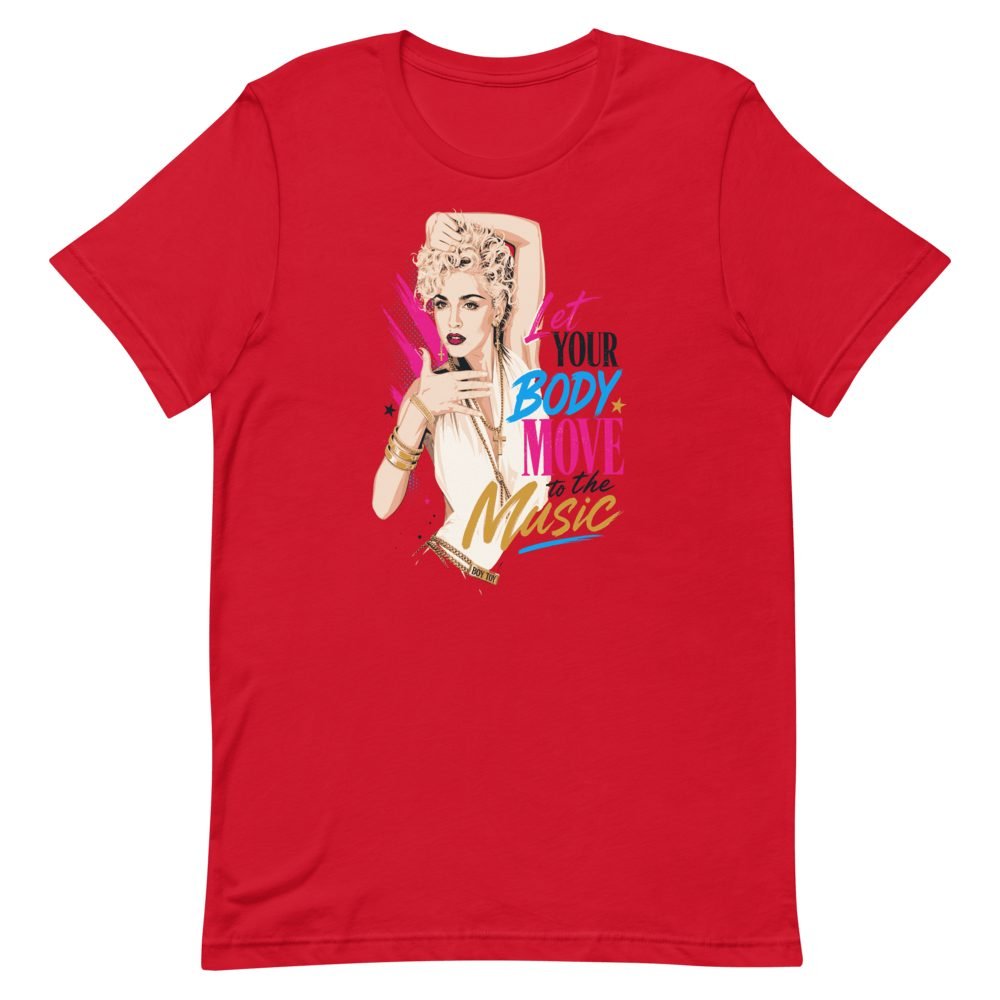
Madonna Let Your Body Move 80s Pop Art T-Shirt
Price range: $24.99 through $26.99
Shop this designBeing the variable turned out to be fine
In algebra, X isn’t a blank. It’s the thing you’re solving for — the value that’s there, doing real work in the equation, just not yet written down. Everyone after us got a position in a sequence. We got a variable.
It was supposed to be temporary. Capa used it because he didn’t know what to call those kids yet. Fussell used it for the people who’d stepped off the ladder. Coupland borrowed it, the novel sold, and the placeholder hardened into the permanent name of eighty million people across the Western world. We are the only cohort named for not having been identified yet, and then we spent forty years quietly proving the name was right.
So: what comes after Gen X is the Millennials, then Gen Z, then Alpha, then Beta, and by the time you’ve finished reading this, someone in an office has probably sketched the one after that. Whether any of them end up meaning much is a separate question, and Pew — which would know — has already started hedging. Nostalgia isn’t a highlight reel and a birth year isn’t a personality, and we were always going to be the generation least likely to be moved by either.
You had to look us up. Honestly, given the alternative, we’ll take it.
Before you go
You made it to the end. Respect.
Get the best of these in one short weekly email, plus whatever we just printed. No spam. We were raised better than that. Mostly.