Look up 90s board games and you’ll get two lists from two different decades. One is the toy aisle: games that talked, buzzed, rang, lurched, and occasionally screamed at you from a videotape. The other is a hobby forum, where the 90s are the decade the modern board game was born and nobody has heard of the talking ones. Neither list mentions the other. Neither mentions us.
That’s odd, because we were there for both. Over the course of the decade, Gen X ran from about ten years old to about thirty-five, which is exactly the wrong age for one of those lists and exactly the right age for the other. We were too old for the games that talked. We were the ones reading their instructions out loud to somebody younger. And then we took a different box to a party in a rented apartment, and board games quietly stopped being a kids’ thing. Nobody filed a report. Here’s ours.
90s board games had two audiences, and we were the other one
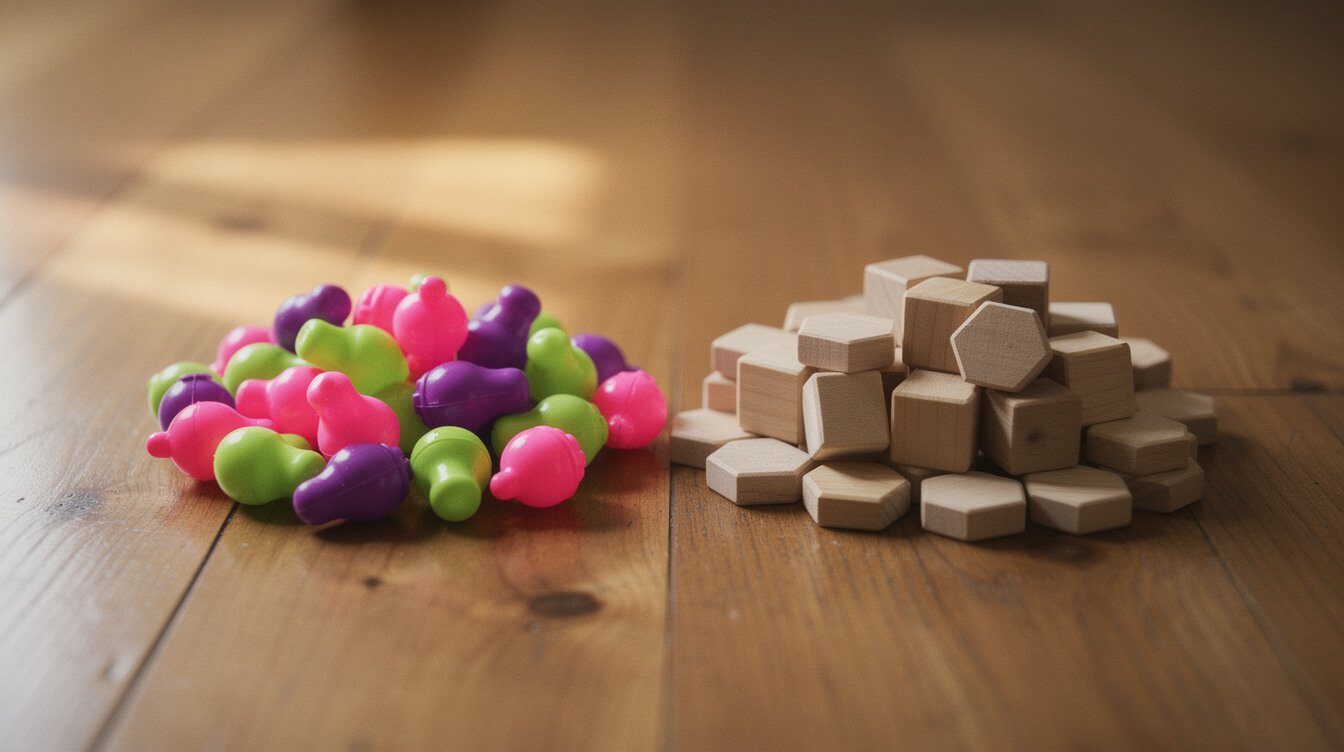
Start with what the search results agree on, which isn’t much. The nostalgia lists are written by people who were kids in the 90s, and they remember the decade from about three feet off the ground. Their 90s board games are bright plastic, battery-powered, and loud. The hobby threads are written by people who collect, and their 90s is a run of serious designs with wooden cubes, auctions, and rules you could argue about for a year. Both are accurate. They just describe different rooms in the same house.
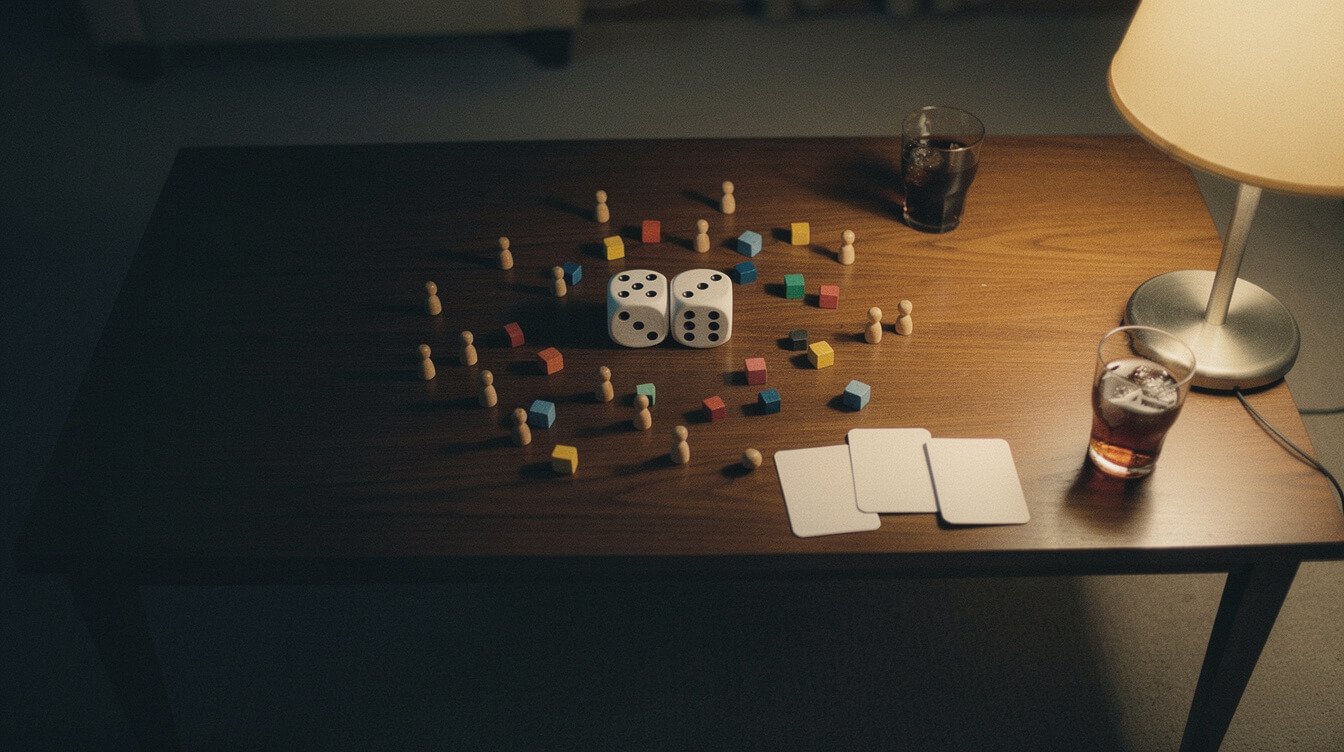
Gen X moved between those rooms. In 1991 a lot of us were twelve, babysitting for three dollars an hour, and the game on the living-room floor was somebody else’s. By 1997 a lot of us were twenty-eight with a futon, a milk crate for a coffee table, and friends coming over with a box under one arm. Same decade. Completely different game.
Too old for one list, too early for the other
The kids’ lists file us under “parent,” which most of us weren’t yet. The hobby crowd files us under “early adopter,” which we didn’t call ourselves, because nobody had told us there was a hobby. We just thought we were playing games with our friends. The category arrived later, the way categories do, and by then we’d already done the work of making it normal for adults to sit on a floor on a Saturday night and roll dice on purpose.
So that’s the angle here. Not a ranked list, because there are plenty, and the rankings mostly measure how loud a game was. This is 90s board games from the Gen-X side of the table: the games we watched, the games we read aloud, and the games we actually chose.
The toy aisle started talking
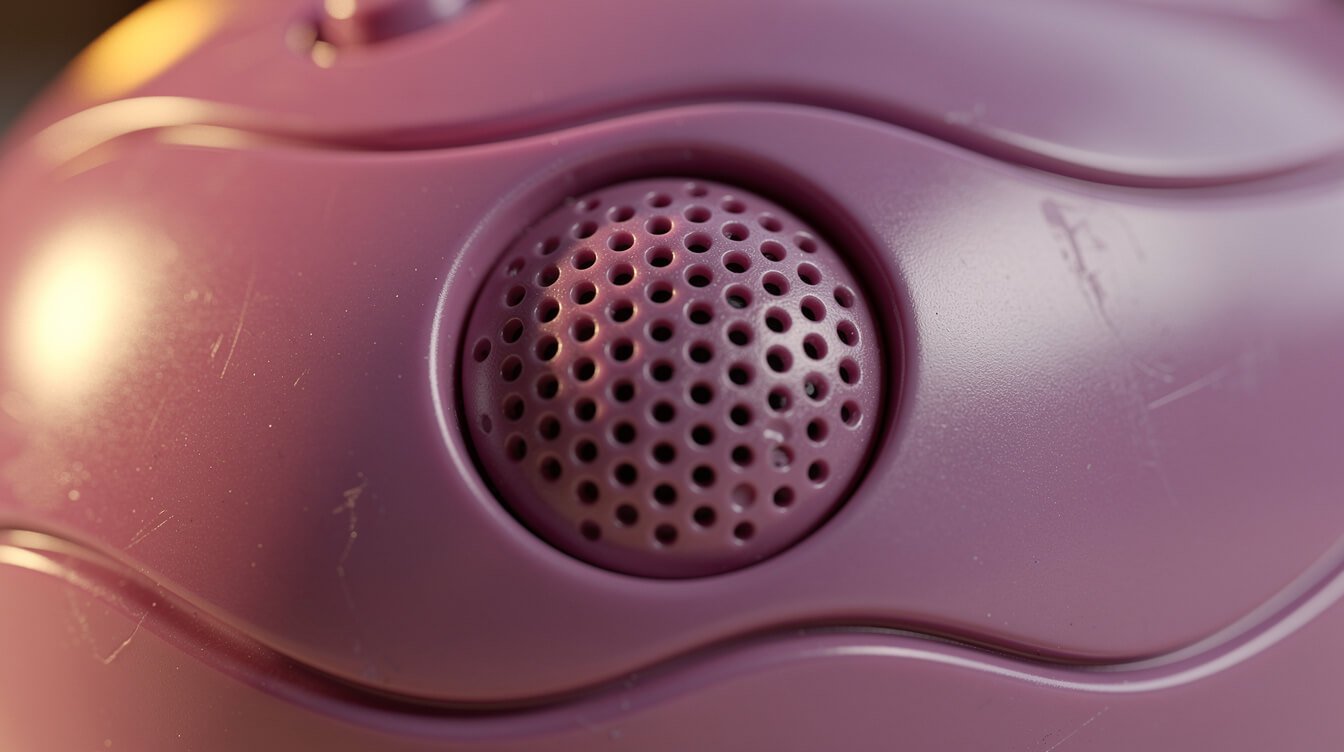
Sometime around the end of the 80s, cheap electronics got cheap enough to put in a box that also had a cardboard board in it. The result was a run of games that didn’t really need a player to keep score, keep time, or keep secrets, because a small plastic computer in the middle of the table did all three.
The best-known of the talking 90s board games is the shopping game with the talking mall in the middle. It’s on every 90s list, and it’s slightly older than the lists think. The original came out in 1988, the talking edition in 1989, and a redesign followed in 1996. Its maker followed it with a whole line of electronic voice games. The one the younger half of the generation remembers best is the pink plastic phone that told you, one clue at a time, which boy liked you. You dialed a number, a recorded voice gave you a hint, and the hint was always slightly less helpful than you wanted. Call it practice.
Games that scared you on purpose
Then there was the jump-scare school of design, which deserves its own shelf. A dad asleep in bed who sat bolt upright if you pressed his alarm clock one too many times. A shark that lurched across the board on a timer. A domed arena where two players fired ball bearings at a puck, which was, it turns out, a 1971 game with a new dome on it. And from Australia in 1991, a horror game that came with a videotape: a man in heavy makeup on the TV screen who interrupted your turn to insult you and give orders. It sold its two millionth copy by Christmas 1993, and the sequel made the top ten in the US in 1995.
If you were twelve, all of this was the most exciting thing in the house. If you were seventeen, it was a sound coming from the next room. If you were twenty-four, you were the one who’d bought it for a niece, and you were now in a living room at nine at night while a pillow-sized plastic dad screamed at a six-year-old. These games weren’t really for us. They were happening near us.
Reading the rules out loud to a seven-year-old
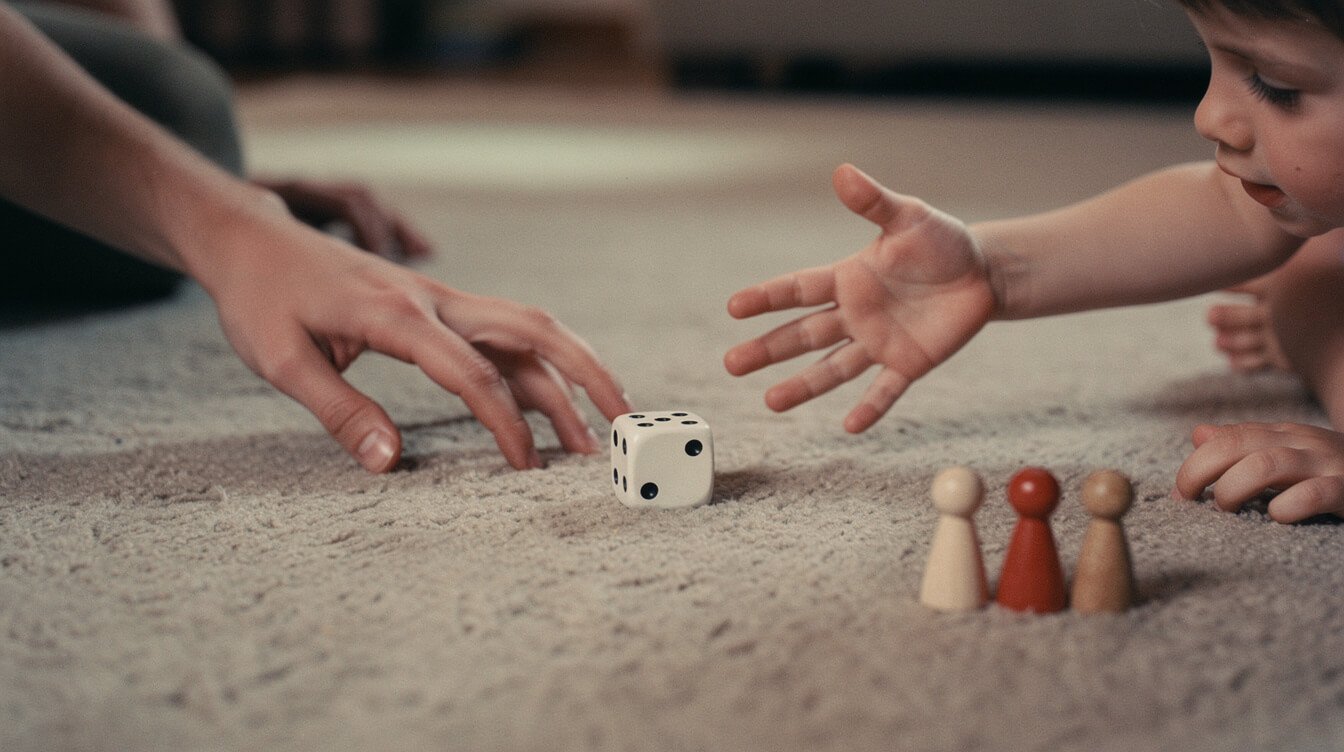
This was the actual Gen-X job in the 90s board games era: the reader. Somebody had to sit on the carpet, unfold the instruction sheet, and announce how the game worked to a younger audience that had already started playing. You read the first paragraph. You got as far as “setup.” The seven-year-old had rolled the die three times and was moving a piece in a direction that existed in no rulebook.
You learned fast that the instruction sheet was a suggestion. The game had to end before bedtime, before the parents got home, or before your patience did, and those were all hard deadlines. So you edited. Turns got shorter. Two of the special squares quietly stopped being special. A game that claimed to take forty-five minutes now took eighteen, and everyone agreed it had always been eighteen. You weren’t cheating. You were the producer.
The babysitter’s rule
Every babysitter had one house rule that the game box never mentioned: the game ends when I say it ends, and the kid wins. Not every time. Often enough. A small person who wins a game at 8:40 goes to bed. A small person who loses a game at 8:40 wants a rematch, and the rematch has no ending. We figured this out on our own, the way we figured most things out, and it remains the single most useful piece of game design most of us have ever done.
The thing about reading rules out loud is that you start to see how a game is built. Which parts are doing work and which parts are decoration. Where a rule exists only to sell a plastic gadget. That turns out to be a skill. We’d use it later, on our own kids, and some of us are still using it, on our own kids’ kids, with a deadpan that’s become more or less hereditary. The talking toys are part of a bigger shift we already wrote about in what actually happened to our 80s toys. By the 90s, we were the ones handing them down.
The party games were older than the party
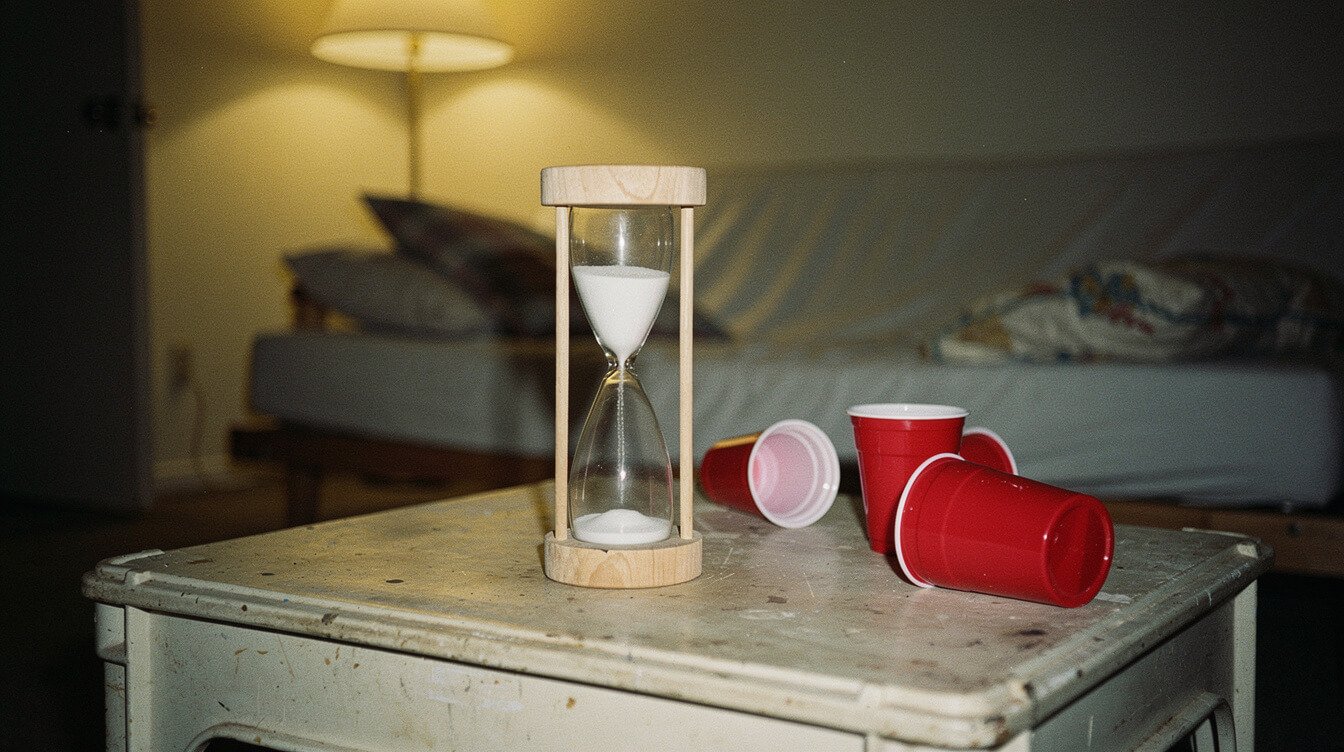
Here’s the part the lists get wrong in a way that matters. Ask anyone which games ran a 90s house party and you’ll get the same handful: the one where you draw the word and your team shouts at you, the one where you can’t say the five forbidden words on the card, the one where you list things that start with a letter before the timer runs out, and the one where everyone writes a fake definition for a real word. Those are absolutely the games of the 90s apartment. None of them came out in the 90s.
The fake-dictionary game is from 1984. The drawing game is 1985. The category game is 1988. The forbidden-words game is 1989. They were born in the 80s and grew up in our apartments. One recent search summary dated the category game to 1993, which tells you how completely we absorbed it. The decade didn’t invent the adult party game. It just gave it somewhere to happen: a room with no parents in it, a sand timer, and seven people sitting on a floor because the futon only held three.
Why a game, and not just a party
Partly money. A game cost less than a round of drinks at the bar and lasted longer. Partly the room: in a one-bedroom with no table, a game gave everyone something to look at that wasn’t the stain on the ceiling. And partly that a game is social cover. You could spend an evening across from somebody you liked without having to make conversation. You just had to draw a horse badly and let them guess it. Every first-apartment party had one couple that met over a team drawing game and one couple that broke up over one.
The decade did add one. A 1998 party game crammed drawing, trivia, word puzzles, humming, and sculpting clay into one box. It was sold first through an online bookstore and a national coffee chain, which at the time was a strange place to buy a board game. It worked. The company that made it sold for $77.5 million in 2008. It’s the most Gen-X origin story on this list: a party game that skipped the toy store entirely, because its audience was no longer in the toy store.
The newsletter
Like a mixtape, but it shows up on its own
One email a week. The good posts, new designs, zero exclamation points. Unsubscribe whenever. We won't take it personally.
Meanwhile, a game from Germany (and a deck of cards from a mathematician)
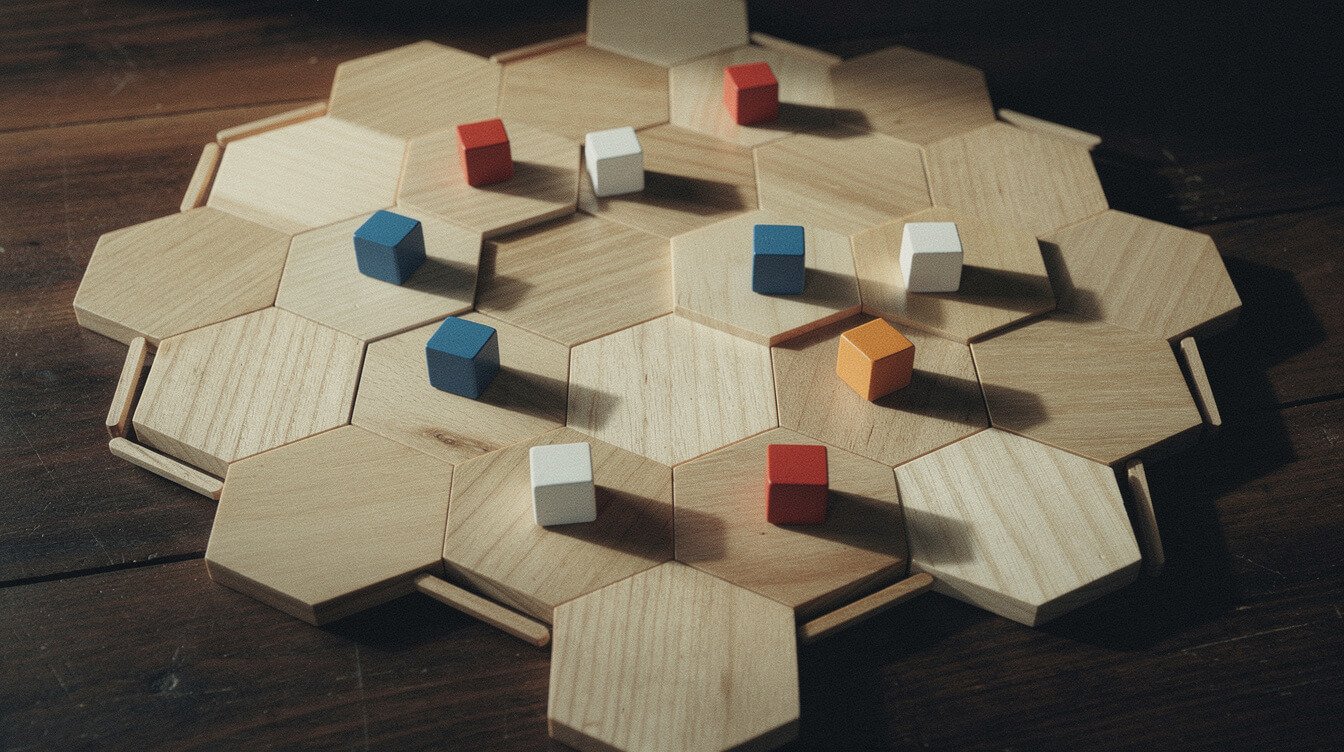
While the party games were running the apartment, the other half of the 90s board games story was happening somewhere quieter, usually in the back room of a comic shop or a game store with a hand-lettered sign about a tournament on Thursday.
In 1993, a math PhD’s collectible card game came out, and inside a year half the people you knew from college were carrying a shoebox of cards and talking about it in a vocabulary you didn’t have. In 1995, a German game about settling an island won Germany’s game-of-the-year prize. You traded sheep for brick, built roads, and argued about it, and an American publisher brought it out in English in 1996. It’s sold more than 32 million copies since, in 40 languages. In 1995, it was something a friend’s roommate had brought back from a trip and nobody could find in a store.
The first adult hobby gamers
This is where Gen X did something no generation before us had done in numbers: we kept playing board games as adults, by choice, with other adults, and nobody made us. Our parents played cards. Some of them played the old family games at the holidays, out of duty. We sat down on a weeknight to play a game about wheat with an hour of rules, and we did it sober, and we did it again the next week.
We were also, as usual, too early to get credit. The hobby didn’t have a name in the mainstream until the 2000s, when people a few years younger than us discovered it and wrote about discovering it. And when a monster-collecting card game crossed over from Japan at the very end of the decade, published in the US by the same company behind the 1993 card game, the people standing in line at the store with a ten-year-old were mostly us. We knew how to read the rules out loud. We’d been doing it since 1991.
No pieces to lose
For the one who read the rules out loud, then rewrote them. No batteries, no setup, nothing that talks back.
Where the 90s board games ended up
The talking 90s board games mostly went quiet. Their electronics were the first thing to go, and a talking game that doesn’t talk is just a board with a hole in the middle. A lot of them went to the thrift store, where they sit on the bottom shelf under a stack of jigsaw puzzles, and every so often someone our age picks one up, turns it over, and puts it back with a face that says “oh, no, not that.”
The party games had a better retirement. They moved from the apartment to the house, from the floor to an actual table, and then to the top shelf of a closet at somebody’s in-laws’, where they come down once a year at the holidays and are just as good as they were. That’s the closet game now. Plenty of them are still in print, a little redesigned, which tells you they were never really a fad. They were a format, and the format still works.
And the hobby games won outright. The settlement game is in big-box stores. Board-game cafés exist. People a decade younger than us write long essays about the golden age of tabletop games as if it started in 2010. It didn’t. It started in 1995, in a one-bedroom apartment, with a game nobody could find in a store and four people who’d all just turned twenty-six. If you’d rather wear the decade than store it, the shop has a few things with no pieces to lose. The rest of what we owned back then is in the 90s stuff we paid for ourselves, and none of it talked either.
90s board games: quick answers
What were the most popular 90s board games?
It depends which 90s you mean. For kids, the electronic and gimmick games ran the decade: the talking mall, the pink phone, the videotape horror game, and a long run of jump-scare and dexterity games. For adults, the most popular games at a 90s party were mostly 80s releases, the drawing, forbidden-word, category, and fake-dictionary games. For the hobby crowd, the big ones were the 1993 collectible card game and the 1995 German settlement game.
What was the most popular game in the 1990s?
There’s no honest single answer, and any list that gives one is counting one audience. By long-term sales, the 1995 settlement game is the decade’s biggest new board game, with 32 million-plus copies sold since. By cultural footprint, the 1993 collectible card game is bigger. By sheer noise in a 90s living room, the talking games win without contest.
Were the classic party games actually from the 90s?
Mostly no. The drawing game came out in 1985, the fake-dictionary game in 1984, the category game in 1988, and the forbidden-words game in 1989. They became 90s board games because that’s when the people who loved them got apartments of their own to play them in.
What board games came out in the 90s for adults?
The 1998 multi-activity party game, sold through an online bookstore and a coffee chain, was the decade’s big new adult party game. On the hobby side there was the German settlement game, a run of European auction and tile games, and the collectible card games. Almost all of them were played by Gen X first, usually on a floor.
Are 90s board games worth anything now?
Some are, to collectors. But the ones worth the most are the ones nobody played. The game you actually remember is worth the evening it gave you, which is more than most things in the closet.

From the shop
Nirvana In Utero Chinese Fan Art Vintage T-Shirt
Price range: $24.99 through $26.99
Shop this designFinal thoughts: we carried it across
The 90s board games lists all leave us out for the same reason. We weren’t the target market for any of it. The talking games were for our younger siblings. The hobby games were for people who didn’t exist yet. The party games had been sitting on store shelves for years, waiting for somebody with a living room and no parents in it.
We were the somebody. We read the rules to the little kid, and then we took the game to the apartment. Twenty years later, half the adults we know have a shelf of games they play on purpose, and nobody thinks it’s strange. That used to be strange. We made it normal, mostly by not making a big deal about it, which is the most Gen-X way to change anything.
If you’re still the one who reads the rules out loud, nobody’s taking that job from you. If you want the long view of the decade, 90s nostalgia, done properly, is a good place to keep going. And if the next game night is an 80s theme party, don’t worry. Nobody has to dress as a board game.
Before you go
You made it to the end. Respect.
Get the best of these in one short weekly email, plus whatever we just printed. No spam. We were raised better than that. Mostly.