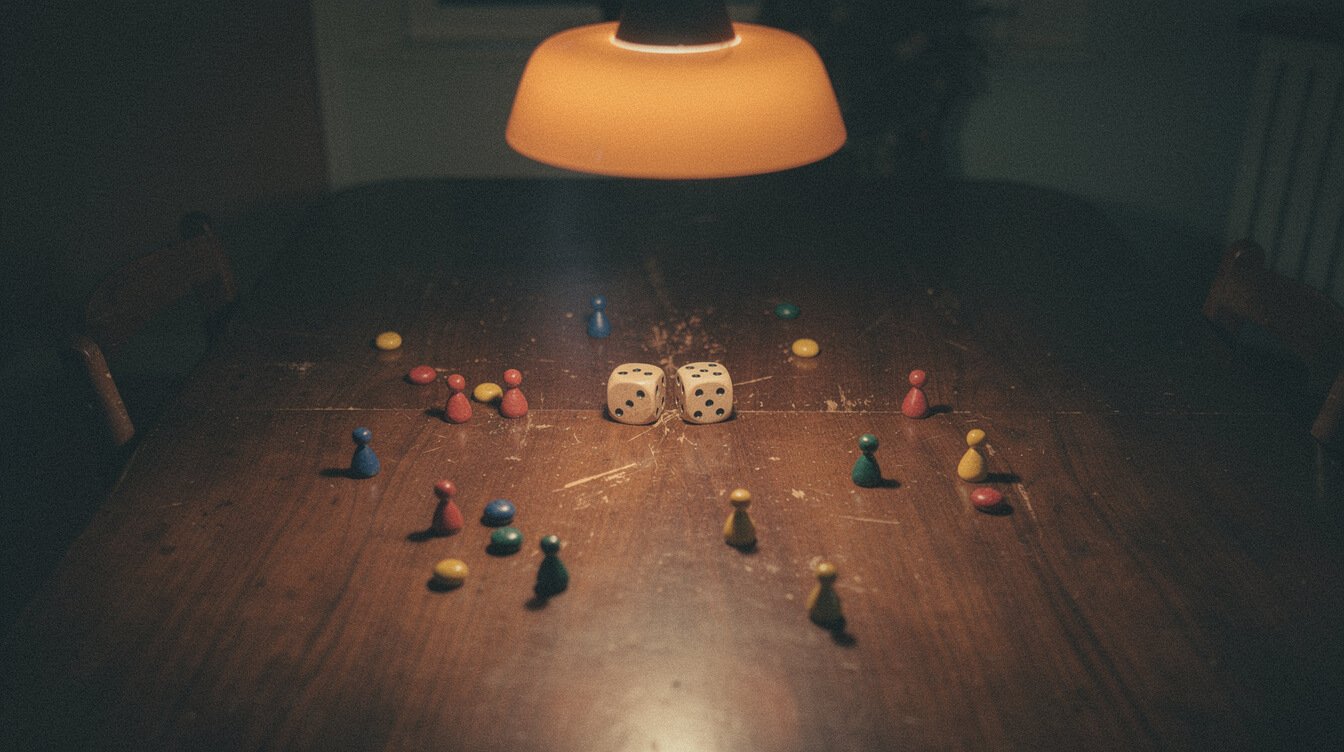
Every list of 80s board games is a list of boxes. Here’s the cover, here’s the year, here’s a paragraph about how much fun it was. And every one of them leaves out the one thing anybody who was actually there remembers: how the game ended. Because it mostly didn’t. An 80s board game ended when somebody’s mom said “dinner,” when a little brother sat on the board, when the dog came through, or when one player stood up, lifted one edge of the cardboard, and let gravity file the final report.
Winners happened. They were rare enough that you remembered them, like a snow day or a working pay phone. The usual ending was a table covered in pieces, a box lid on the floor, and a parent asking whether anyone planned to put this away before Christmas. So this isn’t a ranking. The lists have that covered, forty games deep. This is the other half of the story: why the biggest games of the decade were built to run longer than a kid’s attention span, and the strange fact that a few of them couldn’t be finished even by the grown-ups who made them.
80s board games ended. They almost never finished.
Start with a count. If you went back and tallied every game you started between 1980 and 1989, the column marked “somebody won” would be the short one. The long column would read like an incident log: interrupted by a meal, abandoned at bedtime, lost to a sibling, quit in protest, called on account of a missing die that turned up in the couch two years later. The games were fine. The conditions weren’t. Nobody ever played an 80s board game in a lab.
The house treated a game in progress as a weather system. You couldn’t move it, so you worked around it. The board stayed on the dining table under a dish towel, with a hand-lettered sign on notebook paper that said DO NOT TOUCH, and the family ate dinner on trays in the den for three nights rather than lose somebody’s hotel empire. Whoever was ahead wanted to keep it up. Whoever was losing hoped for a cat.
The four ways it actually ended
If you were there, you know the official list. One: the clock. Somebody’s ride showed up, and the game was declared “paused,” which meant over. Two: the sibling. A younger kid wanted in, got told no, and solved that with one sweep of the arm. Three: the walkout. Somebody did the math, saw the next forty minutes of losing slowly, and remembered they had homework. Four: the flip. It was rare, it was loud, and it was the only ending everyone agreed on, because nobody had to count anything.
None of these show up on the box. The box shows four smiling people around a table, everyone with a full set of pieces and a clean shirt. What you got was two kids on a carpet, a dog, and a deadline. We’ve written about what happened to the toys themselves, and the same rules applied here. The game you remember isn’t the one in the catalog. It’s the one that lasted until dinner.
That’s the thing about 80s board games that the lists never mention. The famous ones weren’t designed to fit an afternoon. A few were designed in another century, to make a point. One was designed so it could only end in total victory. One spun off into a movie that shipped three different solutions. And one cost more than a week of allowance, then spent four years being argued about in court. Each one, it turns out, had a reason it never finished.
The property game was built to teach you the opposite
The biggest of the long games was the one with the little green houses. You know which one. A family played it every holiday, and it ended in tears or a dispute about the rules about once in three tries. What almost nobody knew in 1984 is that it started as a protest.
In 1902 and 1903, a woman named Lizzie Magie designed a board game in Arden, Delaware, and patented it in 1904 as The Landlord’s Game. It was a teaching tool for the economic ideas of Henry George. She described it as a “practical demonstration of the present system of land grabbing with all its usual outcomes and consequences.” The idea was to show how rent made property owners rich and tenants poor. She also hoped, and this is the part to sit with, that kids who played it would have their natural suspicion of unfairness provoked, and carry it into adulthood.
Then the game spread the way games spread before anybody could sell them. College students drew their own boards. Quakers in Atlantic City renamed the squares after their own streets. Thirty years later the version everybody knows arrived in stores, and when the company that sold it learned its supposed inventor wasn’t the only one, it bought Magie’s patent for $500. So the game a whole generation used to learn that the winner is whoever owns everything was designed to teach the exact reverse. We learned the opposite lesson. Very thoroughly. Usually from an older cousin.
The rule that would have ended it
Here’s why it never finished. The official rules say that if you land on a property and don’t want to buy it, the bank auctions it off to the other players. The auction is the release valve. It gets every property onto the board fast, and the game ends in a reasonable time. In almost every 80s house, nobody read that far. A skipped property just sat in the bank, waiting for someone to land on it again. The game slowed to a crawl. Even the official estimate puts a game anywhere from one to six hours, and that’s for people who follow the rules.
Nobody followed the rules. The most famous house rule of all, the cash in the middle of the board that you collected when you landed on the parking corner, isn’t in the rules either. It just pumps more money into the game so nobody goes broke, which is the only way the game can end. Decades later, the maker polled its social media followers about the house rules people actually played. In 2014 it put the winners in a special edition, which is a company admitting, in writing, that the rule nobody followed and the rule everybody followed had switched places. The kid at the table who said “that’s not how you play” was usually right. She was also usually eleven, the banker, and outvoted.
The world-conquest game had no ending (in America)

If the property game was slow, the world-conquest game was geological. You know it: forty-two territories, six continents, a fistful of dice, and one kid who planted every army he had on the small continent in the bottom-right corner of the map and simply stayed there, like a man who has found the good seat at the bus station. The usual estimate runs one to eight hours. Eight. A school day with no lunch.
It was invented in 1957 by a French filmmaker, best known for a short film about a boy and a balloon. It arrived in the US in 1959, and the American version had one goal: conquer the entire world, which means eliminate every other player. That’s an ending that requires everyone else at the table to lose completely, in order, while still being willing to sit there. You can see the problem.
The treaty on notebook paper
The rules neither endorse nor prohibit alliances. They just leave the door open, and every 80s kid walked through it. Two players would agree to leave each other’s borders alone until a third was gone, and sometimes they wrote it down on a sheet of notebook paper with both signatures. It was the most serious document most of us had signed at that age, more binding than a permission slip and less binding than a pinky swear. Rules can’t enforce an alliance, so they broke. The break was the best part of the game and the worst part of the friendship.
Europe had a fix. European editions handed each player a secret mission, like capturing two particular continents, so a game could end before anyone owned everything. In the US, those secret-mission rules weren’t added to the standard box until 1993. So the American 80s ran on the version with no exit. Every game we played was the long one. It explains a lot about how those games ended: not at the end of a world war, but at 9:30 on a school night, with somebody’s dad standing in the doorway holding the light switch like a referee’s whistle.
There was a brief attempt to fix it with a castle version in 1986, set across eighteenth-century Europe instead of the whole globe. It was a financial disappointment. It turns out nobody wanted a shorter war. They wanted to keep the long one, and lose it to a curfew.
The mystery game, and the movie that couldn’t pick one

Of all the 80s board games, the mansion murder mystery was the one that should have ended cleanly. It has an answer. It’s literally in an envelope. Somebody guesses right, the envelope opens, done. And still it found ways not to finish.
The notepad ran out first. Every copy came with a pad of little detective sheets, and by 1983 every pad in America was down to the cardboard backing. After that you drew your own grid on notebook paper, which meant somebody’s grid was always missing a room. Then came the accusation made too early, by a kid who was mostly sure. An accusation is final, so the kid was out, and had to sit there for twenty minutes holding cards that everyone wanted to see, which is its own kind of punishment. And every so often somebody opened the envelope at the end and found that a card had been put back in the wrong place last time. That meant the murder had been unsolvable all along, and nobody could prove who’d done it.
Three endings, one per theater
Then, on December 13, 1985, the movie version came out and took the problem to another level. Each theater got one of three different endings. Some theaters announced which one you’d see. Most of us found out on the playground the next Monday, when three kids who’d seen the same movie each insisted they knew who did it, and all three were right. There had even been a fourth ending, which was written and cut. The director said it really wasn’t very good.
It made $14.6 million against a $15 million budget, which means it technically lost its own game. Then, when the tape came out in August 1986, all three endings were stitched together and played one after the other. That’s how most of us actually saw it: at a sleepover, on a rental, watching a mystery solve itself three times while somebody’s older sister said “this is so dumb” and refused to leave the room. If you can’t remember who did it, that’s not your memory failing. That’s the only accurate memory available.
That’s the joke under all of this. The one game on the shelf with a guaranteed answer became, in its most famous form, the decade’s most public refusal to give one. If a game ends unresolved and that reminds you of how things went at your house, the GenerationX shop has a few things for people who never got a straight answer either.
The newsletter
Like a mixtape, but it shows up on its own
One email a week. The good posts, new designs, zero exclamation points. Unsubscribe whenever. We won't take it personally.
The fifty-dollar tower and the court case that outlasted it

By the early 80s, the game companies could hear the arcade from the parking lot, and they did what scared companies do: they put a computer in the box. The most ambitious of these 80s board games was a black tower that sat in the middle of a round board, with buttons, sound effects, and lights. It was announced in September 1981 at a magic club in Los Angeles. Inside was a single chip with about 2K of memory. That’s less memory than the plain text of this article. It tracked your gold, your warriors, your food, and the dragon, and it told you when you’d lost. The machine kept the score so nobody else could argue about it, which was the first real fix the decade had for the flip.
The price ran somewhere between $50 and $79, depending on the store and the month, which made it the board game you looked at in the toy store and then looked at your parents and then put back. The commercial featured one of the most famous voices in film, which raised the stakes further. And despite good reviews and good sales, the maker stopped producing it after a single holiday season. Most of us knew exactly one kid who had it. You played it at his house, and you played it well, because the batteries didn’t last.
Decided on appeal
Here’s the part no list mentions. Two independent inventors had shown the company a prototype in February 1980: a space game with a round board and a computer unit in the middle. They’d signed a waiver, the company passed, and a year and a half later the tower showed up in stores. They sued. In April 1984 a jury awarded them $737,058.10, their estimated share of royalties on $22 million in sales. In August 1984 the judge threw the verdict out. He wrote that the company had probably “plagiarized the plaintiffs’ idea without so much as a by-your-leave,” and ruled against the inventors anyway, on the strength of the waiver. In May 1985 the appeals court reversed him and put the award back.
So the most expensive board game of the decade got pulled after one Christmas and then took two more years and three rulings to finish. That’s the most 80s board game ending there is: the game was over, but the argument about the game kept going, and somebody had to bring in a higher authority. Every family had a version of that appeals court. Usually it was whoever owned the rulebook, as we covered in the post on how 80s trivia got settled.
The marble under the couch
Then there was the other answer to the arcade, the one with no batteries at all. In 1986, a three-dimensional adventure game put a plastic volcano in the middle of the board and let you roll red marbles down it at the other players. Physics replaced the computer. It was the most fun that box ever held, and it ended the same way every time: a marble jumped the track, rolled under the couch, and joined the permanent collection in there with the missing die, two crayons, and a dime. A company that brings old games back restored it through a crowdfunding campaign in 2018. Grown adults paid good money, presumably to roll the marbles under a nicer couch.
Left the board up for three days.
For whoever wrote DO NOT TOUCH on notebook paper and meant it. Nothing to set up, nothing to put away, no ending required.
80s board games: quick answers
What were the most popular 80s board games?
The ones you remember fall into a few groups. There were the long family games inherited from earlier decades: property, world conquest, and the mansion mystery. There were the new electronic games that put a chip in the middle of the board. There were dexterity games with marbles, plastic traps, and things that popped. And at the end of the decade came the adult party games. The 80s also produced a run of party games that later took over the 90s apartment, which we covered in 90s board games.
Why did 80s board games take so long?
Partly the design and partly us. The big family games were built for total victory: one player owns everything or conquers everything, which takes hours by definition. House rules made it worse. The property game’s skipped auctions and its cash-in-the-middle rule both stretch the game. The American world-conquest game had no secret-mission ending until 1993. Add a kid’s bedtime, and most games ran out of evening before they ran out of players.
Are 80s board games worth anything now?
Some are, to collectors, and almost always for the same reason: completeness. A game with every piece, an unpunched sheet, and a box that isn’t held together with tape is rare, because nobody’s copy was like that. The electronic games are worth more if the electronics still work. The game you actually played, with the replacement pawn and the house rule written inside the lid, is worth about one evening of arguing. That’s more than most things in the closet.
Can you still buy them?
Many of the classics never went out of print. They’ve just been redesigned a few times. Several of the decade’s strange ones have come back as reissues. The volcano marble game returned through crowdfunding in 2018, and a few of the electronic games have been rebuilt with an app instead of a chip. The originals turn up at estate sales and thrift stores, where the box is usually right and the contents are usually a surprise.
What’s the best way to play one now?
Read the actual rules once. Use the auction. Agree on an ending before you start: a time, a score, a number of rounds. That’s the one modern improvement worth stealing. Then, honestly, play it the old way anyway, on the floor, with a snack nobody’s supposed to have near the board. If you want the full 80s evening around it, the 80s theme party for people who were actually there has the rest.

From the shop
Nirvana Incesticide Chinese Reimagined T-Shirt 涅槃乐队
Price range: $24.99 through $26.99
Shop this designFinal thoughts: it’s still set up somewhere
Somewhere there’s a game from 1986 that technically never ended. The board went back in the box with the armies still on it, or the money got shuffled back into the bank without anyone counting it, and the lid went on, and the box went up on the shelf. Nobody won. Nobody lost. It was just over, the way most things were over in the 80s: not with a ceremony, but with somebody calling your name from another room.
We’re fine with that. Honestly, the 80s board games we remember best are the ones we never finished, because the ending wasn’t what we were there for. We were there for the treaty on notebook paper, the cousin who ran the bank like a payday lender, the three kids on the playground who were all right about the movie, and the one marble that’s still under somebody’s couch. If you want more of the decade without the cheesy part, 80s nostalgia, done properly is the place to keep going. And if the strategy guide in your house was a kid on the bus, 80s video games picks up there.
The game’s still paused. Your turn.
Before you go
You made it to the end. Respect.
Get the best of these in one short weekly email, plus whatever we just printed. No spam. We were raised better than that. Mostly.