Every 90s slang list on the internet is the same list. All that and a bag of chips. Talk to the hand. Da bomb. Booyah. Not. A cartoon catchphrase, a line from a sitcom, a dance-floor lyric, all printed in the same bold font with the same example sentence nobody has ever said out loud. And somewhere around entry twelve you notice the thing the list can’t: half of those words were coming out of a twenty-four-year-old at a temp job, and the other half were coming out of that twenty-four-year-old’s nine-year-old cousin.
That’s the whole problem with 90s slang as it’s usually told. In the 90s, two generations were talking at once. Gen X was in college, in first apartments, and in jobs with name tags. The kids who’d later be called millennials were in elementary school, in front of the after-school cartoons. Same decade, same words floating around, completely different rooms. The lists merge the rooms and then hand the result to the younger crowd, because they’re the ones writing the lists now.
So let’s sort it by speaker instead. Who was saying what, where, and why one particular mall store printed up a glossary so its staff could keep up.
90s slang lists are two generations stapled together
Search 90s slang today and page one reads like it was written for a reunion that you weren’t invited to. There’s a language-learning app’s list of phrases “that deserve a comeback.” There’s a guide for parents who want to teach their kids the slang of “a true 90s kid.” There’s a murder-mystery party company with thirty terms you can use in character. There’s a piece about which 90s phrases you now only hear on short-video apps, and there’s a Facebook group arguing in the comments. The one honest result on the page is a culture site pointing out that much of the decade’s vocabulary came out of hip-hop and Black neighborhoods first, which is true and which most of the others skip.
What almost none of them do is put a speaker next to a word. “Talk to the hand” sits right next to a cartoon catchphrase as if they came from the same mouth. “Phat” sits next to something a ten-year-old shouted at a slumber party. A word list doesn’t have a column for age, so it doesn’t notice that a decade’s worth of slang came from people who were, at the start of the 90s, anywhere from six to twenty-five years old.
That age gap is the story. If you were born in 1970, you turned twenty in 1990. Your 90s were a dorm, a shared kitchen, and a series of jobs that came with a polo shirt. If you were born in 1984, your 90s were a bus stop and a lunchbox. You heard some of the same words. You did not use them for the same things, and you definitely didn’t learn them in the same order.
Here’s the part that gets lost: a lot of the slang flowed downhill. It started with older kids, college students, and the radio, and it reached elementary schools a few years later through television, by which point the people who’d started it had moved on or were saying it ironically. The little kids got the words after the irony had been sanded off. That’s why so many lists treat these phrases as cheerful. By the time the list-writers heard them, they were cheerful.
We’ve already written about where 80s slang came from, which pile each word belongs in, and about how Gen X slang was delivered, the flat tone and the pause before “whatever.” This one is narrower. It’s about the decade when we were the older siblings, and about who was in the room when each of these words got said.
What the twenty-somethings said

There’s a reason we can be specific about this. Two linguists spent the late 80s and the 90s writing down what college students said, in real time, semester after semester. Connie Eble at the University of North Carolina has collected student slang every term since the early 70s. Pamela Munro at UCLA published a collection called Slang U. in 1989. Those undergrads were us. When Green’s Dictionary of Slang dates a 90s word, the earliest citation very often comes from one of those two notebooks. So if you want proof of who said it first, it’s sitting in a campus slang list written down by a professor who was listening.
Here’s what that listening turned up on the older side of 90s slang.
Slacker. The word is old. Green’s finds it in 1899 for anyone who dodged work. But the sense of a twenty-something who has looked at the mainstream and decided to pass shows up in 1990, in a Memphis newspaper describing Austin’s “underachieving writers and musicians known around town as slackers.” A low-budget Austin movie that same year wandered from one talker to the next with no plot at all and made the word national. The point is who it described. Slacker was a word about us, said by us, mostly while we were explaining to a parent why we’d moved back home.
The job with no future. In 1986 a Washington newspaper ran a headline about fast-food work being bad for kids, and Green’s earliest citation for the word is right there in it. In 1991 a novel about three twenty-somethings hiding out in the desert, the book that made the generation’s name stick, made the word famous and defined it: low pay, low prestige, low dignity, low benefits, no future, service sector. You know the word. It has a burger chain’s prefix on it. We said it about our own jobs, which is the only way it was ever funny.
Phat. This one came from Black American speech, where Green’s has it as a word of approval in 1963. Eble’s campus list catches it in 1990 meaning “hip, cool, trendy.” So by the time a fourth-grader said it in 1997, it had already been on a college campus for seven years and in Black neighborhoods for over thirty.
Random and sketchy. Both are campus words. Eble has “random” in 1982 meaning undesirable and by 1988 meaning unexpected. Munro has “sketchy” at UCLA in 1989 for unstable or strange, and Eble has it in 1993 for “of questionable character.” A sketchy landlord. A random guy at the party who knew nobody. These words were built for a life with a lot of strangers in it, which describes your early twenties pretty well.
All that. Here’s the one that proves the point. A Baltimore paper noticed in 1991 that people were saying “all that” to mean something was really cool. Eble’s 1993 list has the extended version, “all that and a bag of chips,” and defines it as conceited, thinking highly of oneself. It was sarcastic. On a college campus in 1993, you said it about the guy with the new car who wouldn’t stop mentioning the new car.
Notice what these words have in common. They’re for describing work you didn’t want, people you didn’t trust, and plans that fell through. It’s the vocabulary of somebody with a lease, a roommate who owes them forty dollars, and a manager. If you lived in a first apartment furnished from the same short list as everyone else’s, you know exactly what the register was for.
What the little brothers and sisters said
Now the other room. We’ll concede it in one section, because it’s real and because it’s what most of the lists are actually describing.
The kids had television. Specifically, they had a wall of after-school and Saturday programming built for them, plus the cartoon families that ran in prime time and that their parents pretended not to watch. A huge share of what gets called 90s slang came out of the TV set and went straight to the playground: the catchphrase of a cartoon kid with spiky hair, the scripted bits from sketch shows aimed at ten-year-olds, a dance-move phrase from a hit single. Kids repeated them sincerely, loudly, and constantly, which is what kids are supposed to do with a good catchphrase.
Here’s where “all that” comes back. In 1994 a kids’ sketch show took the first two words as its title. The sarcasm didn’t make it onto the network. To an eight-year-old, “all that and a bag of chips” meant great, full stop, and that’s the definition the lists print today. The older kids had used it to roll their eyes at someone. The younger kids used it as a compliment. Both are right, and neither one is the whole story.
“Talk to the hand” followed the same route. Eble catches it on campus in the spring of 1995. Within a few years it was a schoolyard staple with the full arm extension and the “’cause the face ain’t listening” follow-through. Booyah has the same shape: Munro has it at UCLA in 1989 as a word for suddenness, and it was later turned into a celebration noise for sports highlights and video games.
None of this makes the kids wrong. It just means a 90s slang list is really a family photo where the older sibling is cropped out. The words are in frame. The people who said them first aren’t.
It also explains why a twenty-something in 1998 could hear their own college slang shouted at a birthday party by a bunch of fourth-graders and feel suddenly, specifically old. That feeling was the generation gap happening in real time, in a pizza place, over a word you thought was yours.
The year the mall handed out a glossary
This is the part that never shows up on the lists, and it’s the best evidence that the two-room theory is right.
In 2012, a writer at The Awl published a document he’d kept since college. His girlfriend had applied for a job at a mid-90s mall clothing chain, and part of her training as a greeter was a printed “Street Verbage Guide.” The misspelling was theirs. Management wanted sales associates to memorize it so they could relate to the customers. She was told to study it. He asked her to get him a copy, because it was funny even then.
Think about who’s in that store. The trainee was a college student working a mall job, which is to say, one of us. The customers she was being trained to talk to were teenagers, a few years younger. And the company’s answer to the gap between them was a photocopied glossary.
The guide was what you’d expect from a corporate memo about street talk. Most of its vocabulary came from Black and hip-hop speech, and it had been flattened into a cheat sheet, definitions and all. The writer who kept it called it wrongheaded and full of stereotypes, and he was right. It defined “wassup” as “hi, what’s up,” a few years before a beer commercial turned that exact greeting into a national catchphrase. It said “off the hook” had two meanings: “1.) good 2.) bad.” That is the most honest line in the document, because it shows the authors were guessing.
What the guide shows is the moment slang turned into a sales tool, with a training manual and a quiz. The 80s had ad slogans that got loose and wandered into the cafeteria. The 90s had companies going the other way: listening to how people talked and then sending it back down to the sales floor. A mall store teaching its staff the customers’ slang, so the staff could sell to those customers in their own slang, is the 90s, and 90s slang, in one document.
And the person being asked to perform it was a twenty-year-old in a polo shirt who already knew the words, found the whole thing embarrassing, and saved a copy as a joke. That’s the generational reaction in one move. We didn’t fight it. We kept the evidence.
If you spent your teens in the 80s mall, the 90s version is the same building with you on the other side of the counter. That’s also the counter where you learned your first workplace dialect, which brings us to the words that came with us to the office.
The newsletter
Like a mixtape, but it shows up on its own
One email a week. The good posts, new designs, zero exclamation points. Unsubscribe whenever. We won't take it personally.
90s slang that went to work and never clocked out
Here’s the part that applies to you on a Tuesday. A surprising amount of 90s slang never retired. It just changed jobs, and the people who carried it in were the twenty-somethings who got hired in the 90s and kept getting promoted.
Sketchy went from describing a party guest to describing a vendor, a contract clause, or a link in an email you’re not going to click. It’s now a perfectly respectable thing to say in a meeting, which would surprise the UCLA student who first got it written down in 1989.
Random made the jump intact. “Random question” is now how half of all work messages start. It means “this isn’t a big deal,” and it is almost always a big deal.
Props came out of Black speech and rap, where Green’s records “props” and the longer “propers” for respect. It is now the word a department head uses to thank a team in a group thread without sounding like a department head. Props to the team. Nobody in that meeting is thinking about the 1992 lyric it came from.
Bounce, as in leaving, is one of the long list of senses Green’s records for the verb, but the 90s gave it to a whole generation as the sign-off. “I gotta bounce” covers you at 5:01 on a Friday better than any formal excuse could.
Slacker stuck around too, though it got demoted from a generational label to a performance-review euphemism. Some of us have now written the sentence about a younger hire. We noticed. We didn’t love noticing.
The ones that didn’t make it are just as telling. Nobody says “phat” in a budget meeting. “Da bomb” retired with the dot-com bubble, and somebody’s uncle still says “da bomb dot com” at cookouts and should be stopped. “Talk to the hand” lives on only as a gesture you’d get written up for. The pattern is the same one we found with the 80s words: plain words that work in your normal voice get promoted, and anything that needs a bit, a pose, or a quotation gets left behind with the old job.
That’s roughly the rule the shop runs on, too. If a shirt needs a footnote to land, it doesn’t get made. The best of the 90s words never needed one, which is exactly why they made it to the office. And it’s the same thing we noticed in what Gen X actually turned out to be like: keep the tools that still work, and put the novelty items in a drawer.
Said it first, said it flat
Designs for the older room. No glossary, no training manual, nothing on the back explaining it.
90s slang: quick answers

How did people say “cool” or “awesome” in the 90s?
Depends on the room. On a college campus, “phat” (on Eble’s list by 1990, and in Black speech decades earlier), “all that” (noticed in print in 1991), and “the bomb” (which Green’s traces back to 1960). Among the kids, the same words a few years later, plus whatever the sketch shows were saying that season. “Sweet” and “dope” ran across both rooms.
What does “fine” mean in 90s slang?
Two different things, depending on who was talking. “Fine” for good-looking is much older than the 90s. “Fine” as a one-word answer meant the opposite of fine, said flat, usually to a parent or a manager. Gen X used the second one more.
Is “old school” slang?
Yes, and in the 90s it was mostly a compliment. Calling something old school meant it came from before the current thing, and you liked it better. It’s also how the twenty-somethings started describing their own 80s stuff to the kids, which was the first sign we were getting older.
Did Gen X invent 90s slang?
No, and nobody who was there would claim it. A big share of it came from Black American speech and hip-hop, moved through campuses and radio, and reached the suburbs and the schoolyards later. Gen X’s part was being the middle stop. We were the generation old enough to pick it up first and young enough to wear it out.
Is 2000s slang the same as 90s slang?
No. Different decade, mostly different speakers, and a different delivery system. 90s slang moved through hallways, radio, and phone calls that were tied to a wall. 2000s slang moved through instant messages and the early web, which we covered in the dial-up years. Today’s Gen Z slang is a third system entirely, and it is not our job to explain it.
Where can I check when a 90s slang word started?
Green’s Dictionary of Slang shows dated citations for each sense of a word, and a lot of the earliest 90s ones come from Connie Eble’s campus slang lists at UNC and Pamela Munro’s Slang U. at UCLA. If a list says a phrase came from a TV show, check whether a college student said it first. Often one did.
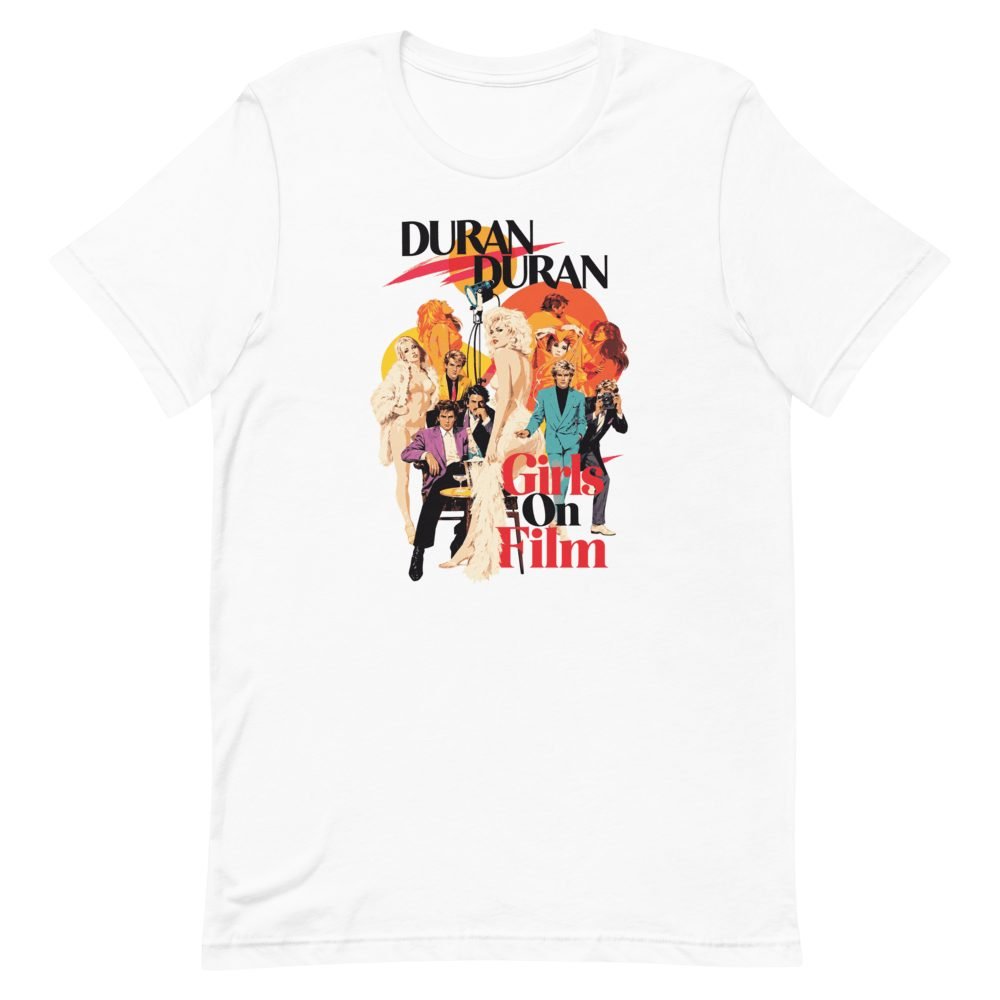
From the shop
Duran Duran Girls on Film Vintage Art T-Shirt
Price range: $24.99 through $26.99
Shop this designFinal thoughts
90s slang was never one thing. There were at least two, running at the same time in the same houses: the older kids at college and work, and the younger kids at school and in front of the TV, sometimes using the same word to mean opposite things. The lists only remember the younger room because that’s who’s writing the lists now. Fair enough. Everybody gets to be nostalgic about their own fourth grade.
But if you were the one with the lease, the name tag, and the photocopied glossary from the mall job, you remember the other room. You remember “all that” as a sarcastic remark. You remember the word for your job before it was a punchline in somebody else’s article. And you’re still saying “sketchy” and “random” in meetings, three decades later, without thinking twice. Our 90s nostalgia piece calls it a coordinate, not a quality judgment. Same here. We were just standing in a different spot.
Before you go
You made it to the end. Respect.
Get the best of these in one short weekly email, plus whatever we just printed. No spam. We were raised better than that. Mostly.