
Somewhere in your parents’ basement, or in a landfill outside a town you no longer live in, there is a plastic robot with one arm. You know the one. The other arm went down the heating vent in the spring of 1985, and everybody agreed at the time that it would turn up. It did not turn up. The robot carried on with one arm for another three years, which, if you think about it, made it a better robot.
That robot is the real history of 80s toys, and it isn’t on any of the lists. The lists show the toy the way the catalog did: mint, complete, standing in front of its own box with every accessory laid out beside it like surgical instruments. Most of them end with a button to buy it again. Fine. But almost nobody in a Gen-X house had the toy that way for longer than about forty minutes on a December morning. We had the version that came after. Scuffed, short a piece, running on batteries borrowed from the smoke detector, with a sibling’s initials in permanent marker on the bottom of one foot.
So this isn’t a list. You already know the names. This is a condition report: what 80s toys were actually like once they got into the house, and why the version you remember isn’t the one anybody is selling back to you.
80s toys, after the first forty minutes
The first thing to go was always the box. It didn’t survive the morning. It was torn open from the wrong end, the cardboard insert was wrenched out with the twist ties still attached, and by noon it was in a black trash bag with the wrapping paper, waiting for the curb. Nobody kept it. Nobody even considered keeping it. A box was the thing standing between you and the toy, and you had waited since August.
Then the toy entered general circulation, and general circulation was rough.
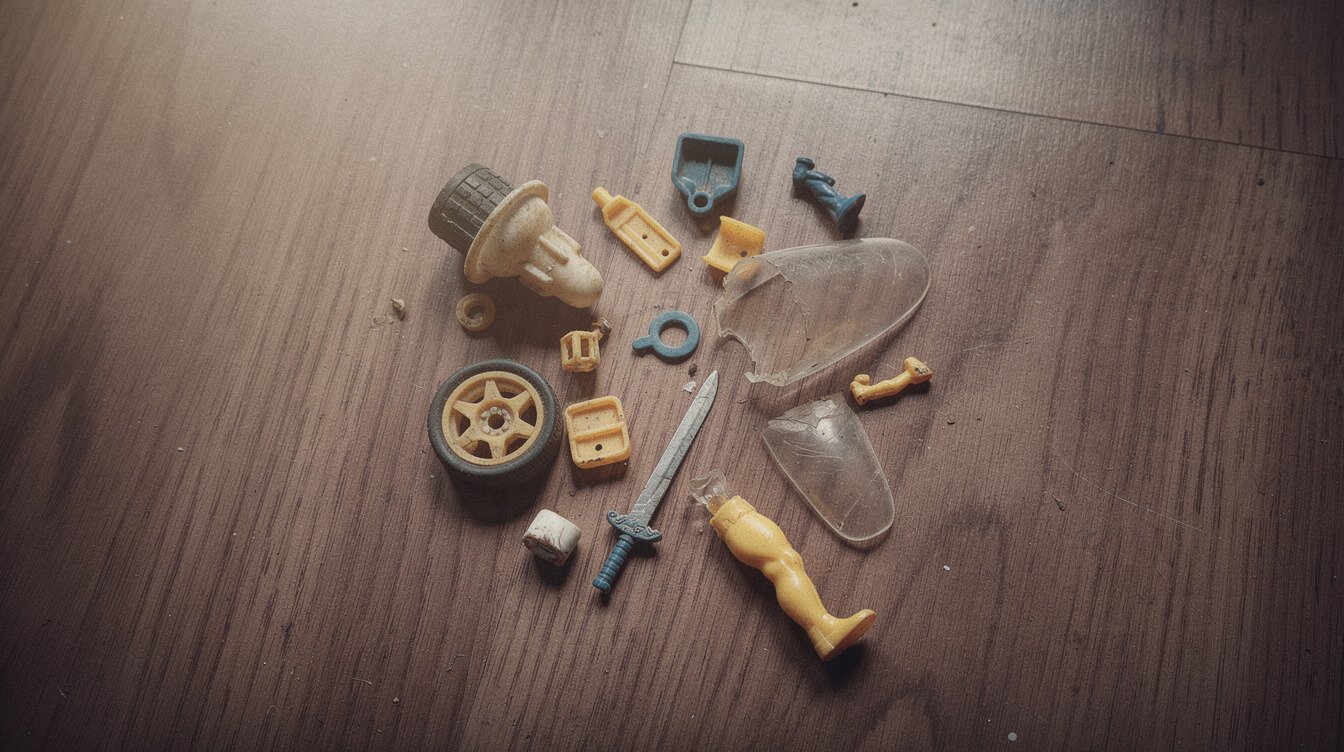
Every house had a toy chest, or a laundry basket doing the job of one, and the bottom of it was an archaeological record. Go down far enough and you hit a layer of pieces that no longer belonged to anything. A single wheel. A tiny plastic sword that fit three different figures’ hands, none of them correctly. A cracked translucent canopy from a vehicle that had been thrown away two moves ago. One leg. Nobody could have told you which toy any of it came from, and nobody threw it out either, because you never knew.
The pieces didn’t stay in their own product lines, either. The figure from one set drove the vehicle from another set, at a scale that made him look like a man piloting a shoe. The doll went on missions with the robots. A dinosaur ran the space station. Every kid in America was running an unlicensed crossover event out of a shared bedroom, years before anybody had a word for it, and the continuity was airtight because you were the only one who had to understand it.
Here’s the funny part. The same generation that shredded every toy box it was ever handed spent the 90s keeping the box for every piece of electronics it bought, stacked on the top shelf of the closet, just in case. We wrote about that habit in 90s nostalgia items, the ones we paid for ourselves. The difference is simple. As adults we paid for the stereo. As kids, the toy just showed up, and something that shows up for free doesn’t get a box.
Two toy days a year
Here is the economic fact that every list leaves out: in most Gen-X houses, new toys arrived on exactly two days a year. Your birthday and Christmas. Halloween was an honorary third, but it paid out in candy, and Halloween was its own operation.
Everything else was the off-season, and it was long. Between January and your birthday you played with what you had, and what you had was the stuff from last time, now with a missing piece. A new toy in, say, April was a genuine event, and it was usually explained by a grandparent visiting, a hospital stay, or a parent’s guilty conscience about something you’d only figure out later.
So the wanting had a long run-up. The fat holiday catalog showed up in the fall, and it got studied so hard the pages went soft and fell open by themselves at the toy section. You circled things. You circled them again in a different pen when you changed your mind. The Saturday morning commercials had already done the reconnaissance; the catalog was where you confirmed the intel. It’s the same reflex we covered in school book fair nostalgia: a sheet of paper listing things you might own was the most exciting document in the house, and the circling was half the fun.
And then you had to negotiate. Every kid learned the basic rule by about seven: ask for the big thing and you’ll get the medium thing. Ask for the medium thing and you get socks. So you asked high, you got the medium thing, and you acted surprised. Everybody knew the script. Nobody said it out loud.
The friend’s-house economy
The other ten months of the year ran on visitation. There were toys you knew intimately and never owned. You knew the rules of a friend’s racetrack better than he did. You knew which button on his electronic game was sticky and how to work around it. You could find the trick door on his playset in the dark. And at 5:30, when his mother said it was time to go home, you put it all back and walked home with nothing.
Every neighborhood had one kid who got everything. Usually his parents were divorced and competing, and that meant two Christmases. Nobody envied his situation exactly. But everybody went over to his house.
Missing pieces, dead batteries, and the drugstore cousin
If you want to know whether someone really had 80s toys or just read about them, ask about batteries.
Batteries not included
Three words that ruined more Christmas mornings than any family argument. The toy came out of the paper, the toy needed four C cells, and every store in town was closed until the 26th. What followed was the most focused search of the year. The kitchen junk drawer: one battery, wrong size. The flashlight in the car: dead. The television remote, the clock radio, the smoke detector in the hallway. A lot of 80s toys ran their first day on power stolen from a fire-safety device, and nobody mentioned it again.
Then the little screw on the battery door went missing, because it always did, and the door got taped shut. Masking tape first, then electrical tape when the masking tape gave up. Open that door in March and you’d find the batteries from Christmas, wearing a crusty white bloom that you were told not to touch, and touched.
The piece count
The back of the box said forty-two pieces. By Valentine’s Day it was thirty-one. By summer, you’d stopped counting. The missing ones went where small plastic things always went: under the couch, down the heat register, out the car window, and, most often, up the vacuum hose. Everybody knows that sound, the sharp rattle of something hard going up the hose and then nothing. A parent heard it too. A parent decided not to open the bag.
The toy kept working anyway, mostly. Toys of the era were built on the assumption that you’d lose something, so the set with the missing piece still basically worked. The robot with one arm was still a robot. The board game with the missing piece got a penny or a button or a bread-bag twist tie, and the twist tie was promoted to full player status for the next nine years.
The drugstore cousin
Then there was the gift from the relative who loved you and didn’t know the difference. You asked for the real one. You received the version from the spinning rack at the drugstore: the colors slightly wrong, the name almost right, the joints that bent at the hip and nowhere else. A figure that was sort of a soldier, sort of a ninja, and sort of nothing in particular.
You played with it anyway. A lot of us played with it more than the real ones, because nobody else had it, so it got to be whatever you needed that afternoon. That’s an underrated feature. The real figure came with an entire biography printed on the back of the card. The drugstore one came with nothing, and nothing turned out to be a lot of room.
Same goes for the box art, by the way. Every box showed the toy in a desert, under a stormy sky, mid-explosion. Then you got it out and it was three and three-quarter inches tall, standing on the linoleum next to the dog’s water bowl. Nobody felt cheated. The kitchen floor was a perfectly good desert if you squinted.
The 80s toys that could actually hurt you

The standard Gen-X line here is “and we turned out fine,” which is usually said by someone with a small scar they can’t fully account for. So let’s be precise about it.
Start with lawn darts, because they’re the cleanest case. A weighted, metal-tipped spike about a foot long, sold as a backyard game, which you threw underhand toward a plastic ring on the grass. The ring was the target. Your brother was, technically, not. The Consumer Product Safety Commission banned the sale of lawn darts in the United States effective December 19, 1988, after a run of skull-puncture injuries and deaths, most of them to kids. In 1997 it reissued the warning and told people who still had a set in the garage to destroy it. Which means that for most of the decade, the official safety system was “aim away from your brother.”
And lawn darts were just the headline. Plenty of other things sat in the toy aisle:
- The wood-burning kit. A pen-shaped tool with a red-hot metal tip, sold for kids to scorch designs into a plank. It worked exactly as described, on the plank and on your thumb.
- The chemistry set. Small glass bottles of real chemicals and an alcohol burner. The instructions were mostly suggestions.
- Anything spring-loaded. If a toy launched a projectile, the projectile was eventually launched at a face. The manufacturer’s warning about this was in very small print, on the box, which was already in the trash.
- Metal toys with edges. Pressed steel trucks and wagons that rusted, bent, and developed edges you could open mail with.
None of this is a case for the good stuff being dangerous, and it isn’t a sales pitch for scars. It’s just the condition report. The toys of the decade were made by adults who assumed someone else was watching, sold to kids who were mostly on their own, and the gap between those two assumptions is where the stitches came from.
For a lot of us, the most dangerous toy wasn’t in the toy chest at all. It was the bike, at the top of the steepest hill in the subdivision, with no helmet, because helmets were a thing other people’s kids wore. We’ll get to outside in a minute.
The newsletter
Like a mixtape, but it shows up on its own
One email a week. The good posts, new designs, zero exclamation points. Unsubscribe whenever. We won't take it personally.
Where all the 80s toys went
Nobody remembers giving up their toys. That’s because, for a large share of us, nobody asked.
Toys left a Gen-X house by three main routes. The first was the garage sale, a folding card table at the end of the driveway, everything a quarter, and some kid from two streets over walking off with your entire childhood for a dollar fifty. The second was the cousin. “You never play with those anymore,” a parent said, after the fact, about a box that had already been driven two states away. You did play with them. You played with them on a schedule nobody else understood. The third was the basement, and the basement flooded.
Moving did the rest. Every move was a purge, and the purge was run by a parent with a deadline and no sentimental attachment to a one-armed robot. If the toy chest didn’t make it onto the truck, it didn’t make it.
Then, about thirty years later, the toys came back, and they came back with the box.
That’s the strange thing about the collector market for 80s toys. The loose, played-with ones are everywhere, cheap, and sold by the pound in plastic tubs. The expensive ones are “complete in box,” which is to say, the exact version almost nobody had. The sealed, unplayed, mint example in a protective case is the rarest form of the toy precisely because using it the way it was meant to be used destroyed it. You are being sold back a childhood that belonged to whichever kid had the self-control to never open his presents. You didn’t know that kid. Nobody did.
Reissues are the same thing with fewer steps: a fresh copy of the box you threw away, around a toy you’d now be scared to take out of it. We’ve written about how every round of 80s nostalgia is a dub of a dub, and the reissue shelf is the tidiest example. It’s the catalog photo, built in plastic.
The mall knew this all along, incidentally. The toy store at the 80s mall was a museum of boxes you looked at and didn’t buy. The toys you actually owned came from two days a year and a drugstore rack.
That’s more or less the thinking behind the GenerationX shop. Designs for people who remember the robot with one arm, not the one in the catalog. Nothing to assemble, and nothing to lose down the heat vent.
No box. No missing pieces.
Batteries not required. Nobody’s giving it to your cousin.
80s toys: quick answers

The questions people actually type, answered without a slideshow.
What toys were popular in the 80s?
Robots that turned into vehicles. Small action figures sold with vehicles and playsets to put them in. Soft dolls that came with paperwork. Small cars on orange track. Interlocking plastic bricks. Plush animals that lit up or talked. Handheld electronic games with one game in them. And the six-sided puzzle cube, which most of the country “solved” by peeling the stickers off and putting them back. If you know the toy from that description, you were there. If you need the names, any of the lists will give you forty of them.
What was the top toy in 1984?
It depends on who you ask, and that’s the honest answer. The soft-faced doll with the adoption papers had caused actual fistfights in store aisles during the 1983 holiday season and was still hard to find going into the next year. 1984 was also the year the robots that turned into trucks landed in American toy aisles. Ask five people who were eight that year and you’ll get five answers, all correct, and at least one of them will be about a toy their friend had.
What popular 80s toys no longer exist?
Lawn darts, legally, since December 1988. Beyond that, very little is truly gone: most of the famous lines have been reissued at least once. What no longer exists is the knockoff economy. The off-brand drugstore figures and the no-name versions in the grocery-store aisle were never reissued, never collected, and mostly never photographed. If you had one, you might be the only archive.
Why are 80s toys so expensive now?
Mostly, they aren’t. Played-with ones are cheap and everywhere. The prices you see in headlines are for complete, boxed, untouched examples, which are rare for the same reason this whole article exists: almost nobody kept the box.
What did 80s kids do when the toys broke?
Went outside. This is the answer nobody puts on a list because you can’t buy it again. The biggest toy of the decade was a creek behind somebody’s house, a pile of dirt where a new subdivision was going in, a stick fort that got rebuilt every spring, and the bike that got you to all of it. No batteries. No box. No missing pieces, because there were no pieces. You came home when the streetlights came on, or about forty minutes after.

From the shop
Huey Lewis I Wanna New Drug Fan Art T-Shirt
Price range: $24.99 through $26.99
Shop this designFinal thoughts: the toy you remember isn’t on the list
The lists aren’t wrong, exactly. Those were the toys. The names are right, the years are right, and the photos are lovely. They’re just photos of a toy nobody had.
The toy you had was one arm short. It ran on smoke-detector batteries and a strip of masking tape. It belonged to a crossover universe with the dog’s chew toy and a dinosaur. It probably came from a drugstore rack, or from a friend’s house on loan until 5:30, or from one of two days a year that you spent ten months building up to. And it left the way most things left an 80s house, without anyone asking you, in the back of a station wagon heading to a cousin.
That’s not a sad story. It’s just the accurate one. The toys were never really the point. The point was how much you could get out of something that was missing a piece, which turns out to be a skill this generation has been using ever since.
If you still have the robot, keep it. Don’t look for the arm. It’s not coming back.
Before you go
You made it to the end. Respect.
Get the best of these in one short weekly email, plus whatever we just printed. No spam. We were raised better than that. Mostly.