Search for 80s christmas decorations right now and you get a store. Then another store. Then a wall of pictures, and then a list of eighteen items with one warm sentence each, mostly about memories and magic. Somebody on an auction site wants forty-nine dollars for a lot of forty-six pre-owned ornaments, most of which your aunt used to hang without a second thought. Nobody on page one explains how any of it worked.
Which is a shame, because how it worked is the whole story. Look at the photos long enough and a pattern shows up. The snowman on the lawn glowed. The tree on the end table glowed. The angel on top of the real tree glowed, and so did the plastic Santa on the TV, and so did the strange spray of fibers on the bookshelf that changed color every few seconds. The 70s ended on a sweater and a thermostat. The 80s took Christmas, put a light bulb inside every single piece of it, and ran a cord out the back.
80s christmas decorations plugged in

Start with the context nobody remembers, because most of us were too young to clock it. In November 1973, in the middle of the oil embargo, the president went on television and asked Americans to skip the outdoor Christmas lights to save energy. A lot of people did. That year the neighborhood was darker than usual, and the adults were in a mood about gas lines.
By the early 80s, that mood was over, and the house made up for lost time. The defining thing about 80s christmas decorations isn’t a color or a theme. It’s that so many of them were appliances. They had a cord, a bulb, and sometimes a motor. They needed a plug. You didn’t hang them, you installed them, and the installation came with a small engineering problem: where, exactly, is this going to plug in?
Every family solved it the same way, which is to say badly. Brown extension cords ran under the rug. Two-prong adapters went into three-prong outlets. A cube tap went onto an outlet that already had a cube tap on it. The cords were tucked behind the couch, under the skirt of the tree, and along the baseboard, where somebody would vacuum over them in a week and a half. If the house had one outlet in the living room, and plenty of houses did, that outlet worked harder in December than it did the rest of the year combined.
The lights themselves were changing. The big fat bulbs of the 60s and 70s were giving way to strands of tiny mini lights, which ran cooler, used less power, and came fifty or a hundred to a strand, so you could buy four strands and hide nothing. The tree went from a few dozen thumb-sized bulbs to a few hundred little ones, and the living room started looking less like a lamp and more like a pinball machine.
You can see all of this in the old photos, if you know where to look. The family is lined up in front of the tree, sure. But look at the floor. There’s a cord. There’s always a cord.
The snowman on the lawn was a milk jug with a bulb in it

The light-up plastic figure on the front lawn has a name, and almost nobody who owned one knew it. It’s a blow mold. The name comes from how it’s made: a tube of hot plastic goes into a mold, compressed air gets blown in, and the plastic inflates against the walls of the mold like a balloon inside a box. It’s the same process that makes milk jugs and soda bottles. Your snowman was, technically, a very ambitious milk jug.
Companies had been turning them out cheaply since the early 60s. One of the biggest started out making pool toys and foam pipe insulation, and its first blow mold was a pumpkin-shaped candy pail for Halloween. Another was the same outfit that gave America the plastic pink lawn flamingo. So the lineage of the thing glowing on your lawn ran straight back through the beach and the garden center, which tells you most of what you need to know about its build quality.
Here’s how one actually worked. The figure was hollow. There was a hole in the back or the bottom, and you pushed a light cord with a single bulb socket up through it. That was the whole electrical system. The plastic was thin enough that the bulb lit the figure from inside, so after dark the snowman glowed a soft, slightly radioactive white, and the Santa glowed a red that didn’t occur anywhere in nature.
The problems were all physical. A hollow plastic figure weighs about as much as a loaf of bread, so the first good wind put him on his face in the yard. Somebody’s father would come out in a parka and wedge a brick against his feet, or drive a tent stake through a hole that was never meant for a tent stake. The side that faced south faded faster than the side that faced the house, so after a few winters, every snowman on the street had one cheek a little paler than the other. And the bulb inside got hot enough that, eventually, a soft spot appeared right above it. Nobody worried about this. Everyone probably should have.
For about forty years, if you wanted a yard decoration, this was the yard decoration. Carolers, candy canes, a nativity, a Santa with a sack. Then in 2001 someone figured out how to sell a residential version of the giant inflatable gorilla outside the car dealership. The blow-up Santa was bigger and cheaper to ship, and by the end of the decade it had taken over. The last major blow mold maker in the country closed after the 2017 season. Figures that sold new for about fifteen dollars now resell for hundreds. One collector’s family sleigh, bought by a grandmother for three dollars, is now a thousand-dollar piece. Of all the 80s christmas decorations, the blow mold has had the strangest afterlife. That snowman with the faded cheek is somebody’s retirement plan.
The ceramic tree came from a night class
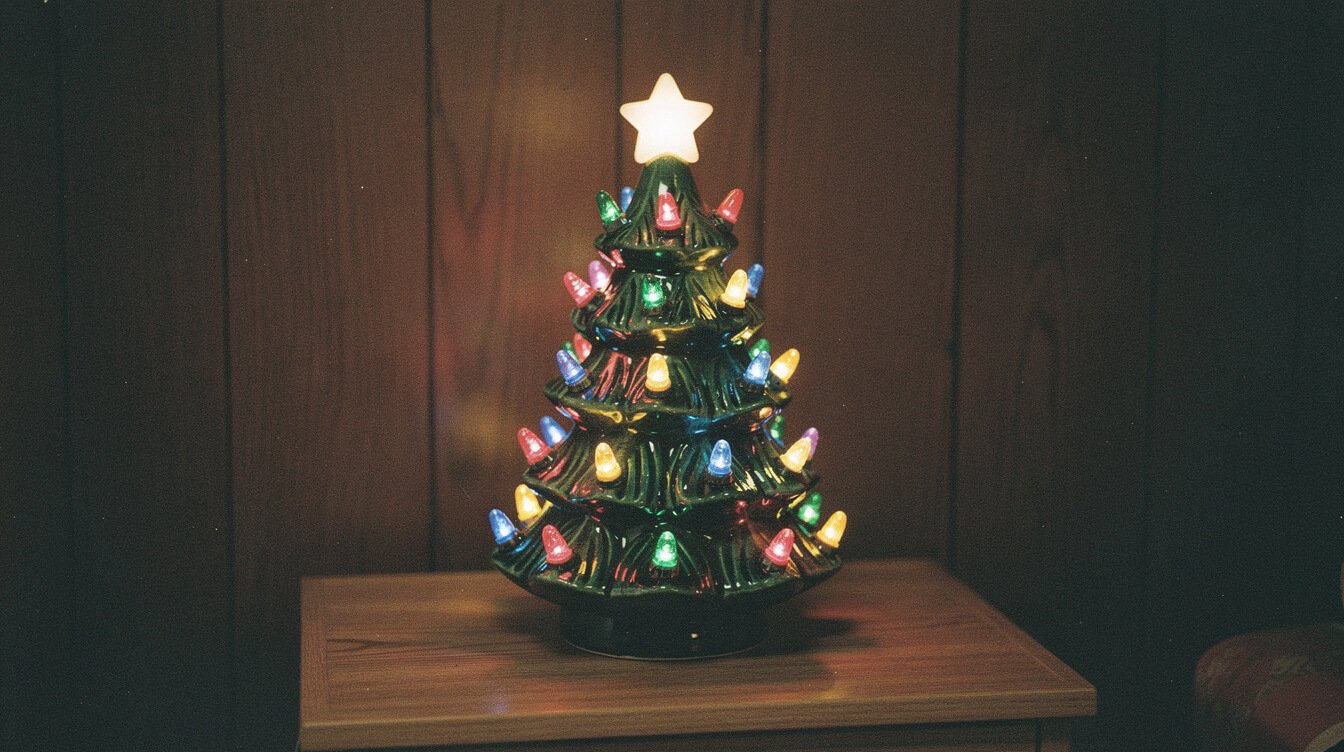
If the blow mold was the outdoor icon of 80s christmas decorations, the indoor one was the ceramic tree. A foot or two of glossy green ceramic on a little base, with dozens of small holes in the branches. Each hole held a tiny plastic “light,” a colored peg shaped like a bulb, or sometimes like a bird. A single bulb inside the hollow tree lit all of them at once, so it glowed like a tree full of jellybeans. A white plastic star went on top. It sat on the end table, or on top of the TV, which got warm anyway.
Here’s the part of the story nobody puts on the list: hardly anybody bought one in a store. The original mold dates back to 1958, but the trees spread through the 60s, 70s, and well into the 80s, mostly through ceramics classes. And those classes were a whole world.
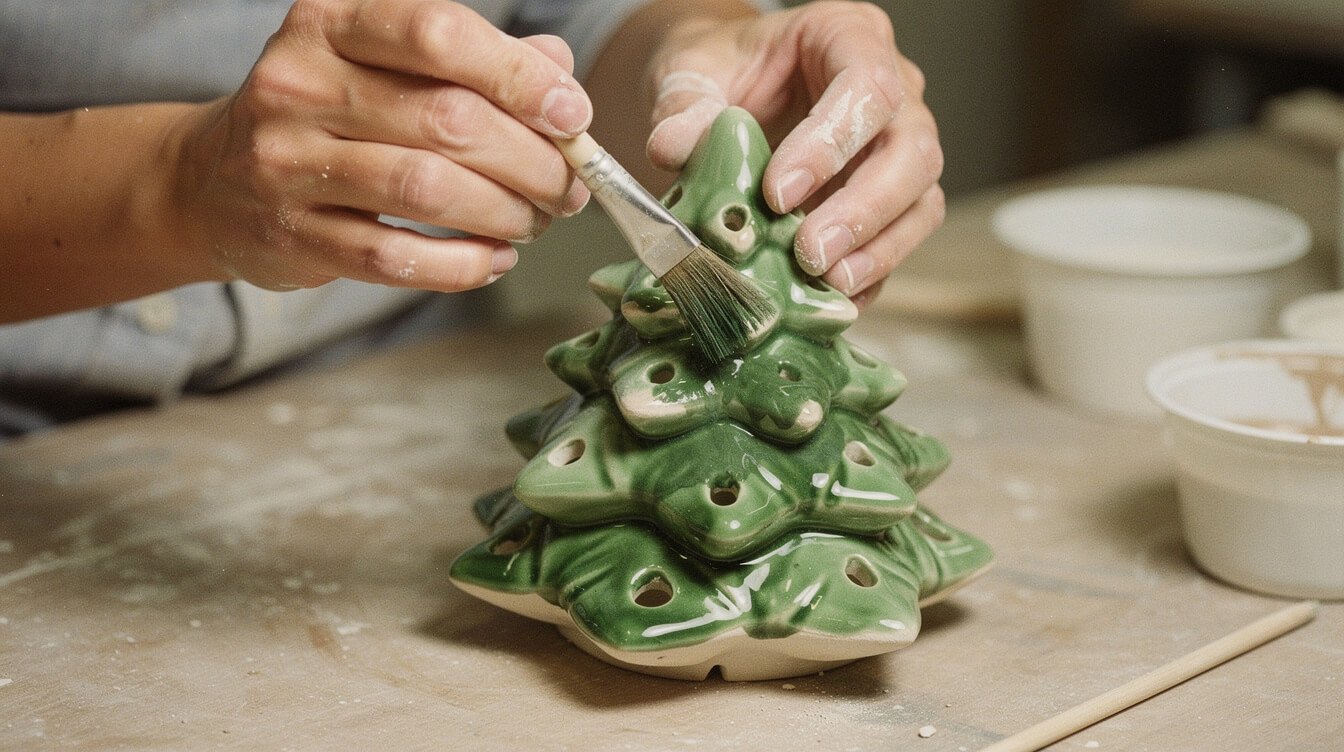
Somewhere in your town there was a ceramics shop, usually in a strip mall, usually with a kiln in the back that kept the room ten degrees warmer than the parking lot. Your mother, or your aunt, or your friend’s grandmother, went on a weeknight. She bought the tree as greenware, which is unfired clay, chalky and fragile enough to crack if you looked at it wrong. She cleaned the seam lines with a little tool and a damp sponge, and the shop fired it. Then she came back and painted it, coat by coat, and it got fired again. That took weeks. It took a lot of weeknights. It was, functionally, a support group with a kiln.
So the ceramic tree on your end table was not a purchase. It was a project, and it was signed. Turn one over and there’s often a name scratched into the bottom, and a year. That’s why the trees that come up at estate sales now are so particular. The green is a slightly different green on every one. The glaze pooled where somebody got tired. One branch is missing a light.
And one branch is always missing a light. The pegs were tiny and they fell out. A kid pulled them out to see what they did, and a cat batted them under the radiator. You’d find a little blue plastic bulb in the carpet in March and know exactly what it was. Shop owners who sell the trees now say the people buying them are the grandchildren of the women who made them, looking for a replacement for the one that broke, or went to a thrift store, or went to the sister who didn’t even want it.
There was a whole ecosystem of these things, too. Ceramic Santas, ceramic nativities, ceramic candy dishes. If something could be cast, it was. But the tree was the hit, because it did the one thing every 80s Christmas object was supposed to do. It lit up.
The tree came in a box, with a color code

Plenty of 80s families still bought a real tree. Plenty didn’t. By 1992, about 46 percent of American homes with a Christmas tree had an artificial one, and the 80s were the decade that got them there. The fake tree had stopped being a novelty, the silver kind your grandmother had in 1962. Now it was a green plastic thing that came in a long cardboard box and got stored in the garage, the basement, or the crawl space under the stairs.
Of all the 80s christmas decorations, the tree took the most assembly. It was a kit. First the stand, which was a metal base with three legs. Then the center pole, which was a green-painted dowel or metal post with rows of holes drilled into it. Then the branches. Each branch was a wire stem with plastic needles twisted around it, and each stem had a colored dot of paint on the end. Red for the bottom row, then blue, then yellow, and so on up. You matched the color on the branch to the color on the hole, row by row, bottom to top, like a very boring board game. The tree came out the same height and the same shape every single year. That was the point of it.
Somebody always sorted the branches first, on the carpet, longest to shortest. This is where a kid became useful. You could read the paint colors before you could read the instruction sheet, which had been folded and unfolded so many times it was soft as cloth. The trouble was that the paint wore off. After five or six Christmases, one branch had no color left at all, and that branch became a mystery. It went wherever there was a hole. There was always one hole left at the end, and the branch never fit it.
Then came fluffing. The branches came out of the box flat as a pressed flower and had to be bent into shape by hand, every tip, one at a time, until the thing looked less like a bottle brush and more like a tree. The plastic needles left little green flecks all over your sleeves, and the wire tips poked you through your shirt. If your family skipped the fluffing, everyone could tell. The tree looked like it had been through something.
We’ve written before about how 80s decor turned the whole country into one room, and the boxed tree was part of the same pattern. Everyone’s tree was the same shape. Everybody’s branches had the same color dots. It never quite looked real. It wasn’t supposed to look real. It was supposed to look the same as last year, and it did. If you’d still rather wear the joke than store it in the garage, the GenerationX shop sells shirts that need no fluffing at all.
At the end of the season, the whole thing went back into the box. It never fit. The box had been designed to hold the tree exactly once, at the factory, and after that it held most of the tree, plus a bulge, held together with packing tape that got another layer every January. By 1989, the box was more tape than box.
The newsletter
Like a mixtape, but it shows up on its own
One email a week. The good posts, new designs, zero exclamation points. Unsubscribe whenever. We won't take it personally.
Angel hair, bubble lights, and the thing in the corner that changed color
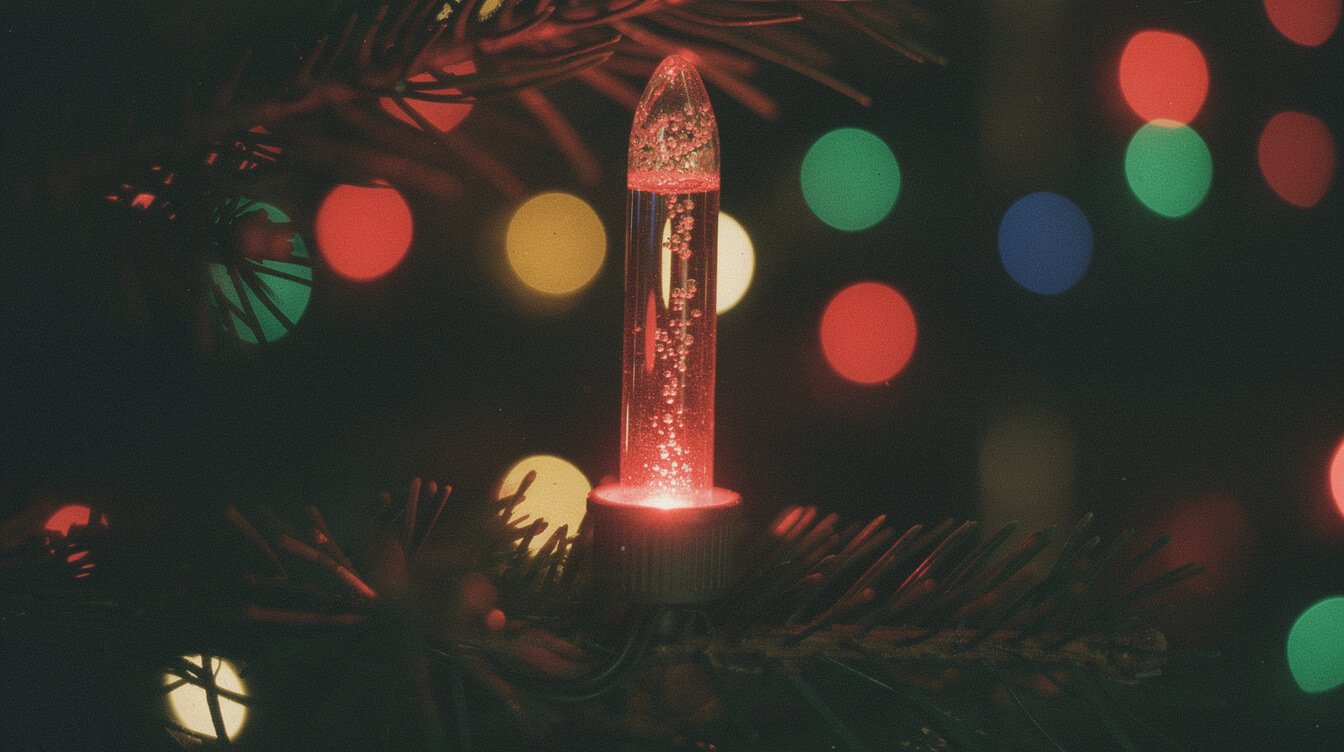
Some 80s christmas decorations were simply strange, and they’re the ones the photo lists can’t explain, because a photo can’t show what they did.
Angel hair was a cloud of white fiber that you pulled apart and draped over the tree, so the lights glowed through it like they were wrapped in fog. It was lovely. It was also spun glass, which meant it was fiberglass, which meant your hands itched for a day and anyone who touched it without gloves ended up with tiny splinters they couldn’t see. Every box came with a warning. Nobody read the warning. Somebody’s mother always handled it, wearing kitchen gloves, while the kids watched from a safe distance, the way you’d watch someone handle a snake.
Bubble lights looked like little candles. Each one was a narrow glass tube full of colored liquid, sitting on top of a bulb. The liquid had a very low boiling point, so once the bulb warmed it up, a stream of bubbles started rising, and it kept going all night. The catch was that “once.” A bubble light took its sweet time getting started, so you plugged the tree in and then waited, staring at a dozen tubes that weren’t doing anything. One of them never started. You flicked it with a finger, and that was the official repair procedure, and sometimes it even worked. They’re a 1940s invention, but they were still on half the trees we knew, usually because they’d been on a grandparent’s tree first.
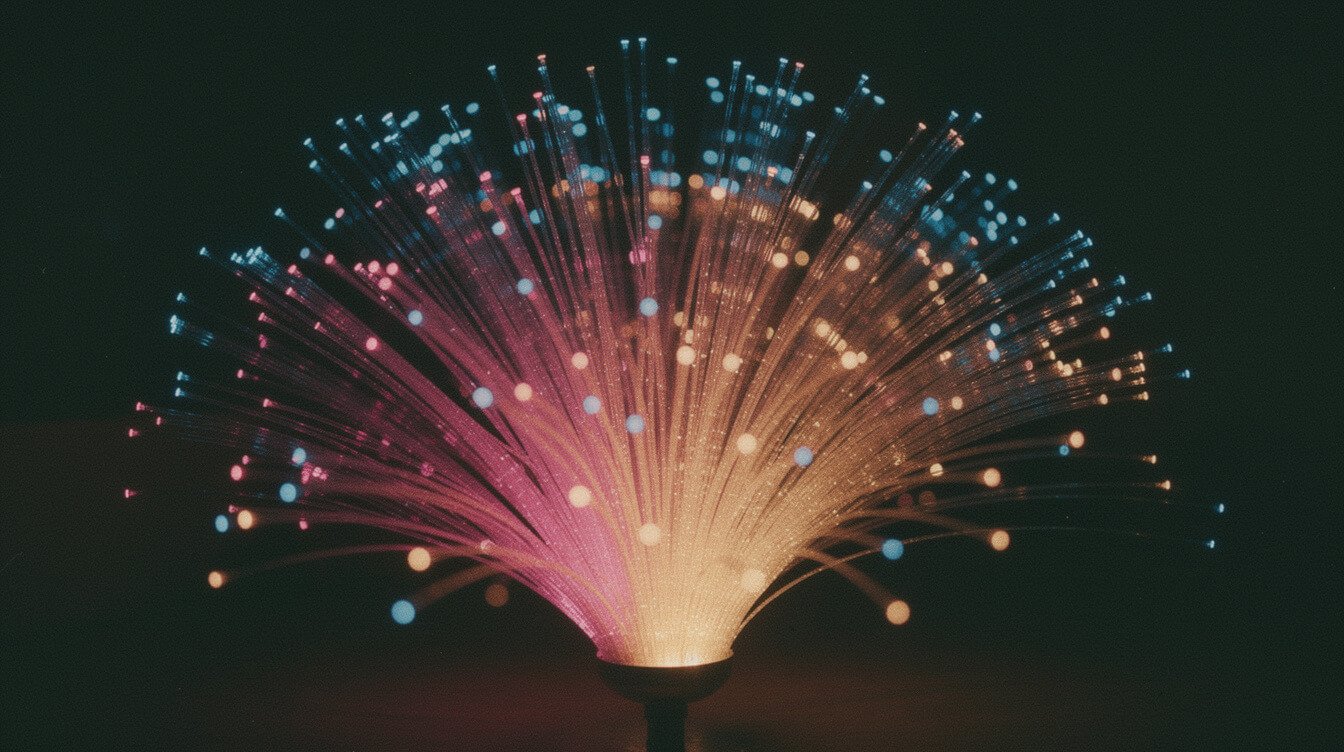
The fiber-optic piece was the newest of the lot, and it felt like the future. It was a spray of hundreds of clear plastic strands coming out of a base, like a dandelion gone to seed, and every strand had a point of light at its tip. Inside the base was a bulb and a little wheel of colored film, and a motor that turned the wheel very slowly. The whole thing went blue, then magenta, then amber, then blue again. It hummed. The first versions were sold as lamps. By the 80s they showed up as tree toppers, as angels with glowing wings, and as whole tabletop trees that sat in the corner and changed color while you watched TV. Nobody knew what they were supposed to represent. Nobody asked.
Add the foil garland, the wall plaque of Santa’s face that looked like popcorn melted onto plastic, and the cards taped around the doorframe until the doorframe disappeared, and the living room was a lot to take in. You didn’t so much decorate an 80s house as wire it.
The kids’ side of all this, the jobs and the waiting, has its own write-up in our 80s christmas piece. This part was the hardware.
No cord. No bulb. No fluffing.
For whoever held the flashlight while somebody else found the outlet. It doesn’t light up, and it’ll still be in one piece in January.
80s christmas decorations: quick answers
What were popular christmas decorations in the 80s?
The most common 80s christmas decorations were light-up plastic lawn figures (blow molds), hand-painted ceramic trees with plastic peg lights, boxed artificial trees with color-coded branches, strands of mini lights, bubble lights, angel hair, foil garland, fiber-optic tree toppers and centerpieces, and Christmas cards taped around the doorframe. The common thread is that most of them plugged in.
What colors were 80s christmas decorations?
Bright, primary red and green, plus a lot of gold and silver foil, multicolored lights, and white plastic. The softer looks came later. The hunter green, burgundy, and plaid that people now think of as “vintage” belongs to the next decade. We covered that in 90s christmas decorations, which took over the whole house in a different way.
What is a blow mold?
A hollow plastic yard figure, made by blowing air into hot plastic inside a mold, the same way you’d make a milk jug. You lit it with a single bulb pushed up through a hole in the back. They were cheap and everywhere from the 60s through the 90s, faded unevenly in the sun, and fell over in any real wind. Inflatables replaced them in the 2000s. Now old ones resell for hundreds.
Where did ceramic Christmas trees come from?
Mostly from ceramics classes. The mold dates to 1958, and for the next few decades, people bought the trees unfired at hobby shops, cleaned and painted them by hand, and had them fired in the shop’s kiln. That’s why vintage ones vary so much in color and finish, and why many have a name and year scratched into the base.
Were 80s christmas trees real or fake?
Both, and the balance was shifting. By 1992, about 46 percent of US households with a tree used an artificial one. The typical 80s fake tree assembled branch by branch, with paint-dipped tips matched to colored holes in a center pole. Pre-lit trees came much later.
Was angel hair dangerous?
Mildly. Original angel hair was spun glass, basically fiberglass, so it caused itching and tiny cuts if you handled it bare-handed. The boxes said to wear gloves. Most of us learned that the other way.
How do I get an 80s christmas decorations look now?
Think lit, not styled. Use multicolored lights instead of warm white, put one ceramic tree somewhere visible, add a blow mold if you’ve got the yard and the budget, and let a cord show. Buy secondhand when you can: the vintage pieces have the slightly-off color and the wear that new reproductions don’t. And skip the real angel hair. Some things were never worth the splinters.

From the shop
Huey Lewis I Wanna New Drug Fan Art T-Shirt
Price range: $24.99 through $26.99
Shop this designFinal thoughts: 80s christmas decorations ran on a timer
The last piece of 80s christmas decorations hardware didn’t look like a decoration at all. It was the timer. A beige plastic box that plugged into the wall, with a dial on the front and little tabs around the edge that you pushed in or pulled out to tell it when to turn on and off. One tab for 5 p.m. One for 11. In between, the snowman on the lawn glowed, and the ceramic tree glowed, and the fiber-optic thing in the corner kept changing its mind.
The timer was the adult admitting that all of this was a system. It had a schedule. It ran on electricity and a little bit of nerve. Every year somebody set it wrong, so the lawn lit up at four in the morning and went dark during dinner, and nobody noticed for three days.
That’s what’s missing from the gallery pages and the eighteen-item lists. They show the objects, nicely lit, one at a time. They don’t show the brick against the snowman’s feet, or the bare branch with no color dot, or the bubble light somebody had to flick. They don’t show the cord. And the cord was always the giveaway. Somebody ran it. Somebody taped it down. Somebody, every December, got down on their knees behind the couch with a flashlight and made the whole house light up.
Most of us are that somebody now. Mind the outlet.
Before you go
You made it to the end. Respect.
Get the best of these in one short weekly email, plus whatever we just printed. No spam. We were raised better than that. Mostly.