Search for 90s nostalgia movies and the internet hands you a ranking. A streaming service lists the nine it happens to be carrying this month. A film-school site ranks thirty-four of the decade’s best and promises, right in the summary, “No nostalgia picks here.” Bold, given the search. Then a user-made list of a hundred, then a countdown video, then a lifestyle site suggesting titles for a cozy millennial movie night. All of them are answering the same question: which movies?
That was never the question. Ask a Gen-Xer to name their 90s movies and they won’t give you a ranking. They’ll give you a schedule. The one that was on every Saturday at two. The one somebody taped off cable, with the commercials still in it. The one they saw three months late on a floor that held onto their shoes. Nobody in this generation picked the movies they ended up loving. The movies were on, and we were home.
90s nostalgia movies weren’t picked. They were on.
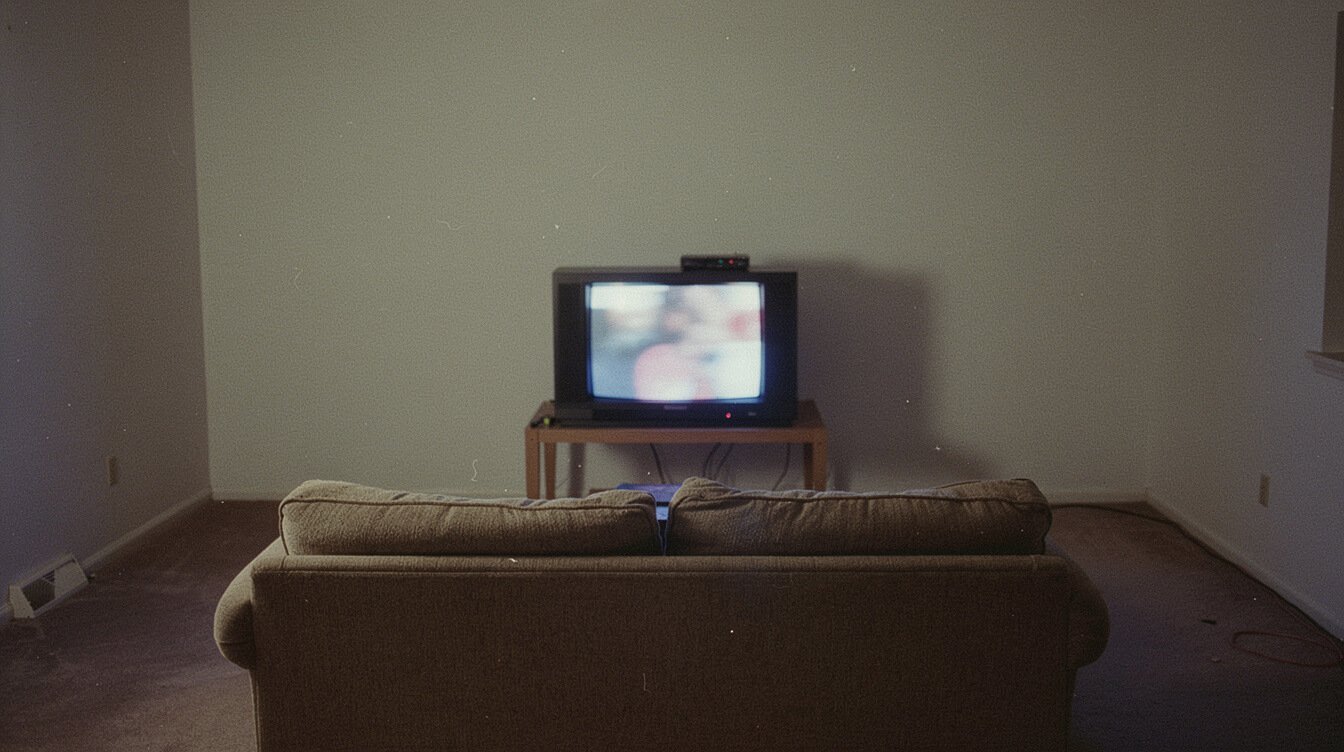
Here is the part that’s hard to explain to anyone who grew up with a search bar. For most of the decade, the movie you watched on any given afternoon was the movie a stranger had decided to put on. You didn’t choose it. You found it, the way you’d find a twenty in a winter coat, and you watched it because the alternative was the shopping channel or a golf tournament conducted entirely in whispers.
We’ve written before about the video store, where picking took an hour and the hour was the point. That was the deliberate way to get a movie, and it cost money and a ride. The rest of the week ran on the other system, the free one, and the free one didn’t take requests. Between those two, the free one did more of the work. A rental was a movie you watched once. A cable movie was a movie you lived next to.
That’s the real difference between the ranked lists and the 90s nostalgia movies people actually carry around. A ranked list is a set of choices. What we have is a set of accidents that repeated until they turned into furniture. Nobody would put half of them on a best-of list, and we could recite all of them from about the forty-minute mark onward.
Which tells you something about the word “favorite.” A favorite movie from that decade usually isn’t the best one you saw. It’s the one you saw the most, and how often you saw it was decided by someone with a programming grid and a licensing budget. Somebody in an office, working out how to fill a Sunday afternoon, built most of a generation’s taste without ever meeting any of us. Unpaid, as far as we know. Same as us.
Your canon was programmed by a stranger with a grid
Basic cable in the 90s was a small number of movies on a very long loop. A title came into rotation and stayed there. It ran Saturday afternoon, again Tuesday night, again at some hour that only exists when you’re sixteen and the rest of the house is asleep. Next month it ran again. If it was a movie that cost nothing to air, it ran forever.
So you saw the same films constantly, but almost never from the beginning. You came in from outside, flipped past it, and it had been on for fifty minutes. You stayed. Next time, it had been on for an hour. You stayed again. You have seen the back half of certain movies something like thirty times and the first twenty minutes maybe once, possibly never. Ask a friend how one of them starts and watch the face they make. They know the ending cold. The opening is a rumor.
The movie you knew from the middle
This produced a specific kind of fluency. You knew characters without knowing how they’d met. You knew a plot well enough to argue about it, minus the premise. A whole generation came to understand certain stories the way you understand a neighbor’s marriage: you weren’t there for the start, you’ve only seen the arguments, and you’ve formed strong opinions anyway.
It also meant the “rewatch” was involuntary. Nobody sat down and decided to see a movie for the twelfth time. The movie sat down next to you. You’d be eating cereal at four in the afternoon, and there it was again, at the part with the car, and you’d think fine. That’s how a mediocre movie turns into a favorite: not by being good, but by being there every time you were.
Why the bad ones stuck
The grid didn’t care about quality. It cared about what was cheap to license and what fit in a two-hour slot with breaks. That’s why so many 90s nostalgia movies people swear by are, objectively, a little rough. They weren’t chosen by critics or by us. They were chosen by math. And because we didn’t choose them, nobody ever had to defend the choice, which is the only reason we’re still allowed to like them.
It’s the same thing Saturday morning did to an earlier version of us: an appointment you never made, kept religiously. The cartoons ended. The appointments didn’t. They moved to the afternoon and got a little more violent.
Edited for television, formatted to fit your screen
Every broadcast movie came with a short warning before it started, white text on black, read in nobody’s voice: this film has been modified from its original version. It has been formatted to fit your screen. Sometimes it added that the film had been edited for content, or edited to run in the time allotted. Nobody read it. Everybody can still recite it.
Each of those phrases meant something specific happened to the movie before it reached the living room, and most of us didn’t know what until much later.
Formatted to fit your screen
Movies were shot wide. Television was square-ish. Somebody had to decide which two-thirds of every scene you’d get, and the answer, shot by shot, was “the middle, mostly.” This was called pan and scan, and it was standard on broadcast and on most tapes until widescreen home formats caught on late in the decade. It’s why you remember so many conversations between one person and a doorframe. The other person was there. They were just a few feet to the left, in a part of the picture that had been trimmed off at the factory.
Sometimes the crop moved mid-shot, sliding across the frame like a security camera, because something important had happened on the side. You didn’t notice at the time. You assumed the camera was just like that. Years later you watch the same scene at its original width and realize there were three people in the room the whole time, and one of them was the joke.
Edited for content
Then there was the dubbing. Network edits replaced the swearing with substitute words, and the substitutes were chosen by someone who had never heard a human being swear. If you know the cornered cop who, in the broadcast version, yells something about a Mister Falcon, you know. A tough guy lands a perfect line, and his mouth makes one shape while a completely different, much more polite word comes out, dubbed in from another room in another year. It was hilarious then. It’s funnier now, because for a lot of us the polite word is the canonical one. The real line sounds wrong.
Edited to run in the time allotted
And movies got shorter. Not by much. Just enough to make room for nine minutes of ads in a two-hour slot. A scene vanished here, a subplot got thinner there. If you ever watched an unedited version as an adult and thought, huh, I don’t remember that, it’s because you never saw it. It was cut for the dealership ad. After the start of 1997, a little ratings box started showing up in the corner too, for a few seconds at the top of the hour, a small grown-up checking on you and then leaving the room.
So the movie you’re nostalgic for is, in a real sense, a different movie: narrower, politer, shorter, with ads. That version doesn’t exist anywhere anymore. Nobody saved it. Unless somebody in your house pressed record.
Three months late at the dollar theater
The theater was the other half of 90s nostalgia movies, and for a lot of us it wasn’t the shiny one. First-run tickets were real money for a fifteen-year-old with a part-time job. The second-run house was not. A movie that had opened in the summer turned up there in the fall for a dollar or two, after everybody had already talked about it, which meant you went in knowing the twist and acted surprised anyway, as a courtesy.
Second-run theaters had a particular feel. The carpet had a pattern designed to hide things, and it had been asked to hide a lot. The seats leaned. The floor kept a little bit of you every time you stood up. Usually it was tucked in a strip center, or the far end of the mall nearest the parking lot nobody used. The print had been run so many times it had scratches you came to recognize, the same flash of white at the same point in the reel, like a crack in a friend’s windshield.
It was also the most unsupervised place a teenager could legally spend two hours for a dollar. Nobody checked which theater you went into. Nobody checked whether you left when it ended. If your plan was to see one movie and drift into a second, the dollar theater wasn’t going to stop you. It barely had a staff. It had a guy, and the guy was also making the popcorn.
The free preview weekend
The home version of the dollar theater was the free preview weekend. A few times a year, usually around a holiday, a premium movie channel switched itself on for everybody, hoping you’d get hooked and call to subscribe. For three days, the scrambled channel you’d been squinting at — wavy, color-shifted, sound sometimes clean and sometimes a rumor — came in perfectly clear. You did not go outside. You watched everything they had, including things you didn’t want, because it was free and it might never happen again. Then on Monday the picture went wavy again, and you went back to squinting.
If you squinted at that channel on a weeknight hoping the scramble would slip, we don’t need to discuss it. You know. Everyone knows. That’s one of those things that’s genuinely universal and genuinely never mentioned, which is roughly the whole operating principle behind what we make in the shop: designs that land on the people who were there and don’t explain themselves to anyone who wasn’t. No titles, no quotes, no footnotes.
The newsletter
Like a mixtape, but it shows up on its own
One email a week. The good posts, new designs, zero exclamation points. Unsubscribe whenever. We won't take it personally.
The tape somebody else recorded
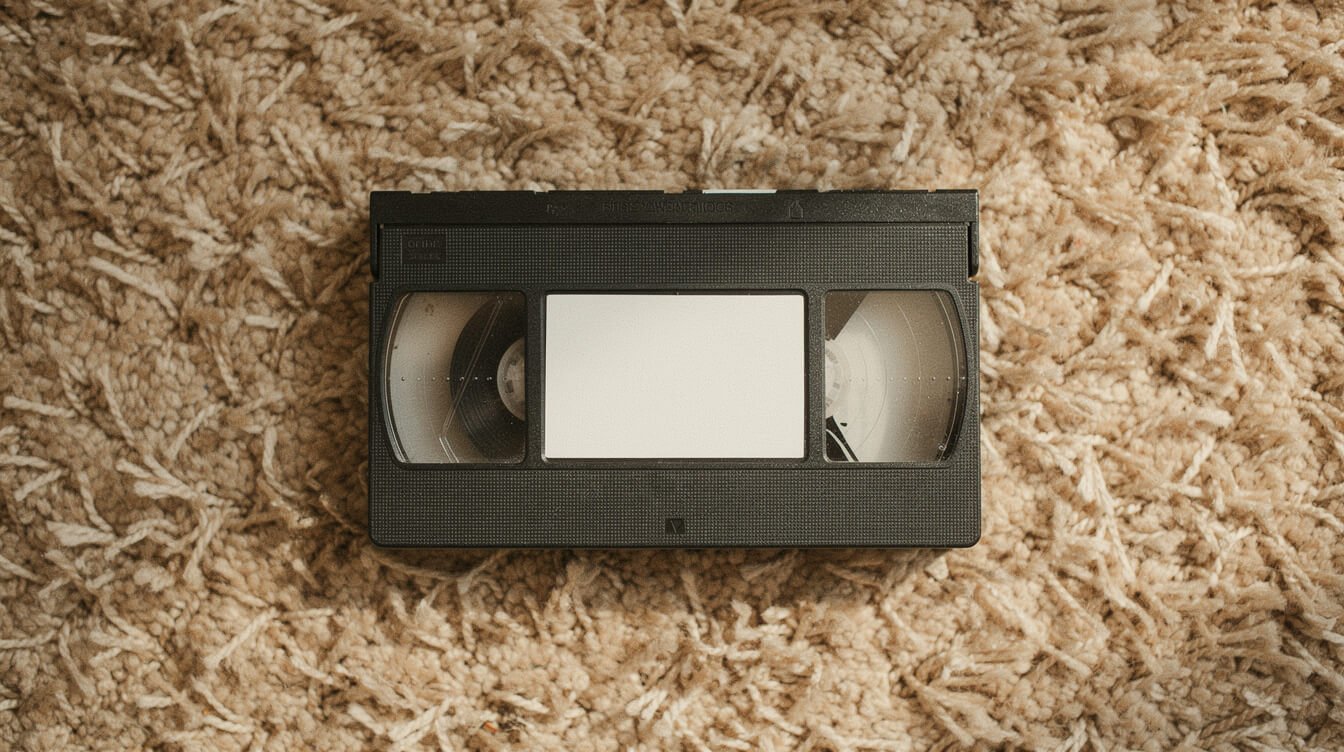
Every house had one. A tape in the cabinet that somebody had recorded off TV, at the slowest speed, so it could hold three movies in one cassette and look a little worse doing it. The label was in a parent’s handwriting, or a sibling’s, or nobody’s, because somebody always meant to write on it and never did. You watched it constantly. It was the closest thing to owning a movie that most families got.
The household tape had rules, none of them written down. The commercials stayed in, so you knew the ads from one specific week in one specific year better than you know your current phone number. Somebody had tried to pause through the breaks, which meant every scene after an ad started one second late, with half a word missing. And the last movie on the tape always ran out before the end. Always. Somebody had done the math on six hours and gotten it a little wrong, and the movie stopped dead eleven minutes before the climax and snapped to static, or worse, to whatever had been taped there before.
Learning the ending somewhere else
Which meant a whole category of movie you knew for years without knowing how it ended. You found out later, at a friend’s house, or when the grid finally ran it again at the right time, and the ending always felt like reading the last page of a book you’d been told was missing. Some of us still haven’t seen it. We’ve decided we’re fine.
The household tape was also, quietly, the first time a lot of us curated anything. Not by choosing the movies; the grid had chosen them. By deciding which ones were worth keeping, and which got taped over for the next one. That’s a very Gen-X version of having taste: you didn’t get to pick what came in, only what stayed. Same principle that made the 80s look the way they do now, after enough copying, just applied one living room at a time.
If somebody in your house still has that tape, don’t digitize it into anything nice. Leave the ads in. They’re the part that’s actually rare.
Formatted to fit your chest
No titles, no quotes, nothing that needs a footnote. Just the stuff that was on when you got home.
90s nostalgia movies: the questions that keep coming up
What counts as a 90s nostalgia movie?
Not the best movies of the decade. The ones you saw too many times by accident. If you can quote the back half and can’t describe the opening, it counts. If you first saw it with the swearing dubbed over, it counts double. Critics’ lists and nostalgia lists overlap less than you’d think, and the film-school ranking that promises “no nostalgia picks” is at least honest about which list it’s making.
Why do 90s movies feel different on streaming?
Because you’re watching a different cut. The streaming version is full-width, uncut, unbleeped, and uninterrupted. It’s the movie as made, and for a lot of us that’s the version we never saw. The jokes land in slightly different places. The pacing feels long. The polite word you grew up with is gone. None of that is the streaming service’s fault. It’s just that the version you remember was assembled in a broadcast truck.
Is it weird to like the edited-for-TV version better?
No. It’s the version you had. Nostalgia doesn’t track quality. It tracks exposure. A movie you saw forty times in a cropped, politely dubbed version is a movie you know in that version. When the director’s original turns up, it feels like running into a childhood friend who’s had work done.
Why can’t anyone agree on the “best” 90s nostalgia movies?
Because the grid was local. What ran on Saturday afternoons depended on where you lived, which channels your cable company carried, and what the programmer in that market could afford that quarter. Two Gen-Xers from different states can have completely different canons, each defended to the death, each built by a stranger. Arguing about it is a big part of why the topic doesn’t die. We wrote more about that split between remembering a decade and renting one.
Where do I find the old broadcast versions now?
Mostly you don’t. Some people have uploaded off-air recordings, ads and all, and those uploads tend to attract a comment section full of people who are only there for the ads. That tells you where the nostalgia actually lives. It was never the movie. It was the evening around it.

From the shop
Duran Duran Girls on Film Vintage Art T-Shirt
Price range: $24.99 through $26.99
Shop this designFinal thoughts: you can stream it now. It isn’t the same movie.
Everything on those ranked lists is a click away. That’s the strange part. The 90s movies are more available now than they ever were in the 90s: full-width, uncut, on demand, no waiting for the grid to come back around. And it doesn’t quite work, because the thing we’re actually nostalgic for was never available on demand. It was the not choosing. The coming in halfway. The cropped frame, the polite word, the tape that cut out before the end, the dollar seat that held onto your shoe.
That’s why 90s nostalgia movies don’t really fit on a list. A list is made of choices, and almost none of this was chosen. It happened to us on someone else’s schedule, and we liked it more than we’d admit at the time. As nostalgia that isn’t a highlight reel goes, it’s about the most honest kind there is: we didn’t pick it, we didn’t love it on purpose, and we know every word from the middle on.
So go ahead and stream the remaster. Just know the version in your head was formatted to fit your screen, and it’s the one you’re keeping.
Before you go
You made it to the end. Respect.
Get the best of these in one short weekly email, plus whatever we just printed. No spam. We were raised better than that. Mostly.