Nobody sat you down and taught you how to make a mixtape. There was no class, no unit on it, no handout. There was a deck, a stack of records you’d been building since you were eleven, and ninety minutes of blank tape that cost you $2.99 and a minor negotiation at the drugstore. You worked it out the way we worked everything out — badly at first, alone, and then eventually pretty well.
Then it went away, which is fine. Playlists are easier. Playlists are also, if we’re being honest, worth roughly what you paid for them.
The songs aren’t the part that got lost. The songs are all still out there, every one of them, sitting in a search bar waiting for you. What got lost was the constraint: the forty-five-minute wall, the last-song math, and the fact that recording happened in real time, which meant you sat in a room for the entire length of the tape and could not check your phone, because there was no phone. That’s what made the object mean something. You handed someone ninety minutes of your actual life and let them assume it was about the music.
So here’s how to make a mixtape properly, from the tape up — the blank, the sequence, the math, and the card.
What you’re actually making when you make a mixtape
Search how to make a mixtape today and you’ll wade through a lot of advice about beatmatching, BPM, and harmonic key detection, most of it written by people who would like to sell you DJ software. That’s a different object entirely. A DJ mix is a continuous performance aimed at a room full of strangers whose names you will never learn. A mixtape is a letter to one person that happens to be constructed out of other people’s songs.
The distinction isn’t pedantry — it changes every decision downstream. A DJ mix wants seamlessness. A mixtape wants gaps, because the gap is where the last song lands and the next one gets introduced. A DJ mix wants energy management. A mixtape wants an argument with a beginning and an end.
A good one does three jobs at once. It says the thing you have no intention of saying out loud. It makes a case for music the other person hasn’t heard yet, using music they already trust as the collateral. And it locks a sequence in place that they cannot casually escape.
That third one is the part people forget, and it’s the part the format was quietly built on. Skipping a track on cassette was expensive. You had to guess, hold the button down, overshoot, rewind, overshoot the other way, and give up somewhere in the middle of the intro. Nobody did that for a song they merely felt lukewarm about. They sat through it. Which meant your order — the order you agonized over for two evenings — was the order they actually heard.
Shuffle didn’t improve on this. Shuffle is a small betrayal of the entire form.
Pick the blank tape before you pick a single song
Almost everyone who asks how to make a mixtape starts with the songs. Start with the tape instead. The tape decides how many songs you get, and a track list built before you know your ceiling is just a wish list you’ll have to amputate later.
Tape formulation
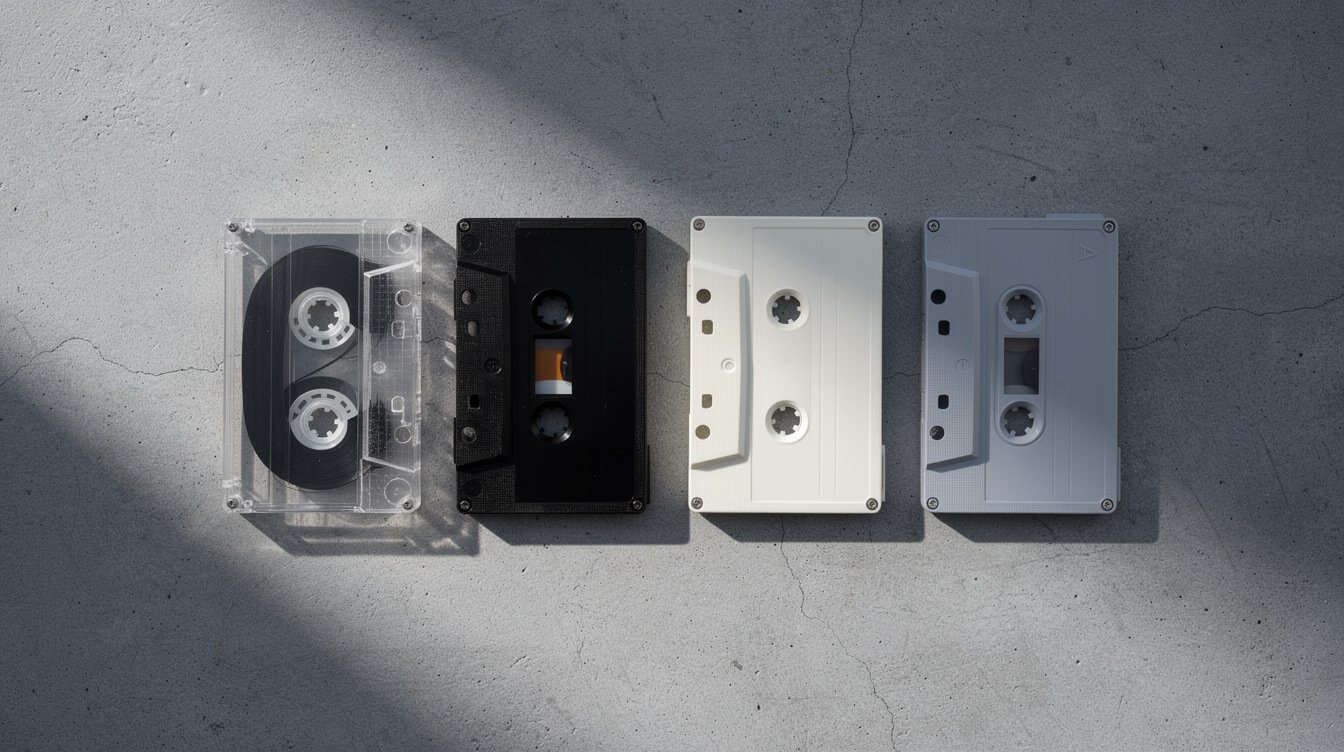
Three kinds mattered. Type I — ferric, the cheap one, the one in the three-pack. Perfectly serviceable, a little soft at the top end, and hissier than you’d like on quiet passages. Type II — chrome or cobalt-doped, the sweet spot, noticeably cleaner in the highs and the correct default for anything you intend a person to keep. Type IV — metal, genuinely excellent, expensive enough that using one was mostly a statement about you rather than about the recording.
Use Type II. It was the right answer then and it’s the right answer now.
Length
A C-60 gives you thirty minutes a side. A C-90 gives you forty-five, and it was the standard for a reason — it’s long enough to build something with a shape and short enough that you have to make choices. The C-100 and C-120 existed, and the tape stock inside them was thinner to fit the extra length, which is a polite way of saying they stretched, jammed, and occasionally chewed themselves into the mechanism in a way that felt personal.
Go C-90 unless you genuinely can’t fill it, in which case go C-60 and stop pretending.
Two details nobody mentions
Noise reduction. Your deck probably has it. Leave it off unless you know for a fact the recipient’s deck has the same system — a tape recorded with noise reduction and played back without it comes out dull and muffled at the top, and they will assume you gave them a bad tape rather than that you gave them a configuration problem.
The leader. The first inch or so of every side is clear plastic leader with no magnetic coating on it. It records nothing. If you hit record at absolute zero you will clip the opening of your opening track, which is a bleak way to start. Wind past the leader, count five, then start.
The first three songs decide everything
You get about six minutes to establish that you know what you’re doing. After that they’ve made up their mind and they’re just confirming it.
Track one opens loud, or at least opens certain. Something that starts on the downbeat and doesn’t ask permission. What it must not be is the first track of an album — that’s the laziest possible move, it announces exactly which record you pulled it from, and it suggests you may not have listened past track one yourself.
Track two sustains. It does not try to beat track one. A tape that escalates twice in a row has nowhere left to go by minute nine and spends the remaining thirty-six minutes descending.
Track three brings it down, and track three is where the actual work happens. Everyone remembers the opener. Nobody chooses a tape because of the opener. Track three is the quiet one that arrives after you’ve earned some trust, and it is almost always the song they end up rewinding.
The rules nobody wrote down
- One song per artist. Two if you’re making a specific point. Three means you ran out of ideas and hoped nobody would count.
- Never two slow ones back to back. One is a moment; two is a mood; two in a row is a sag you can’t recover from without an awkward jolt.
- Don’t open a side with the song you most want them to hear. Bury it fourth or fifth, where they’re paying attention but not braced for it.
- Nothing so obvious it looks like you’re trying. Nothing so obscure it looks like you’re trying considerably harder.
- End side A on a cliff. End side B on a resolution. Side A should make flipping the tape feel mandatory; side B should make stopping feel acceptable.
- No song goes on because it’s clever. Clever is for the title.
The math nobody tells you: how to make a mixtape that actually fits
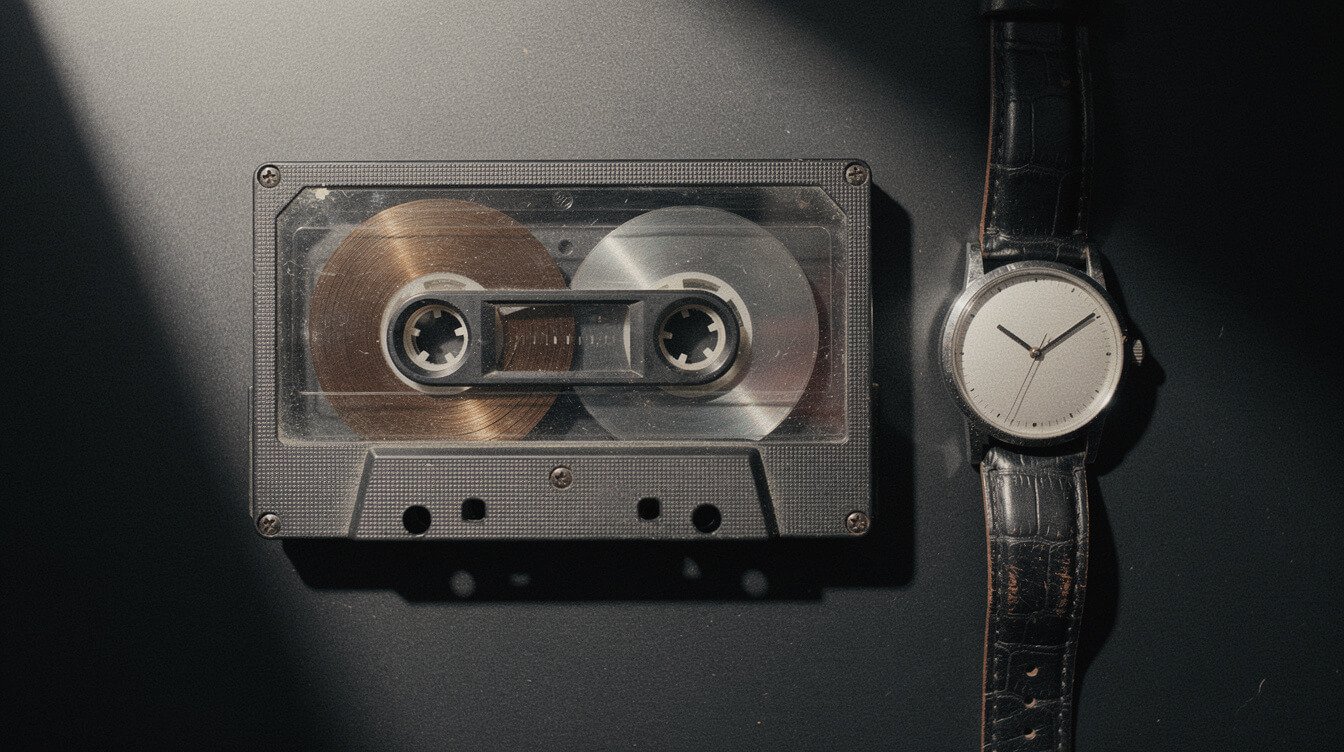
This is the section every guide on how to make a mixtape skips, and it’s the one that separates a tape someone keeps from a tape someone politely never mentions again.
Forty-five minutes a side is the number on the box. It is not the number you have. Between the leader, the gaps you’re going to leave between tracks, and the ordinary reality that tape length and deck speed both drift a little, your working budget is closer to forty-three minutes. Treat forty-three as the wall and the extra two minutes as insurance you’ll be glad you bought.
Build the side backwards
Here’s the move nobody teaches. Don’t fill the side from the front and see where you land. Pick the closer first. Write down its running time, subtract it from forty-three, and fill the remaining space upward from there.
The reason is simple: the last song on a side isn’t a choice, it’s a constraint, and if you treat it as a choice you will discover at minute forty-one that your perfect closer is 6:12 long and you have four minutes of tape. At that point you’re not sequencing anymore, you’re doing triage — swapping in something shorter and worse and knowing it every time you hear it.
Actually write the times down
Not mentally. On paper, in a column, with a running total beside it. Every one of us has, at some point, been confident we had “about six minutes left” and been wrong by ninety seconds. The column is not fussiness, it’s the difference between a finished object and a near miss.
And when the column says you’re ninety seconds over and you love everything on it, the answer is not “it’ll probably fit.” It won’t. Cut the fourth-best song, not the shortest one. Cutting by length is how you end up with a tape that’s technically complete and secretly worse.
What failure sounds like
You should know this in advance, because it’s the one mistake that outlives the tape. The last song fades in and starts building toward something, and then — nothing. The tape runs out mid-phrase and the mechanism clunks to auto-stop with the flat finality of a door closing in another room.
They will remember that clunk long after they’ve forgotten track two. Forty-three minutes. Write it on your hand.
Sequencing is its own small craft, and if you’re the kind of person who enjoys getting the details exactly right rather than approximately right, you’ll probably recognize the impulse behind everything we make over in the shop — getting the reference exactly right rather than approximately right is more or less the reason this place exists. Same disease, different medium.
The dub: real time, one shot, no undo
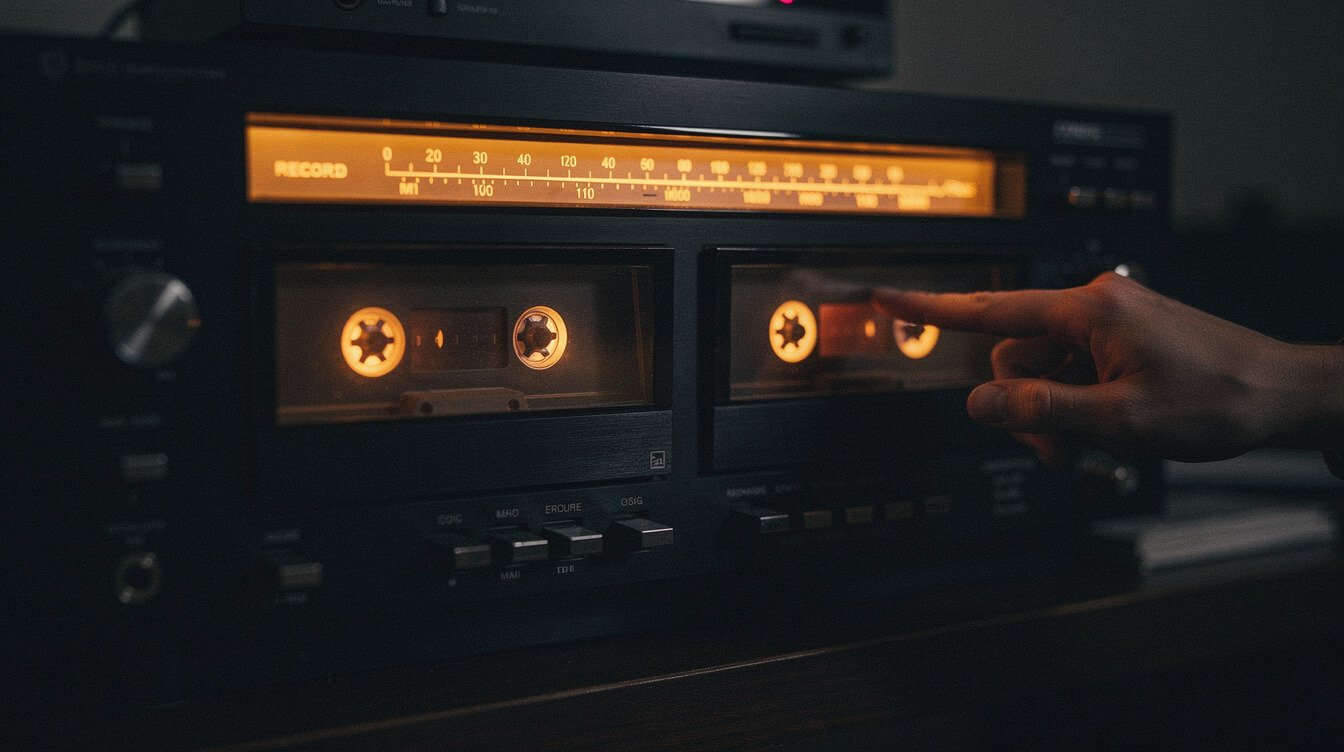
Everything up to now was planning. This part is the commitment.
Recording happens in real time. Ninety minutes of tape takes ninety minutes, and there is no version of this where you get clever about it. High-speed dubbing existed on dual decks, and it sounded exactly like what it was — thin, smeared, and audibly in a hurry. If you’re going to do the thing, do it at 1x.
Levels
Watch the meters, not the volume knob. Record too hot and the peaks distort into a crunchy mess that no amount of playback adjustment will unpick. Record too cautiously and you bury the quiet passages in hiss. The target is peaks that flirt with the top of the scale on the loudest moments and sit comfortably below it the rest of the time. Songs vary wildly in mastering level, so set levels per track, not once at the start and never again.
Gaps
Two to four seconds between tracks. Zero is claustrophobic — the last chord needs somewhere to die. Eight seconds reads as an apology. Between three and four is where it feels deliberate.
Use the pause button between tracks, not stop. Stop disengages the mechanism and leaves a click on the tape at every junction; pause holds everything against the head and gives you a clean seam. This is a small thing that separates a tape that sounds made from a tape that sounds assembled.
The part that was actually the point
You had to be there for all of it. You couldn’t leave the room, because the next track needed cueing and the levels needed setting and the whole enterprise required a human being present and paying attention for the entire runtime. You heard the finished tape before they did, in order, at full length, including your own mistakes arriving in sequence.
And when you flubbed track nine — hit record a half-second late, clipped an intro, left a gap that yawned — you had exactly two options. Live with it, or start the side over from the top and give up another twenty minutes. Most of us lived with it. The people who started over are the reason a handful of these tapes still exist in shoeboxes, and they know who they are.
The J-card, and what you’re allowed to say on it
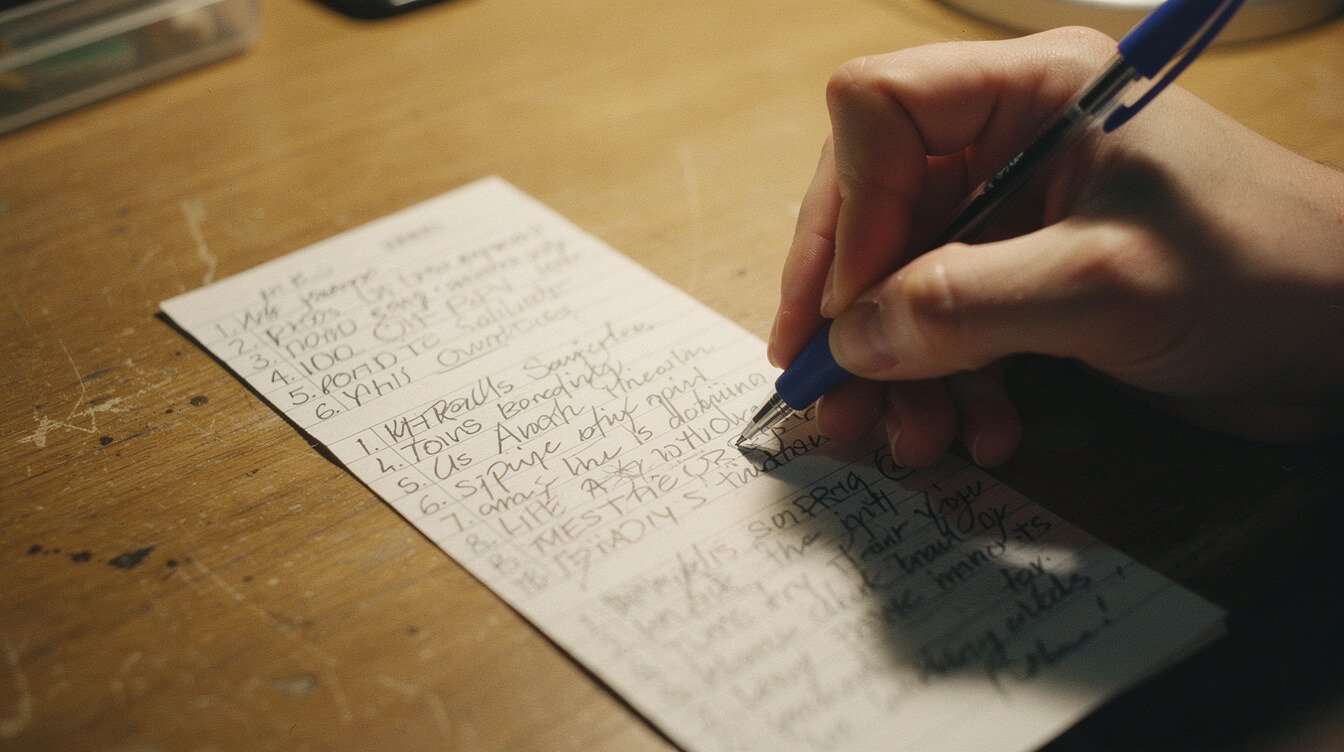
The tape is half the object. The insert card is the other half, and it’s the half people get wrong.
What goes on it: the track list, side A and side B clearly separated, a title, and a date. What goes on it beyond that: nothing.
Handwriting. Ballpoint, on the paper insert, in whatever your handwriting actually looks like. If you run out of room three tracks from the bottom, you get smaller. You do not start a second card, and you do not start over with better planning — the cramped last line is part of the document.
No annotations. No little parenthetical notes explaining why track seven is there or what it reminded you of. If a song needs a footnote to land, it’s the wrong song and you already know it. The whole point of handing someone a tape rather than a paragraph is that the tape does the talking.
Title it properly. One phrase. Not “Songs for Kate,” which is a filename, not a title. Something with a private hook in it — a half-quote, a date that means something, a joke that would read as nonsense to anyone who found it in a glove compartment in 2004. If a stranger could parse it, you’ve overexplained.
Date it. Small, in the corner. You will want the date in twenty years. You will not want the paragraph.
And the rule underneath all the other rules, the one that governed the entire format: you were allowed to care enormously, and you were not allowed to say so. Everything about the object — the hours, the handwriting, the sequencing you’d rearranged four times — said it for you, deniably, which was the only register available to us at the time and which, frankly, we’ve all managed fine with since.
Made for people who rewound it with a pencil
Designs for the generation that raised itself. No footnotes, no explanation, no clip art. If you know, you know.
How to make a mixtape in 2026
There are two honest answers to how to make a mixtape now. One of them involves buying a belt.
Route one: an actual tape
Decks still exist, almost entirely secondhand. Budget for repair as a certainty rather than a risk — the rubber belts inside perish with age whether the deck was used or not, so a working-looking $40 deck is often a $40 deck plus a $30 belt kit plus an evening with a screwdriver and a diagram. Test the fast-forward and rewind before you buy; a deck that plays but won’t wind smoothly has a bigger problem than belts.
Blank tape is still manufactured, though the market has shifted almost entirely to Type I. Chrome stock is mostly old inventory now, priced accordingly, and worth checking for storage damage — tape stored somewhere damp sheds its coating onto the heads and takes the recording with it. New old stock from a climate-controlled warehouse is fine. New old stock from someone’s garage is a coin flip.
Recording from a phone or laptop: run a 3.5mm cable from the headphone output into the deck’s line-in, set the source device to about 75% volume, and then set your actual levels on the deck’s record gain. Running the phone at maximum and the deck low is the fastest way to bake distortion into the source before the tape ever sees it.
Route two: a playlist with tape discipline
Entirely legitimate, provided you accept the constraints instead of quietly dropping them the moment they’re inconvenient. The medium was never the point — the limits were.
- Forty-five minutes. Hard stop. Not four hours. The limit is the craft.
- Fixed order, and say so. Tell them not to shuffle. They’ll shuffle. Tell them anyway.
- One song per artist. The rule doesn’t care what format you’re in.
- Build backwards from the closer. Still the best trick in the file.
- Send it to one person. Not to followers. A mixtape has an audience of one, by definition.
- Give it a real title. Not a mood, not a weather condition, not a season plus a year.
A playlist sent to one named person, in a fixed order, with a title only the two of you can decode, is a mixtape. A four-hour playlist called “chill 2026” is a filing cabinet with a name on the drawer.
Frequently asked questions
How long should a mixtape be?
Ninety minutes total — a C-90, forty-five minutes a side — is the standard and the right default. Plan to forty-three minutes per side to leave room for leader and gaps. If you can’t honestly fill ninety, use a C-60 rather than padding; a tight thirty-minute side beats a bloated forty-five.
How many songs fit on a 90-minute tape?
Roughly twenty-two to twenty-four, so eleven or twelve per side at an average track length of about four minutes. Fewer if you lean toward longer songs, more if you don’t. Don’t work from song count — work from the running-time column. Song count is an estimate; the column is the answer.
What’s the difference between a mixtape and a playlist?
Constraint and address. A mixtape has a fixed length, a fixed order, and exactly one recipient. A playlist typically has none of the three. You can absolutely make a playlist that behaves like a mixtape — you just have to impose the limits yourself, since nothing in the software will impose them for you.
Can you still buy blank cassette tapes?
Yes. Type I ferric tape is still in production and widely available new. Type II chrome is mostly old stock and priced like it. Check storage history where you can — tape kept somewhere humid can shed its oxide coating, which sounds bad and is bad for your heads.
Do you need a special deck to make a mixtape?
No. Any cassette deck with a line-level input and a record function will do it. A dual-deck helps only if you’re dubbing tape to tape. What matters far more than the model is whether the belts are healthy and whether the heads are clean — five minutes with isopropyl alcohol and a cotton swab improves most secondhand decks more than any upgrade will.
What order should the songs go in?
Open certain, sustain on track two, drop the tempo on track three, then build. End side A unresolved so flipping feels necessary, and end side B resolved so stopping feels earned. Choose both closers before you fill either side.
Is it strange to make someone a mixtape in 2026?
Yes. That’s most of the appeal. An object that costs you real, non-refundable time reads very differently in an era when sending someone music costs nothing and takes four seconds.
Final thoughts
The tape was never really about the songs. It was a receipt for time — proof that a person sat in a room for ninety minutes doing something inefficient on your behalf, and then wrote it all out by hand in ballpoint because there was no other way to do it.
That’s the part worth carrying forward, and it’s really the whole of how to make a mixtape that anyone keeps — whether you’re doing it on chrome tape or in an app. Pick a limit and honor it. Sequence like the order matters, because to the one person receiving it, it does. Write the title small and let it stay private. Then hand it over and change the subject immediately, which is the only correct delivery method and always has been.
You survived learning this without instructions the first time. You’ll be fine.
One email. No confetti.
New designs, the occasional piece like this one, and nothing else. Unsubscribe whenever — we’re not going to make it weird.