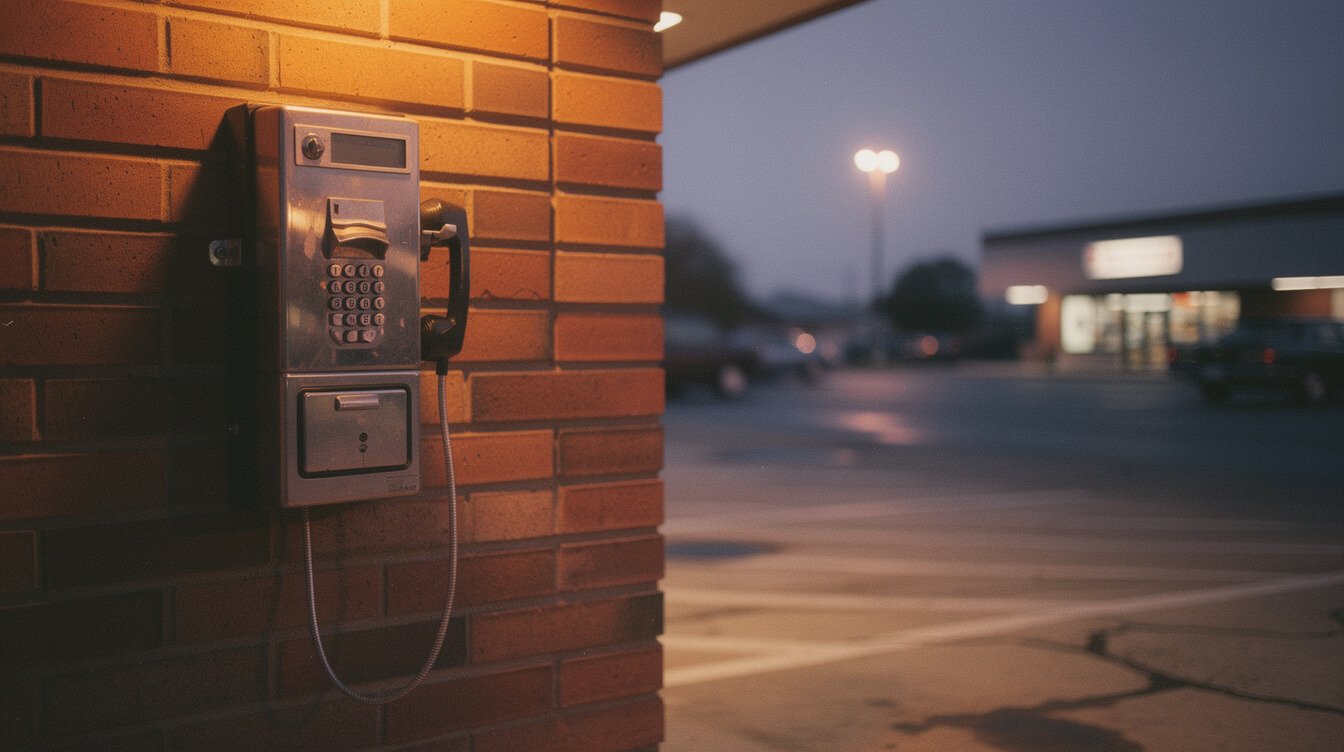
Somewhere in the back of your head there is a phone number you have not dialed since 1991, and you could still produce it right now, under pressure, with a gun to your head. That is the strange part of pay phone nostalgia — it is not really about the phone. Nobody misses the phone. The phone was filthy. The receiver was heavy enough to be a weapon, the earpiece had somebody else’s hairspray on it, and the whole thing smelled like a bus station.
What we miss is the arrangement it enforced. For about two decades, being reachable was something you chose to be, for twenty-five cents, at a time and place of your own choosing. Everything since has gotten that exactly backwards.
This is not a piece about how things were better. Things were worse in most of the ways that are easy to measure, and anybody who has ever stood at a broken phone in the rain with a dead quarter in the slot will tell you so. It is a piece about a specific piece of social machinery we all operated fluently and then never discussed again, because it went obsolete before anyone thought to write the manual. So here’s the manual.
Pay phone nostalgia starts with a quarter in your shoe
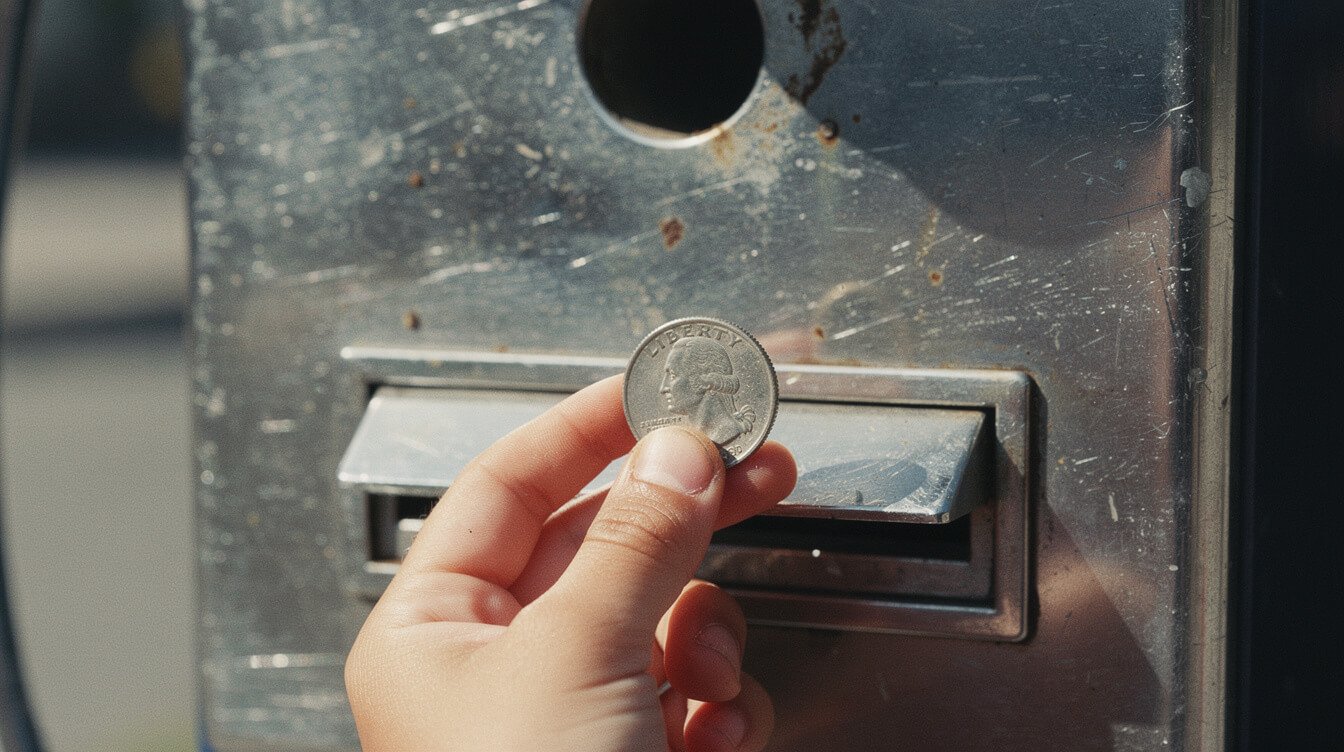
Not in your pocket. Pockets were a rumor. Pockets had a hole in them, or they got turned inside out going over a fence, or you’d already spent whatever was in them at the corner store. The emergency quarter went somewhere structural — flat under the insole of your sneaker, or deep in the toe of a sock, or if you were the organized kind of kid, taped inside the little zip pocket of a backpack where you’d forget it for a year.
The emergency quarter was not your money. This was understood without anyone ever drafting the terms. Your mother handed it over on the way out the door and it entered a kind of escrow — it existed only for the purpose of calling home, and spending it on anything else was a crime you would eventually be tried for. Every one of us spent it anyway. Gum, a soda, one more game. And then you had the long walk home composing the explanation, which was the actual punishment, and which worked.
Here is the part nobody tells you about the quarter: you checked the coin return. Always. Every single time you passed a pay phone, your hand went into that little chrome scoop like a reflex, because sometimes there was a dime in there, and a dime was a dime. Thirty-five years later some of us still clock the coin slot on a vending machine and feel a tiny flicker of the old hunting instinct. It never fully leaves.
And the sound. The quarter went in and fell through what must have been a yard of machinery — that descending clunk-clunk-tick as it got counted and committed. You did not get the dial tone until the coin was satisfied. Money first, then speech. There was something almost honest about it.
You knew the number because there was nowhere to look it up
You had maybe six numbers in your head, and they were the six that mattered: home, your best friend, the other friend whose mom was more relaxed about it, grandma, the pizza place, and whoever you were not telling your parents about. Six numbers is not an impressive feat of memory. What’s impressive is that you didn’t experience it as memorization at all. You knew them the way you know a guitar riff — as a shape, a rhythm, the specific sequence your finger made across the keypad. Ask a Gen-Xer for an old number today and watch them air-dial it before they can say it out loud. The hand remembers faster than the mouth.
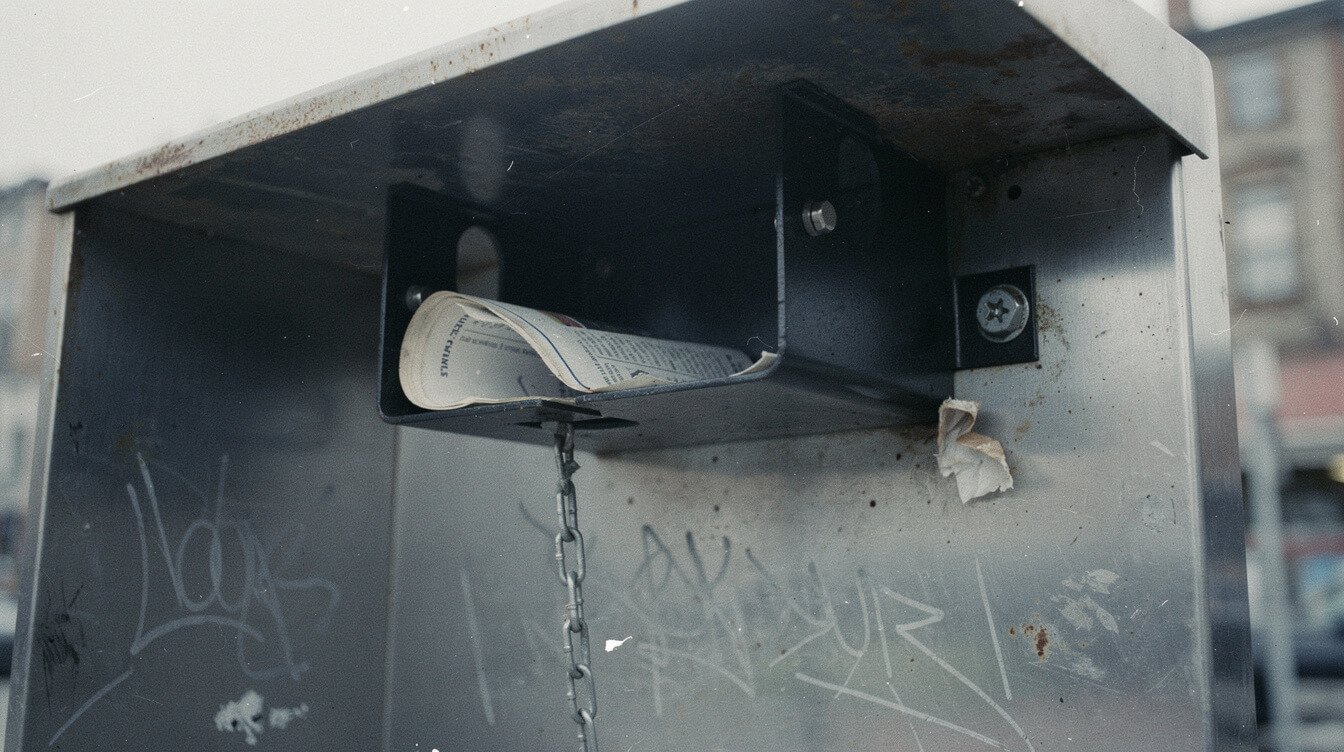
The phone book was supposed to solve the problem of the other numbers. In practice, the phone book was never there. It had been stolen, or rained into a brick, or ripped out at the spine with just the steel bracket and a severed chain left hanging there like evidence at a scene. The chain was the detail that killed you — somebody had anticipated theft, engineered against it, and lost anyway. You could read the entire relationship between the phone company and the public in one empty bracket.
Directory assistance existed, technically. You dialed 411 and a human being looked it up for you, and then you got billed for the privilege, which meant 411 was for adults and emergencies. A kid calling 411 from a pay phone was a kid who had already lost control of the evening. The whole point was to arrive at the phone already knowing what you were going to dial, the same way you arrived at a test already knowing the answers. Improvising at the phone was failure, and it cost a quarter to find out.
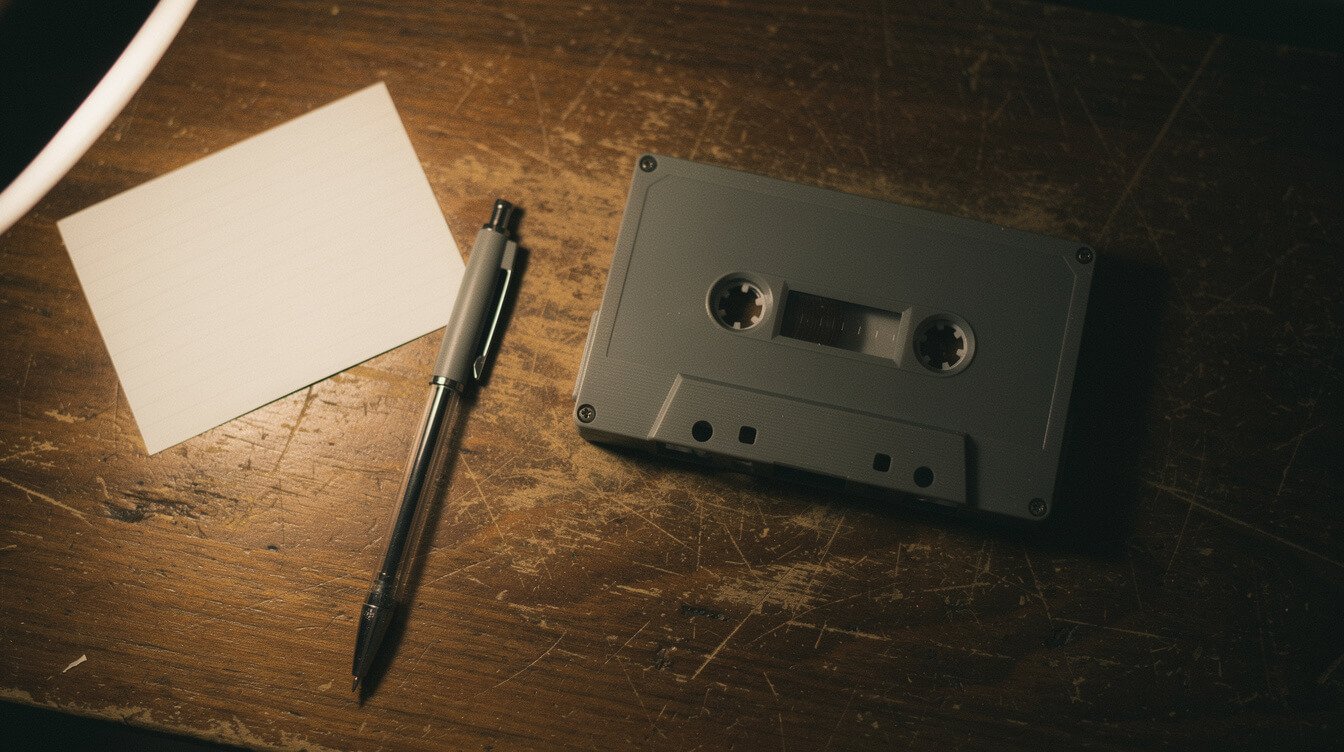
So you planned. That was the real skill, and it is gone now, completely, with no equivalent. Before you left the house you wrote the number you’d need on your hand in ballpoint, or on the inside of a matchbook, or on a scrap that went through the wash and became a blue smear. You committed to a plan because the plan could not be renegotiated after you walked out the door. Area codes meant something geographic and fixed — a number told you roughly where a person physically was, forever, which is a concept that now requires explaining to anyone under forty.
Ask most people today for their partner’s phone number. Watch what happens. We are not smarter than them and we were not trying harder. We just lived in a system that charged a real price for forgetting, and the brain adapts to whatever it gets billed for.
The collect call was a loophole, and everyone used it
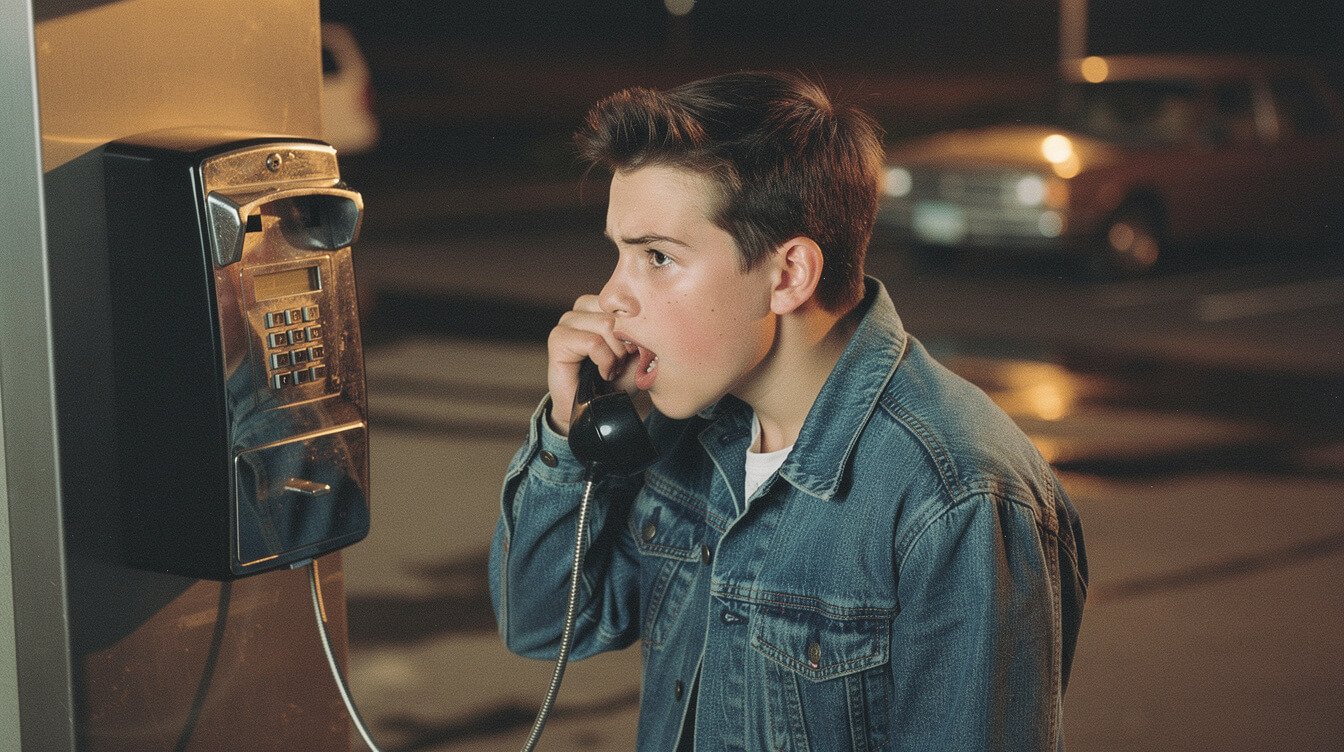
Dial zero, then the number. The operator picks up and asks for your name so the other end can decide whether to accept the charges. A reasonable system, designed by reasonable people, and it took approximately one afternoon for a nation of thirteen-year-olds to find the hole in it.
Because the name prompt does not check your work. The name prompt is an open channel. So you did not say your name. You said, at speed, in one breath, with no gaps: “ITSMEIMDONEATKEVINSCOMEGETMENOW.”
And your mother, on the other end, listened to the entire message, said “no thank you” to the operator, declined the charges, and got in the car. Zero cents. Information delivered in full. The phone company got nothing and the operator knew exactly what had happened and said nothing, because the operator had kids too.
There was a second maneuver, more advanced, for the kids who had really studied. You called somebody, let it ring exactly once, and hung up — that was a prearranged signal meaning I’m here, call me back. Or you fed the phone your quarter, got your three minutes, and spent the first ten seconds reading the number off the little card on the phone so the other person could call you back on their dime, at the booth, where you would then stand and wait. People waited at pay phones. That was a thing you did, loitering next to a specific piece of municipal infrastructure because it was the only address you had.
Later the 1-800 services showed up and turned the whole maneuver into a business model with a jingle, which is how you know the fun was over. But for a good long stretch there, every kid in America was independently running the same exploit against the same billing system, with no forum to compare notes, no one teaching it, and no name for it. It just propagated. Somebody’s older cousin did it in front of you once and that was the entire training.
Nobody had to explain it to anyone. You either figured out what the name prompt actually was or you paid for your calls.
The booth was never as private as the movies made it look
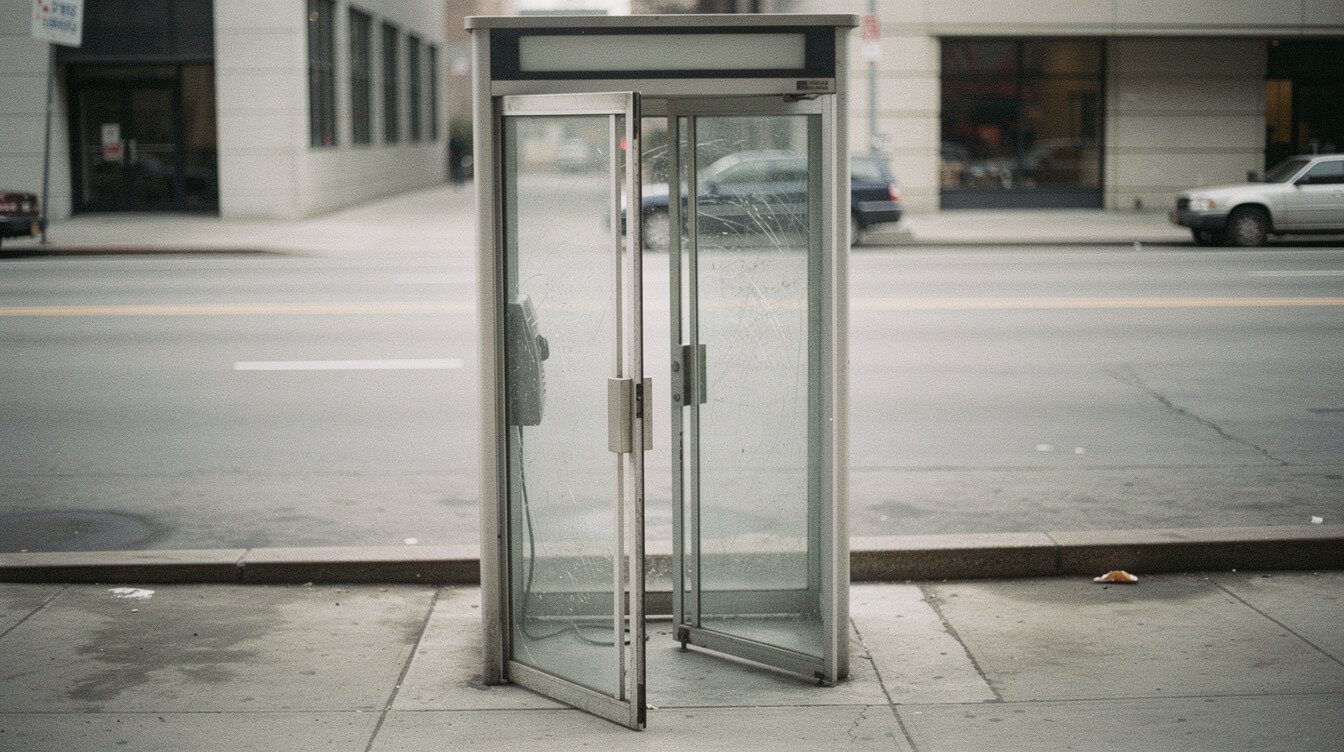
On film, the booth is a confessional. Somebody steps in, pulls the folding door shut, and the city goes quiet so they can have the conversation that turns the plot. It’s a beautiful piece of staging and it has almost nothing to do with standing in one.
An actual booth was a glass box. Four transparent walls, in public, usually with a light that snapped on when you closed the door, so that the effect of seeking privacy was to illuminate yourself like a museum display. The door stuck. The floor had a drift of cigarette butts and one flattened straw. The cord was armored steel and about eleven inches long, so you could not turn your back on the street, which meant anyone walking past could read your face through glass while you said the most mortifying sentence of your adolescence into a receiver.
And there was always someone waiting. Arms folded, a few feet away, close enough to hear the tone of it if not the words, tapping a coin against the glass if you went over what they’d decided was your allotment. You learned to drop your voice for the important part and say the rest in code. You learned to end a call before you were finished with it. The booth taught a whole generation to be eloquent in about ninety seconds, under observation, in a box, for a quarter.
And the booth itself was a bulletin board nobody had authorized. Numbers scratched into the aluminum with a key. Initials. A band name gouged in block letters by somebody with time and a screwdriver. Tape residue from a flyer that had been there and gone. A pay phone in a decent location accumulated a layer of other people’s business the way a tree accumulates rings, and you read all of it, every time, while you waited for somebody to pick up — because there was nothing else to look at and nothing in your hands.
Which may explain some things about how we text.
We’ve got a few designs in the shop for people who clocked all of this the first time and did not need the recap.
The newsletter
Like a mixtape, but it shows up on its own
One email a week. The good posts, new designs, zero exclamation points. Unsubscribe whenever. We won't take it personally.
Nobody could reach you, and that was the arrangement
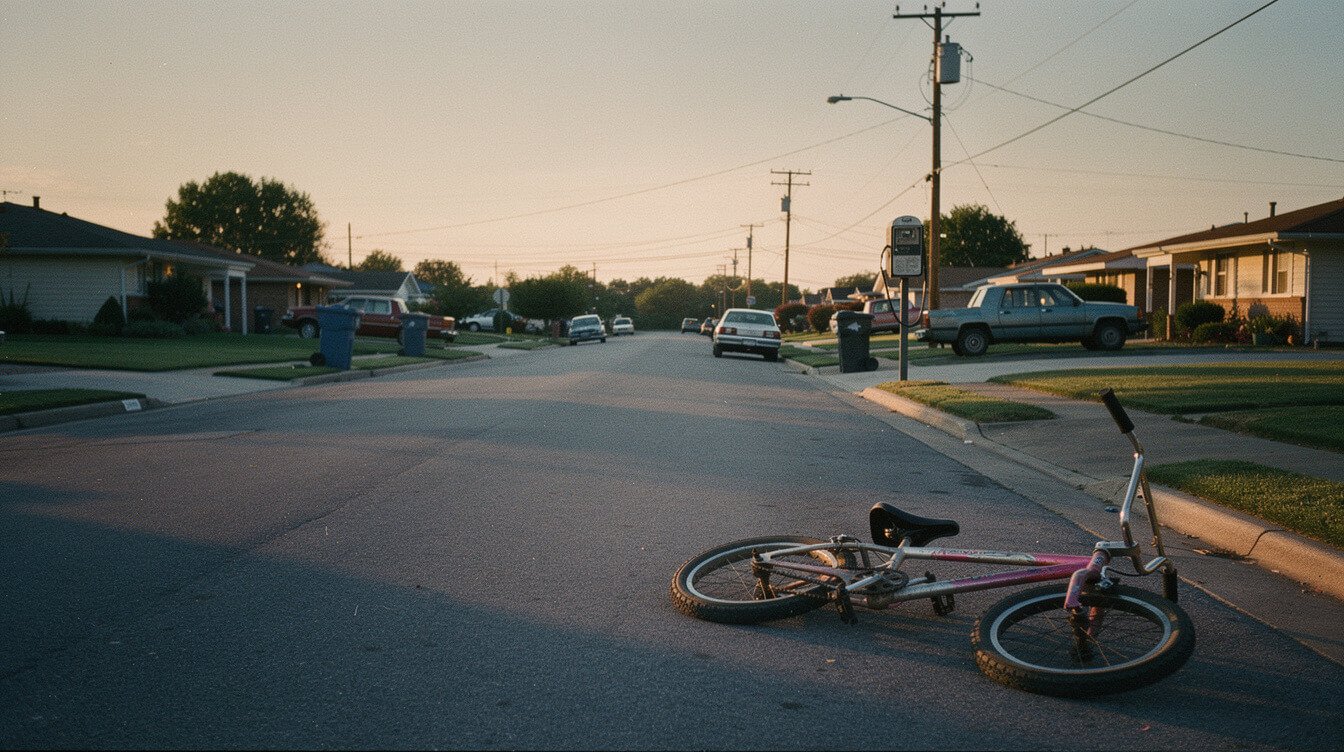
This is the part that lands strangest now. For most of a decade, on most days, your parents did not know where you physically were, and this was not a failure of supervision. It was the deal. You went out after breakfast. You came back when the streetlights came on. The span in between was unaccounted for by anybody, and nobody — not your mother, not the neighbors, not you — experienced that as alarming.
The pay phone was the single valve in that system. It was how you reached in, on purpose, when you had a reason. It did not reach out to you. It had no idea you existed until you fed it. There was no version of events in which the phone on the corner of Oak and Third decided to interrupt your afternoon.
Compare that to every phone since. The home phone at least stayed put, even as it got clever — call waiting started negotiating on its own behalf, and the answering machine turned the kitchen counter into a queue. But all of it was stationary. You could leave the building and be gone.
The flip side is that the pay phone was also the entire safety net, and we all knew where the nearest one was without ever having been told to learn it. That was a real piece of knowledge you carried: the phone outside the drugstore worked, the one at the park had been dead since spring, the one at the gas station was fine but the guy inside would hassle you. If something went wrong — a bike wreck, a ride that never showed, a situation at somebody’s house that had turned — the plan was a quarter and a walk. It was a thin net. It held more often than it had any business holding.
Now reachability is the default state and unavailability is the thing you have to file paperwork for. You don’t decline a call, you explain it later. “Sorry, I was driving.” “Sorry, I had it on silent.” Sorry — as though a few unobserved hours were a debt you’d run up. We are the only people alive who remember the opposite setting, where being out of contact was simply the normal condition of being outside, and where coming back into contact cost money and therefore required a point.
You want to know what being a latchkey kid actually trained into us? Not independence, exactly. Judgment about when something is worth a quarter.
For people who still check the coin return
Designs for the ones who were there, printed on blanks you’d wear on purpose. No footnotes, no explanations.
Calling home to buy another two hours
The highest use of the pay phone was not emergencies. It was extensions.
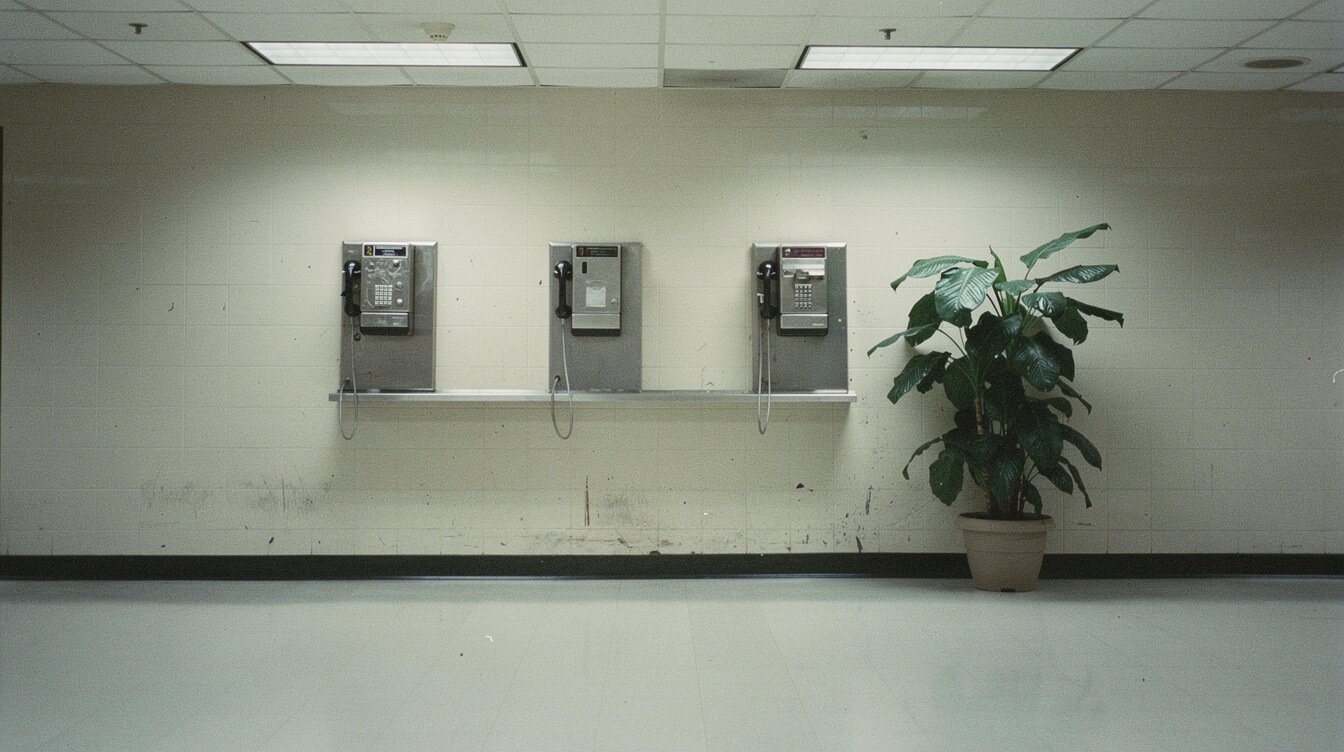
You were at the mall, it was 6:40, you were supposed to be home at seven, and a situation had developed that required you to still be there at nine. So you went to the bank of phones by the restrooms — every mall had them, three or four in a row on tile, one receiver always hanging down — and you placed the call that would decide your evening.
This was not a simple request. This was advocacy. You had to time it: not during dinner, not during the news, and ideally when the parent with the better odds would pick up. You had to lead with reassurance, because an unexpected call from your kid in 1988 meant something had gone wrong, so the first words out of your mouth were always a de-escalation. Nothing’s wrong. Then the ask, pre-trimmed, with the ride home already solved, because an unsolved ride was an automatic no.
And if it worked, you had bought two hours for twenty-five cents, which is the best exchange rate any of us will ever see again. If it didn’t, you had spent your quarter to receive bad news, and you still had to go home, and you had to go home on time, because they knew you’d gotten the message.
The after-event call was its own genre. You came out of a concert or a game into a parking lot of four thousand people, ears ringing, and got in line at the two pay phones by the gate behind thirty other kids all making the identical call. The line moved at the speed of other people’s family negotiations. You listened to every one of them. By the time you got to the front you had workshopped your own opening line against the failures of the six kids in front of you, which is the closest thing to formal rhetorical training most of us ever received.
Then there was the other negotiation: standing there mid-call, out of coins, the operator warning you to deposit more, asking whoever you’d called to hold while you patted every pocket. Some of us learned to beg strangers for a dime. Some of us learned to talk very, very fast. Both skills still show up in meetings.

From the shop
Nirvana In Utero Chinese Fan Art Vintage T-Shirt
Price range: $24.99 through $26.99
Shop this designWhat pay phone nostalgia is really about
We did not love the pay phone. It ate money, it was cold, it was sticky in a way that was never fully explained, and when it was broken — which was often — you walked to the next one. Anybody telling you the hardware was good is lying or was never there.
What pay phone nostalgia is actually about is the margin. The hours in a day that nobody could account for, and that nobody needed to. A pay phone was a door you could walk through in one direction, when you decided, for a price you could feel in your shoe. The default was off. Reaching anyone was a small deliberate act with friction in it, and friction turns out to be the thing that made contact mean something.
We were the last group to live on both sides of that line. We learned the protocol, used it for twenty years, and then watched it get dismantled — first slowly, by the modem in the spare room, then all at once, when the phone got up off the wall and started following us around. We did not vote on this. Nobody asked. One year the booths were just gone, and the brackets where the phone books hung went with them, and now the only place you’ll reliably find a payphone is a decor listing, priced like furniture.
And we are, for the record, the only cohort that will ever be able to compare the two settings from the inside. The people ahead of us had the pay phone and nothing after it worth mentioning. The people behind us have never once had to decide whether a conversation was worth a coin. We got both, in sequence, with the switch flipped somewhere around our late twenties, which means the comparison lives in us and nowhere else, and will go when we do.
Which is funny, in the way that most of this is funny. The machine we fed quarters to in order to buy a little freedom is now a collectible, and the freedom isn’t for sale at all.
Keep your quarter. Check the coin return anyway.
Before you go
You made it to the end. Respect.
Get the best of these in one short weekly email, plus whatever we just printed. No spam. We were raised better than that. Mostly.