Every list of forgotten 90s toys works the same way. Thirty items, one photo each, a caption that says “remember these?” and a comment section full of people who do. The lists are fine. They’re just answering the wrong question. They tell you what got forgotten. They never ask where it went.
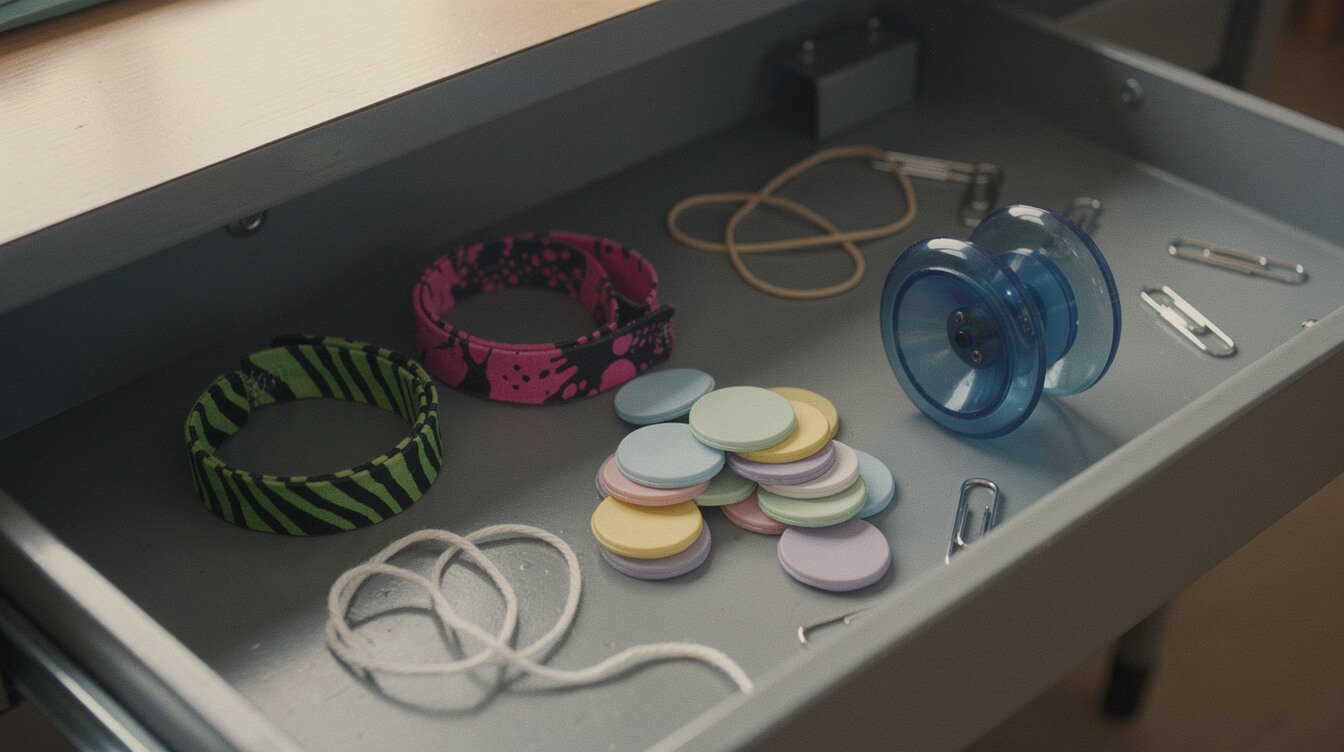
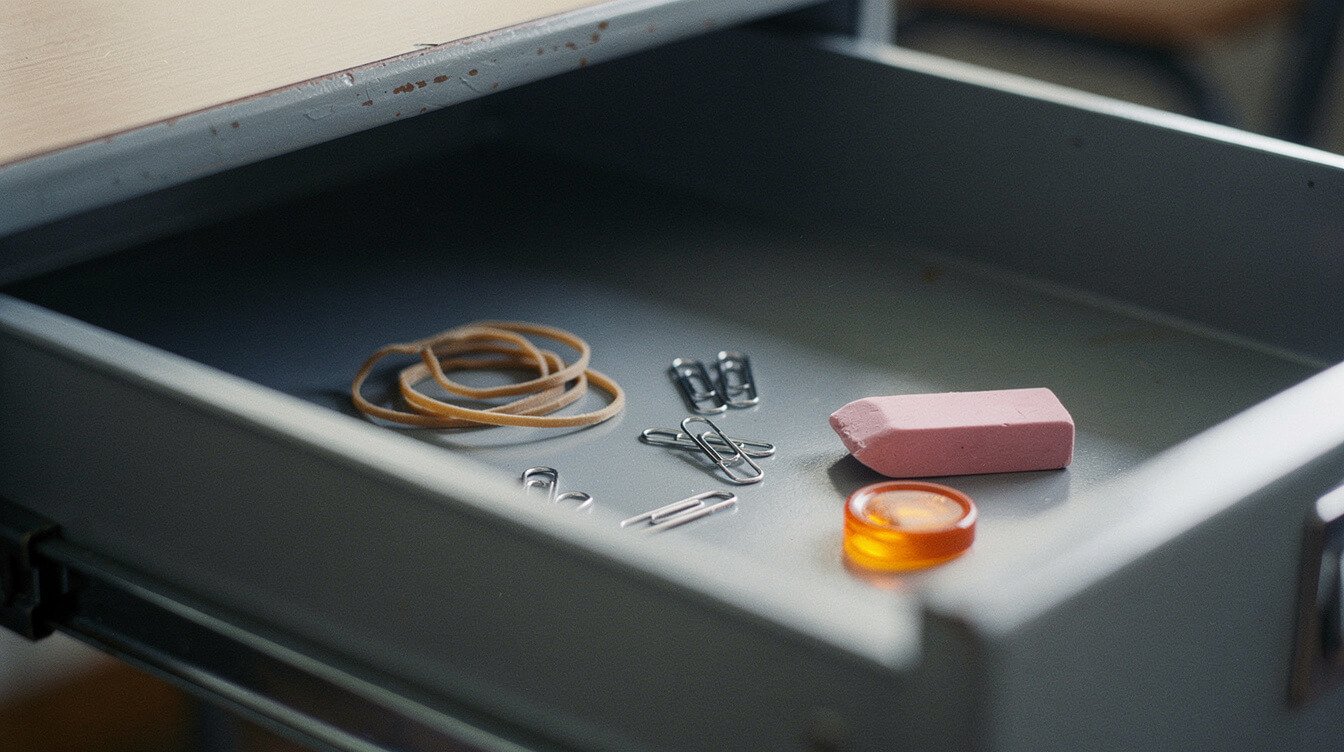
We know where a lot of it went. It went into a drawer. A gray steel drawer at the front of a classroom, the one that stuck on the left side and made a sound like a filing cabinet clearing its throat. The forgotten 90s toys that made the biggest noise didn’t fade out because we got bored. They got taken. A school sent a note home, a principal made an announcement over the PA, and the thing you’d begged for went into the drawer with the rubber bands and was never seen again.
So this isn’t a list. It’s a short history of the drawer, and of the four toys that filled it in order.
Forgotten 90s toys didn’t fade. They were confiscated.
Run down any page of forgotten 90s toys and sort the entries by how they ended. Some were outgrown. Some broke. A lot were simply replaced by next year’s thing, which is how toys are supposed to die. But a specific handful ended a different way: with a policy. Those are the ones people describe with the most heat, because nobody gets nostalgic about a toy they got bored of. They get nostalgic about the one that was taken while it was still good.
The pattern was the same every time. A toy shows up at school in September, carried in by one kid whose cousin lives somewhere it already happened. By October, half the class has one. By November there’s a problem, real or imagined, and somebody has a meeting about it. Then the announcement, then the note home in a backpack, then the drawer. Somewhere around spring, a new toy arrives and the cycle starts again.
The 90s ran this loop more often and faster than any decade before it, for a boring reason: cheap manufacturing. Things that used to cost real money could suddenly be made for pocket change and shipped by the container. A fad no longer needed a year to reach every school in the country. It needed about a semester.
Who was on which side of the drawer
Here’s the part the lists leave out, because they’re written to one age group. Gen X was born roughly 1965 to 1980, which means that when the decade started, the youngest of us were ten and the oldest were twenty-five. So the drawer had people on both sides. The young half of the generation was getting things confiscated. The old half was student-teaching, coaching, subbing, working the register at the mall kiosk that sold the stuff, or finding it in the laundry of a kid of their own. The forgotten 90s toys belong to the whole generation. We just saw them from different heights.
If you were in the young half, you remember the toy. If you were in the old half, you remember the memo. Both count.
The slap bracelet: invented by a teacher, banned by a principal
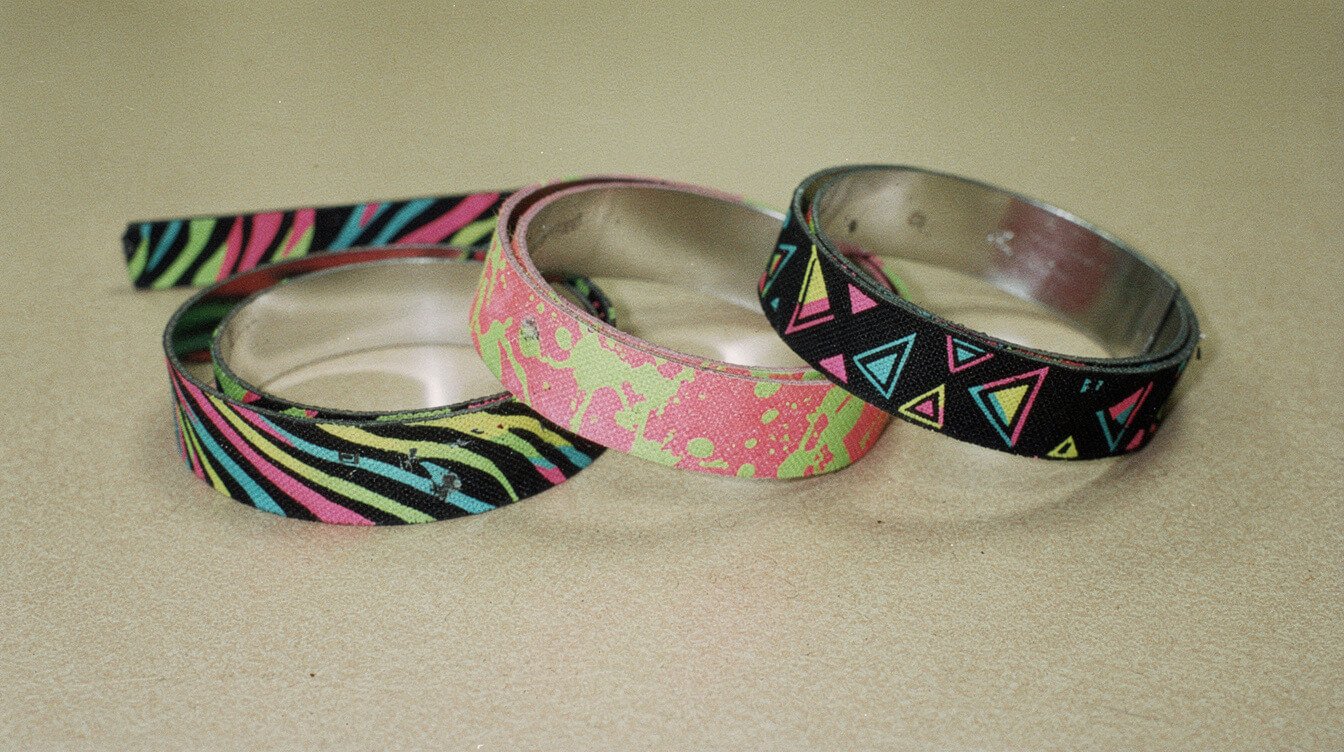
Start with the one that opened the decade, and the irony that comes with it. The slap bracelet was invented by a high school shop teacher in Wisconsin in 1983. He was playing with a strip of steel ribbon in his father’s workshop, the kind of springy metal used in tape measures, and noticed that if you smacked it across your wrist, it curled around and stayed there. He wrapped it in fabric and sold it. Seven years later, it was in half the teachers’ drawers in America.
The original was a sensible piece of engineering: about nine inches long, an inch wide, steel thin enough to flex and thick enough not to fail. That’s not what most kids had. By 1990 the market was full of cheap copies made with thinner steel and thinner cloth, and once the cloth wore through, you were wearing a sharpened ruler on your arm.
That was the fall it all came apart. In October 1990, a four-year-old in Connecticut cut her finger on a knockoff, and the state’s consumer protection office pulled the imitations from shelves. Schools in New York banned them outright. A wire-service story that month ran under the headline “Principal Puts a Halt to Slap-Bracelet Fad,” which is about as close as a newspaper gets to a eulogy. By the end of October, a federal consumer safety panel had issued a national warning.
The way they were actually worn
To be fair to the principals, they weren’t wrong about the use case. Nobody slapped one gently onto their own wrist and admired it. You slapped it onto somebody else. On the forearm, on the ankle under the desk, on the back of the neck of the kid in front of you, which was the move that got you sent to the hall. It was jewelry the way a water balloon is a beverage.
Ask anyone in the young half of Gen X what happened to theirs, and the answer is usually a location: the teacher’s drawer, the bottom of a gym bag, a parent’s dresser where it went “until you can be trusted.” Almost nobody says “I stopped wearing it.” They were taken in their prime.
The slap bracelet never really died, either. A new batch was recalled a few years ago for the same reason as the first one, and before that, in 2013, a tech company filed a patent for a wrist-worn screen that cited the slap bracelet by name as prior art. The shop teacher was right. The principal was also right. That’s the 90s in one object.
Milk caps, and the day the playground got a gambling problem
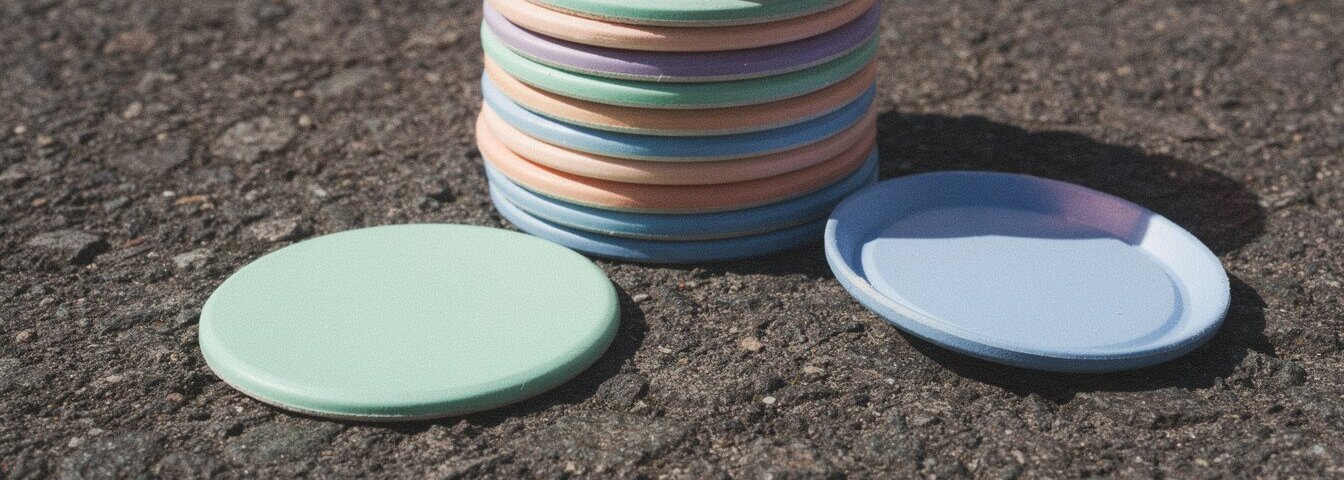
If the slap bracelet was a safety ban, milk caps were the first toy most of us saw banned for ethics. Of all the forgotten 90s toys, they also left the strangest paper trail.
The game itself is old. Kids in Hawaii were playing it in the 1920s and 30s with the cardboard caps from glass milk bottles: stack them face down, throw something heavier on top, keep whatever flips. It faded when the milk bottles did. Then, around 1990, a teacher and guidance counselor at an elementary school on Oahu showed her class the game she’d played as a girl, and it came back. Around the same time, a Maui dairy was printing new caps for its passion fruit, orange, and guava juice. Kids collected those. You can probably fill in the rest.
By 1993, the name on the tube had been bought by a businessman, a federation had been founded, and seven more companies had jumped in after a single trade convention that January. By 1994 the name was in a trademark fight that took until November to settle. You could get the caps free for opening a bank account or with a fast-food kids’ meal. A newspaper in Palo Alto that fall covered a tournament at a shopping center and reported that the game was expected to be a $500 million industry the following year.
“It puts a thrill into the game”
That same article quoted the tournament winner, a ten-year-old, explaining why he played. “It’s fun because you can bet” them, he said. “It puts a thrill into the game.” He was being honest, and he was also explaining the ban before most schools got around to it.
Because the real game wasn’t the stack. It was the agreement before the stack. Every match opened with the same negotiation: for fun, or for keeps. For fun was for cousins and little brothers. For keeps was the real thing, and for keeps meant you could walk out to recess with forty caps and come back with eleven and a grudge. Schools across North America looked at that and saw a playground casino, which, to be fair, it was. Australia and Sweden banned them too. Metal slammers were off-limits even under plenty of kids’ own house rules, because they were heavy enough to count as an advantage and occasionally as a weapon.
If you were in the young half of the generation, you were in middle school for this, and the confiscation was personal: a whole tube, gone, along with the slammer you’d traded three good caps for. If you were in the old half, you were the adult who found a sandwich bag of them in a jacket pocket and had absolutely no idea what they were. Either way, one of the companies behind the official caps went out of business in 1997. The drawer outlasted the brand.
The keychain pet that died during third period
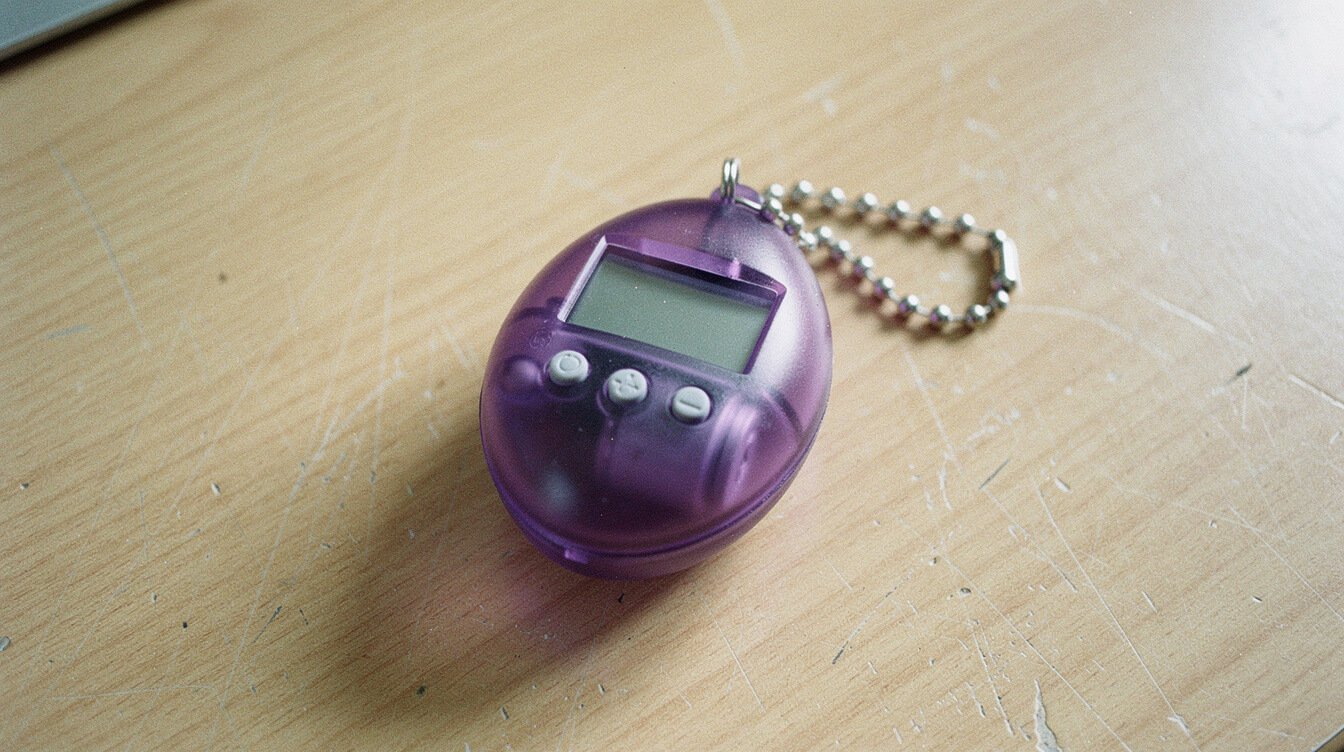
The last great school ban of the decade was the first one that came with a body count. Fictional, but still. It’s on every list of forgotten 90s toys, and every list skips the part where it died in a drawer.
The egg-shaped keychain pet launched in Japan in late 1996, sold four hundred thousand units before the year was out, and arrived in the US on May 1, 1997. By July it had sold ten million. By October, thirteen million. It was a tiny black-and-white screen with three buttons and a creature that needed to be fed, cleaned up after, played with, and put to bed, on its schedule, not yours. And its schedule included the school day.
You can see where this goes. A keychain beeps in the middle of a spelling test because something tiny is hungry. The owner has two choices: feed it under the desk, or let it get sick. Teachers had a third choice, which was the drawer. Within weeks, schools were banning them. A Honolulu paper ran a June 1997 story headlined “Electronic Pets Peep Their Last at Isle Schools,” which covered it.
The clock trick, the babysitter, and the angel
Owners got creative. The original model had no pause button, but if you went into the clock settings, time stopped, which meant you could freeze your pet for the length of a math class. Some kids handed theirs to a friend in a different lunch period, an early version of the babysitting co-op. And the ones who didn’t plan ahead came back to the drawer at three o’clock to find that their pet had died sometime around third period. In the English-language version, it showed up as a little angel. Somebody in marketing decided that was gentler. It was not gentler.
Here’s what the lists leave out: this one wasn’t just a kid’s problem. In 1997 the youngest Gen Xers were seventeen and the oldest were thirty-two, and plenty of the older half carried one to work. That fall, the two people who created it were awarded a parody science prize in economics, “for diverting millions of person-hours of work into the husbandry of virtual pets.” Work. Not homework. Somewhere, an adult’s pet died in a desk drawer at the office, and nobody confiscated it. They just let it happen.
If you’d like something from the decade that doesn’t need feeding, or a reset button, the GenerationX shop is mostly shirts that don’t beep during a meeting. They also can’t die in a drawer. We checked.
The newsletter
Like a mixtape, but it shows up on its own
One email a week. The good posts, new designs, zero exclamation points. Unsubscribe whenever. We won't take it personally.
The late-90s drawer: yo-yos, laser pointers, and the beeper clause
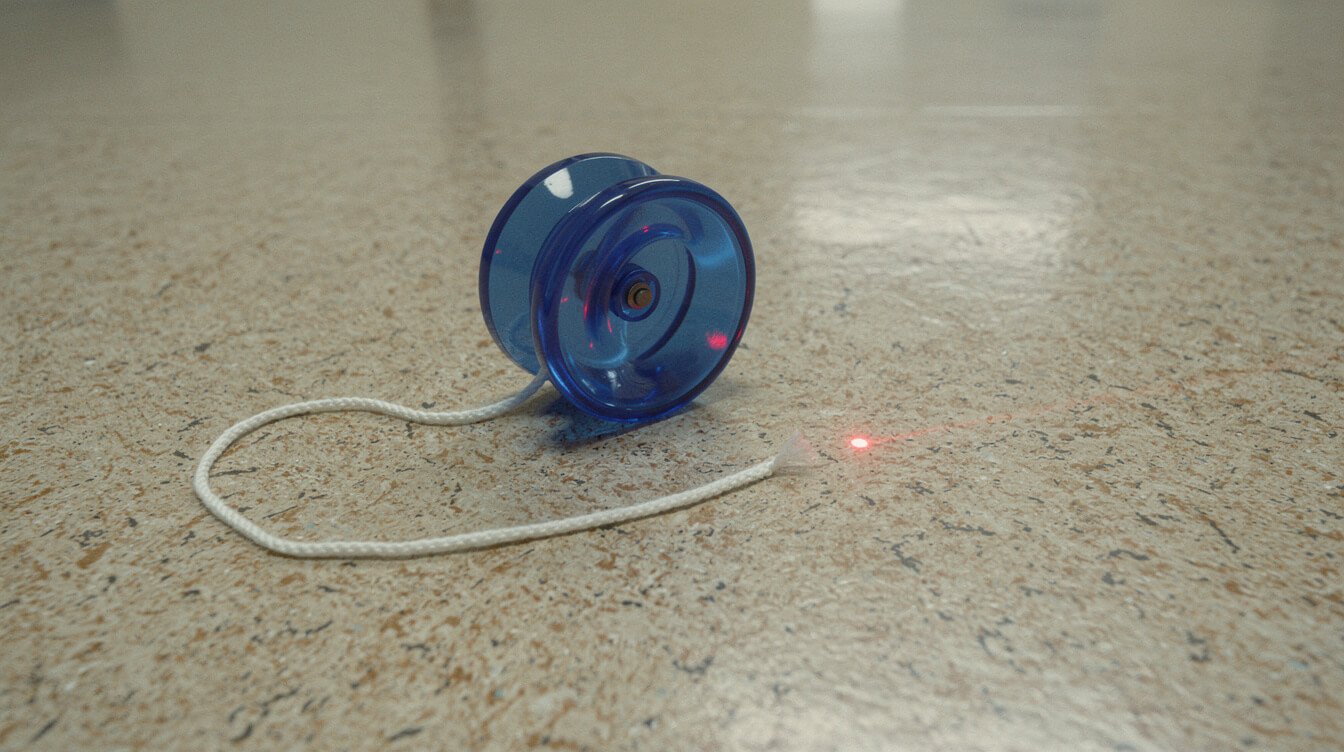
By the end of the decade, the drawer had gone from a punishment to a policy, and the last forgotten 90s toys weren’t really toys at all. You can watch it happen in the paperwork.
The yo-yo came back first. It had been a playground fad twice before, but the version that came back had a ball-bearing axle, an innovation from 1990, which meant it could “sleep,” spinning at the end of its string long enough for tricks with names. By 1997 and 1998 there were demo teams doing school assemblies (some of you remember the guy), and in plenty of schools, a hallway ban followed a few weeks later. You weren’t going to hurt anyone with it, mostly. You were just going to do around-the-world in a hallway four feet wide.
The pointer and the policy
Laser pointers were the late-90s slap bracelet: a grown-up tool that got cheap enough for kids to buy with lunch money, and was immediately used for the most annoying thing possible, which was putting a red dot on the screen during the class movie. In November 1998, a Connecticut school district moved to add them to the list of prohibited items in its “Dress and Grooming” policy. A middle school principal told the local paper, “We have been confiscating them.” The same section of that policy already banned beepers and cell phones. The personnel director said, “Who would have thought years ago we would be seeing things like beepers and cell phones.”
Read that list again: slap bracelets, then milk caps, then keychain pets, then laser pointers, filed next to beepers and cell phones. That’s the moment the drawer stopped holding toys and started holding devices. It never went back.
New York went further. That September, the city proposed a law that banned selling laser pointers to anyone under 21, and having one on school grounds if you were under 22. If you were born after 1976, that technically included you, even if you were the one teaching the class. (There was an exception for instruction. Still.) The youngest slice of Gen X ended the decade too young to legally hold a pointer at school, which was a strange way to find out you were old enough to be the substitute.
Nothing here to confiscate.
For whoever never went back for their stuff in June. Doesn’t beep, doesn’t snap shut, doesn’t need feeding during third period.
Forgotten 90s toys: the questions people actually ask
What are the most forgotten 90s toys?
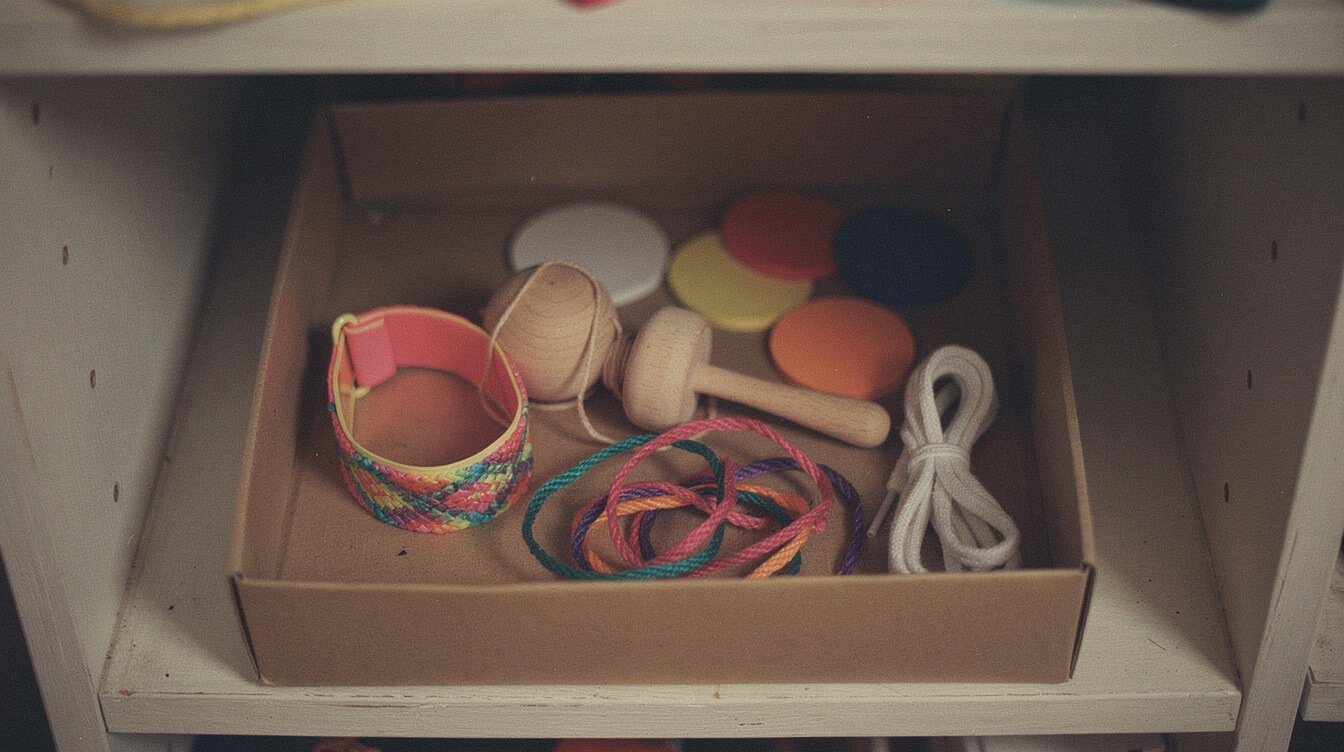
The ones that went out by policy rather than by age: slap bracelets (1990), milk caps and their slammers (1993 to 1995), egg-shaped keychain pets (1997), ball-bearing yo-yos and keychain laser pointers (1998). The other kind of forgotten 90s toys, the ones that simply got outgrown, are covered on every list. These are the ones that got taken.
Why were so many 90s toys banned in schools?
Three reasons, roughly one per year. Safety, which was the slap bracelet. Gambling, which was milk caps played for keeps. And distraction, which was everything that beeped or lit up. The underlying cause was cheaper manufacturing: fads reached every school at once, so every school had the same problem in the same month.
Were slap bracelets actually dangerous?
The well-made originals mostly weren’t. The cheap copies were, once the cloth wore through and exposed the steel edge. A Connecticut recall and a federal warning both came in October 1990, and a new batch was recalled as recently as the late 2010s. Also, they were dangerous in the sense that a ten-year-old with a spring-loaded strap and a clear shot at the back of your neck is dangerous.
Were milk caps really gambling?
Played for keeps, yes, more or less. You staked your caps, and the flip decided who walked away with them. The kid who won that 1994 Palo Alto tournament said the betting was the fun part, which is the most honest quote ever given about a children’s game.
Did teachers ever give the stuff back?
Sometimes, on the last day of school, if you remembered to ask and the teacher remembered which drawer. A lot of it was never claimed. Ask a Gen Xer who taught in the 90s about it and you’ll hear about a drawer full of other people’s childhoods, and an unclear sense of whether it was legal to throw it out.
Are forgotten 90s toys worth anything now?
Most forgotten 90s toys aren’t, and that’s not a tragedy. Anything sealed and untouched can sell to collectors, but the ones that matter here were used hard and then taken, which is the opposite of mint condition. We’ve made the same point about 80s toys and the box nobody kept, and about the adult version of it in the 90s nostalgia items we paid for ourselves. If you’re buying for a younger sibling who was there for the keychain-pet era, our notes on 90s kid gifts are a better place to start than a reseller listing.
Didn’t the toy aisle get louder in the 90s, too?
It did, and the drawer was only half of it. The other half happened at home, on the kitchen table, where the board games started talking back. We covered that in 90s board games. None of those got confiscated. They were too big for the drawer.
From the shop
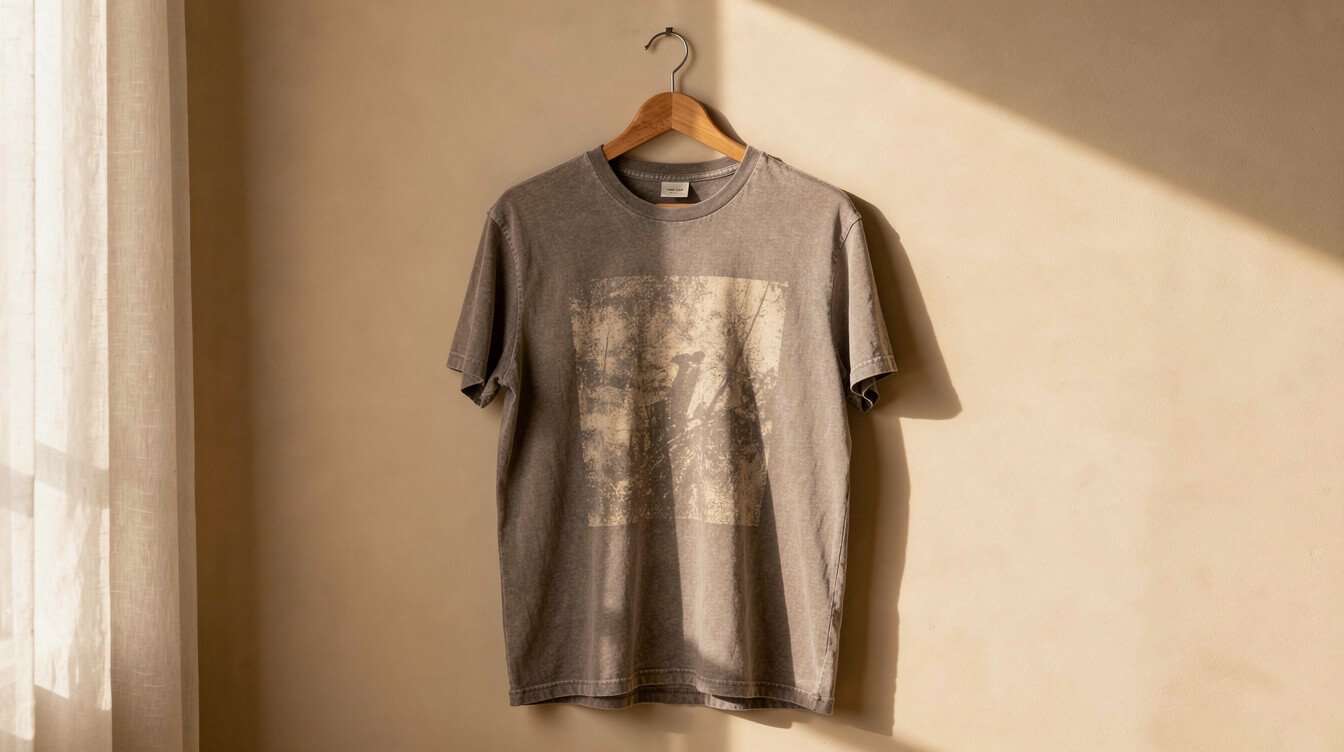
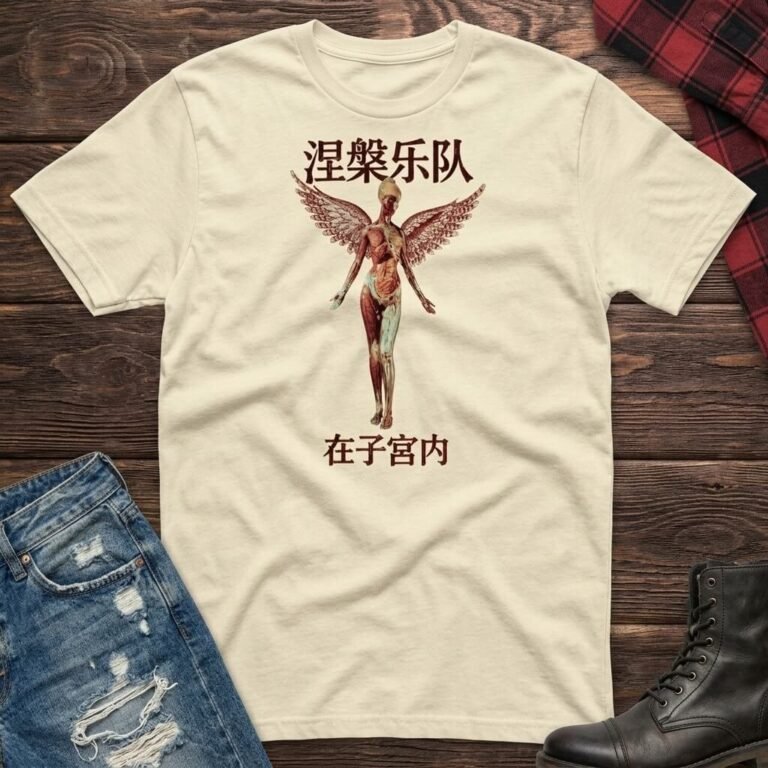
Nirvana In Utero Chinese Fan Art Vintage T-Shirt
Price range: $24.99 through $26.99
Shop this designFinal thoughts: claim your stuff by June
Every school year in the 90s ended with the same announcement, give or take a principal: anything confiscated this year can be picked up from your teacher before the last day. After that, it’s gone.
Most of us didn’t go. You’d moved on by June, or you were embarrassed, or the thing had already been replaced by whatever came next. The slap bracelet, the tube of caps, the pet that died in the drawer around third period. We let them go without a fight, which is very on-brand for a generation that spent the decade shrugging.
That’s the real reason the forgotten 90s toys stick. Not because they were great toys. Most of them were a strip of steel, a stack of cardboard, or a screen with three buttons. They stick because the decade took them away before we were done with them, and you can’t outgrow something you never got to finish.
Somewhere, a gray steel drawer is still full of forgotten 90s toys. If it’s yours, the last day was a while ago. Consider this the announcement.
Before you go
You made it to the end. Respect.
Get the best of these in one short weekly email, plus whatever we just printed. No spam. We were raised better than that. Mostly.