
Gen X Halloween ran on two rules, and nobody ever wrote either one down. Rule one: you got yourself there. Rule two: whatever came home in the pillowcase had to clear inspection before it touched your mouth. Everything else — the costume, who was handing out what, the kid three houses down whose mom gave out pencils like that counted — was negotiable. Those two weren’t.
This isn’t a nostalgia list. It’s the actual shape of the night: what you wore, what got checked, who wasn’t there, how the whole block silently agreed on which houses were open for business, and why the one TV night nobody argued about also happened to land on October 31st. If you were out on the street after dark with a pillowcase and zero adult supervision, you already know where this is going.
The costume came out of the closet, not a costume shop
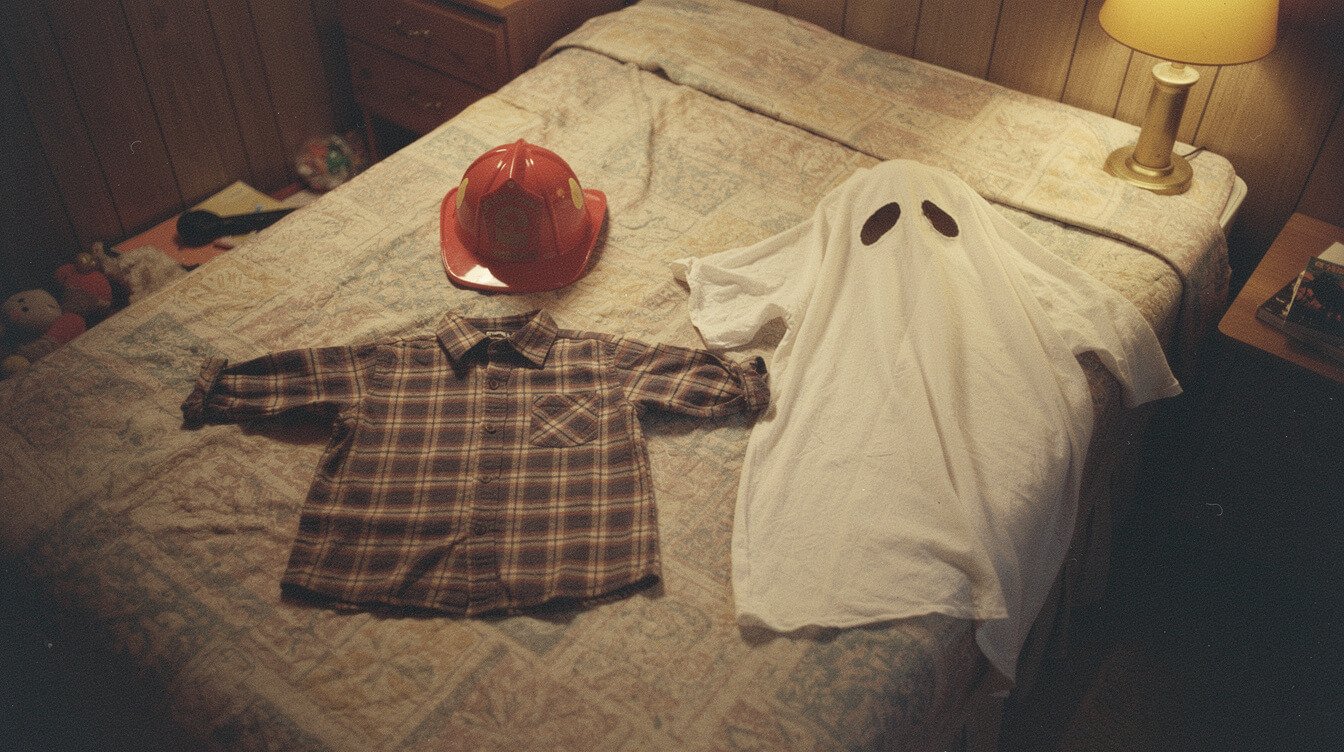
Somewhere there’s a kid whose parents drove to a store, bought a sealed costume, and that was that. That kid was not you. Your costume was assembled the way a ransom note gets assembled — from whatever was already in the house, on a timeline that usually started the afternoon of. A flannel shirt and a plastic hat made you a lumberjack, or a firefighter, or “a guy,” depending on who asked and how convincingly you answered. A bathrobe and a pointed hat cut from posterboard made you a wizard, no further questions taken. If you had an older sibling, there was a real chance you were wearing their costume from three years earlier, taken in at the shoulders with safety pins, still smelling faintly like their closet.
The manufactured option existed — a thin plastic mask with an elastic string stapled to each side, paired with a smock so flimsy it tore before you reached the sidewalk, printed with a face everybody in the neighborhood recognized on sight and nobody’s parents paid a licensing fee to notice. You wore it once. The elastic snapped by house four. You held the mask on with your hand for the rest of the block and called it part of the costume. The eyeholes were never quite where your eyes were, so you spent the whole night looking at the world through two ovals of mesh a half-inch too high or too low.
And if none of that panned out, there was always the sheet: two eyeholes, cut a little too big, a flashlight so you didn’t walk into a hedge. In colder climates the whole production got buried under a winter coat anyway, so the finished look was “ghost, but also visibly cold,” which nobody found embarrassing because everyone else’s costume had the same problem. Nobody’s costume was content. Nobody photographed it for anyone but themselves — maybe one blurry flash photo on the porch before you left, and that was the entire documentation. It existed for exactly one night, got shoved in a closet, and by the following October either fit someone younger or didn’t exist anymore. That’s not a limitation looking back on it. That’s just what a costume was.
The candy had to earn your trust
Here’s the part that actually explains the whole tone of a Gen X Halloween: by the time you were old enough to trick-or-treat unsupervised, an entire generation of parents had already spent a decade absorbing rumors about tampered candy — apples with razors hidden inside, first traded as neighborhood gossip in the 1960s and never fully retired. Nobody in your house could say where the story originally came from, or name a single case that happened to someone they actually knew. Everybody acted on it anyway, which tells you everything about how these things work: the rumor didn’t need to be common to become a ritual. It just needed to be scary enough once.
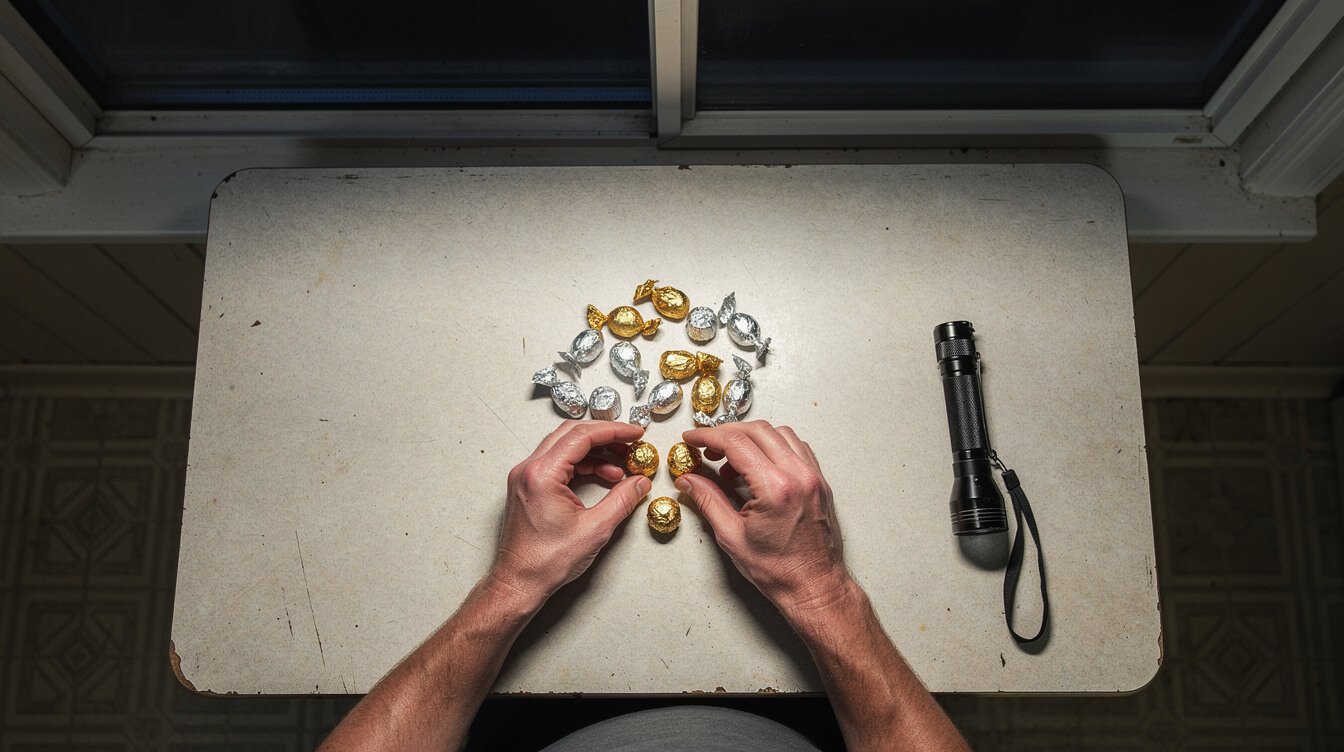
So the pillowcase came home and went straight to the kitchen table, not your room. Somebody’s mom or dad went through it piece by piece under the overhead light — checking wrappers for pinholes, tossing anything homemade or unwrapped no matter how good it looked or how well you knew the family that made it, sometimes holding a piece up to a lamp like it might confess something under enough scrutiny. In a lot of towns, the local hospital offered to X-ray your candy for free, and people actually drove over and did it, pillowcase in the back seat like evidence. That’s not an exaggeration for effect. That was a real Tuesday in October, some years, in towns that otherwise had nothing unusual going on.
You didn’t question the ritual. You sat there, half in costume, mask pushed up on your forehead, waiting for the all-clear on a pile of candy you’d already mentally spent three times over. It’s the most Gen X Halloween detail there is: the fun part came with a background security process running the entire time, and you’d absorbed it so completely you didn’t clock it as fear. It was just the thing that happened before you were allowed to eat, the same way you didn’t question why the porch light was the signal for anything. It simply was.
The porch light was the whole social contract
Nobody explained the porch light rule to you. You just knew it, the way you knew which teacher was strict before you ever had her. Light on meant open for business. Light off meant skip it, don’t ring the bell, don’t even slow down — somebody in that house had decided they were done, or never planned to start, and the entire street respected that with zero enforcement and zero hard feelings. It was an opt-out system with no paperwork, running on nothing but a single bulb and total neighborhood consensus about what it meant.
It’s worth sitting with how well that worked, because it required no coordination at all. Nobody circulated a memo. No house had to post a sign. A hundred families independently agreed to the same protocol and stuck to it, and the only enforcement mechanism was a pack of eight-year-olds who’d correctly identify a dark porch from thirty feet away and route around it without breaking stride. Compare that to how much explaining any comparable system needs now, in an app, with settings, and you start to see why this generation has a specific kind of impatience with things that require a tutorial.
Nobody walked you there
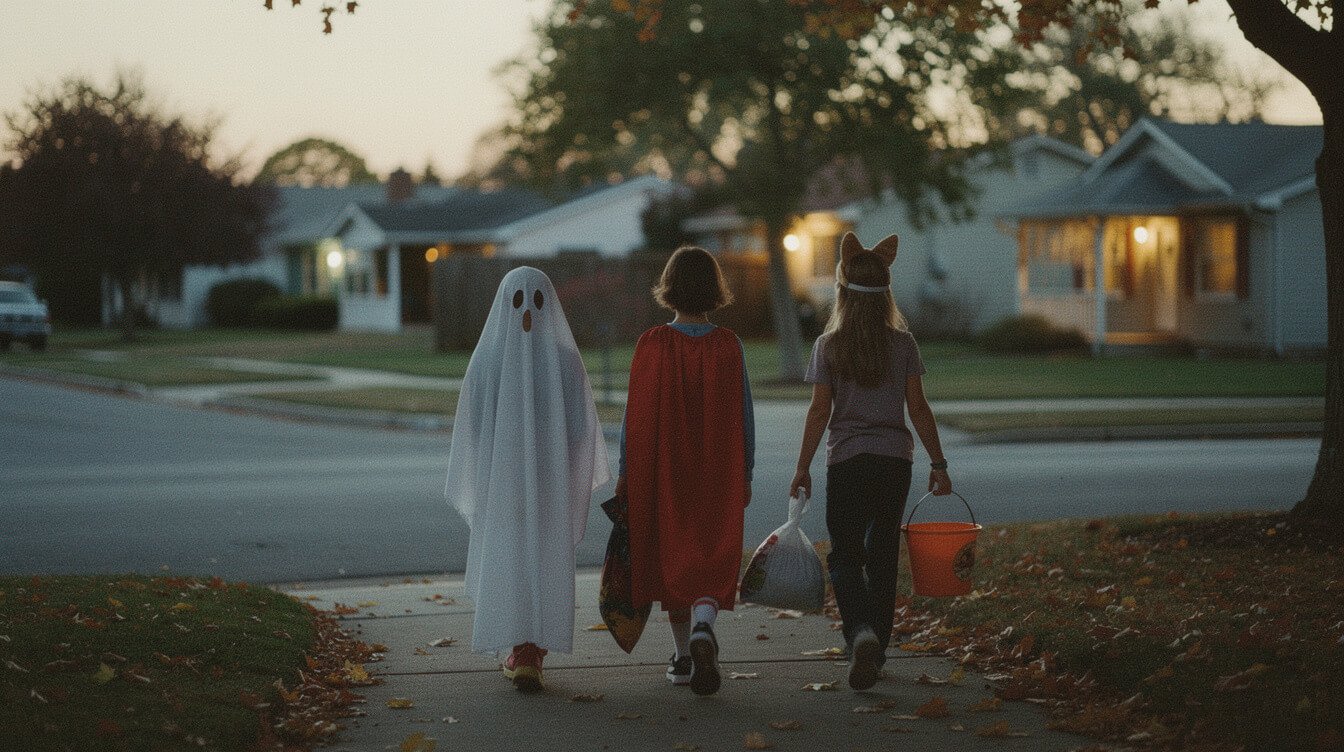
The rule, if you could call it a rule, was “back by dark” or sometimes just “back.” Nobody’s parent came to the door with you. Nobody’s parent was visible at all, unless you count the ones standing on their own porches handing out candy, which doesn’t count — they were working, not chaperoning. You traveled in a loose pack of neighborhood kids that reshuffled block by block, picked up a stray sibling here, lost someone to a bathroom break there, and somehow reassembled at the same three corners without anyone calling a meeting about it. An older kid, usually somebody’s cousin visiting for the week, was unofficially in charge. Nobody voted on this. It was simply understood by height.
If this sounds like an extension of every other unsupervised afternoon you were already having, that’s because it was. Halloween didn’t invent the independence — it just moved it to nighttime and added candy and a wardrobe requirement. If you already know that rhythm from the other 364 days of the year, we’ve written about exactly that version of childhood, the one that ran on a house key on a shoestring and a phone that only rang for you if someone knew the code.
Nobody had a phone to check in with, because phones didn’t come with you. The system worked because everyone’s parents had independently agreed to the same low level of information and were fine with it. Nobody was tracking a dot on a map. There was no group text confirming everyone made it home; there was just the assumption that you would, because you always had before, and if you weren’t back by a specific and non-negotiable hour, someone would eventually stand on the porch and yell your actual full name into the dark, middle name included, which traveled roughly six blocks on a still night and worked every single time.
The newsletter
Like a mixtape, but it shows up on its own
One email a week. The good posts, new designs, zero exclamation points. Unsubscribe whenever. We won't take it personally.
The pillowcase had a hierarchy
Candy did not arrive equal, and you knew the rankings before you got home. Full-size bars were rare enough that finding one felt like a small con had been pulled in your favor, and you announced it to whoever was nearest like you’d found money on the sidewalk. Then came the mini versions of the same thing, acceptable in volume, the reliable middle class of the pillowcase economy. Below that: the loose, unbranded stuff in orange-and-black wax paper that nobody could identify by taste alone, texture somewhere between candle wax and regret. And at the very bottom, in a tier of its own: the house that gave out pencils, the house that gave out a single loose piece of hard candy from a jar that had clearly been open since the previous Halloween, and the house — there was always exactly one — that gave out a box of raisins like anyone had shown up hoping for fruit.
Getting home didn’t end the ranking. It just moved it indoors. The pillowcase got dumped out on the floor or the kitchen table and sorted by category, then traded like a commodities floor — someone would give up three of the loose kind for one full-size bar, no negotiation needed because the exchange rate was already understood by everyone at the table. An older sibling generally extracted a toll for “helping carry the bag,” which was rarely challenged even though everyone knew exactly what was happening. Whatever survived the first week got stashed in a nightstand drawer and rediscovered, stale and slightly bent, sometime around Thanksgiving. This is the same instinct that shows up in the way people still shop for this era’s nostalgia now — not everything from back then earns the same weight, and Gen X has never had trouble sorting the real thing from the filler.
Trick-or-treat for something bigger than candy
Mixed in with the pillowcase was, some years, a small orange-and-black cardboard box — the kind you folded together yourself at school, punched out along the pre-scored lines, and carried door to door asking for spare change instead of, or alongside, the candy. It was for UNICEF, and it had been a genuine national fixture since the 1950s, which meant by the time you were doing it, it wasn’t a special project or a class assignment with a permission slip attached. It was just one more thing you did on October 31st without being told twice why, the same way you knew the porch-light rule without anyone teaching it.
Nobody made a production out of it. You didn’t get a badge, a certificate, or a mention over the school announcements. The box got turned in the following Monday, empty or half-full of dimes and warm pennies, and that was the entire transaction. It’s a small detail, but it’s a real one: somewhere between the costume and the candy check, there was a night where kids were also, incidentally, doing something for somebody else, folded into a night that was mostly about self-interest. Nobody called it character-building. It was just another chore, disguised as a treat run, and you did it without complaint because it took ninety seconds and nobody made you feel noble about it.
The night TV finally agreed with you
Every other night of the year, television was a negotiation — whoever controlled the dial controlled the evening, and you were rarely that person. Halloween was the one night the whole household’s viewing lined up without a fight, because there was exactly one thing on worth watching and everybody already knew what night it aired. Not a marathon, not on demand, not a rerun you could catch later — one airing, one night a year, and if you missed it because you were still out with the pillowcase, you waited until the following October, full stop. There was no negotiating an on-demand replay out of anyone.
Some households solved this with a blank tape loaded into the VCR days in advance, timer set, fingers crossed that nobody else in the house needed to record over it before November. That tape, once successfully made, got replayed so many times across the following years that the picture eventually degraded into a soft wash of tracking lines right at the best part, and everyone in the house had the exact timing of that glitch memorized well enough to talk over it without missing a word of dialogue.
You’ve had this exact argument with a Millennial before, usually about something unrelated, and lost, because they genuinely cannot picture “you only got to see it once a year and there was no other option.” That’s the whole gap in one sentence. The special itself doesn’t need naming here — if you’re from this era, you’re already picturing the couch, the specific commercial break, the exact tone of the theme music. That’s not an oversight. That’s the entire point of writing it this way.
Quick answers
Why does Gen X Halloween feel so different from how kids trick-or-treat now?
Mostly supervision and scheduling. The unsupervised, whole-neighborhood, “back by dark” version of the night was still the default for Gen X kids. It’s largely been replaced by organized events, parent-accompanied routes, and earlier, shorter windows — not because the old version failed, but because the informal trust it ran on doesn’t scale the same way anymore.
Was the tampered-candy panic ever actually real?
Confirmed cases were vanishingly rare, but the rumor itself was very real and very persistent, circulating for years before Gen X kids were even trick-or-treating. The response to it — kitchen-table candy checks, hospitals offering free X-rays — was 100% real, whether or not the underlying threat matched the scale of the reaction.
Did every neighborhood really do the candy inspection?
Not universally, but it was common enough that most people who grew up in this era remember some version of it — a parent, an older sibling, or at minimum a household rule about not eating anything unwrapped or homemade before someone else looked at it first.
What made trick-or-treating explode in popularity specifically in the 1980s?
A mix of things: suburban growth put more houses within safe walking distance of each other, the ritual had a couple of decades to become fully standardized nationwide after spreading from earlier regional traditions, and pop culture of the era leaned hard into the image of kids in costumes going door to door, which reinforced the practice right as Gen X kids were the ones doing it.
Did the porch-light system have any actual exceptions?
One: the house that forgot to turn its light off and then had to pretend it wasn’t home while eight kids rang the bell anyway. Everyone involved understood the social contract had briefly failed, and everyone moved on within about four seconds.

From the shop
Nirvana Incesticide Chinese Reimagined T-Shirt 涅槃乐队
Price range: $24.99 through $26.99
Shop this designFinal thoughts
None of this was designed. Nobody sat down and planned an unsupervised, candy-inspected, porch-light-governed, once-a-year-television economy for children and called it a system. It just accumulated, year over year, out of a few rumors, a couple of civic habits, and a near-total absence of adult oversight — and somehow it worked well enough that everyone who lived it still remembers the exact rules without ever having read them anywhere or been told twice.
If any of this landed — the sheet with the eyeholes, the kitchen-table inspection, the porch that went dark at nine, the walk home with a heavier pillowcase than you started with — that’s the whole design philosophy behind what we make. No footnotes, no explaining the reference. Take a look at the shop if you want to wear the joke instead of just reading it, or stick around and read another one.
Reply and tell me your era
One email, no fake urgency, just the next design and whatever we felt like saying about it.